

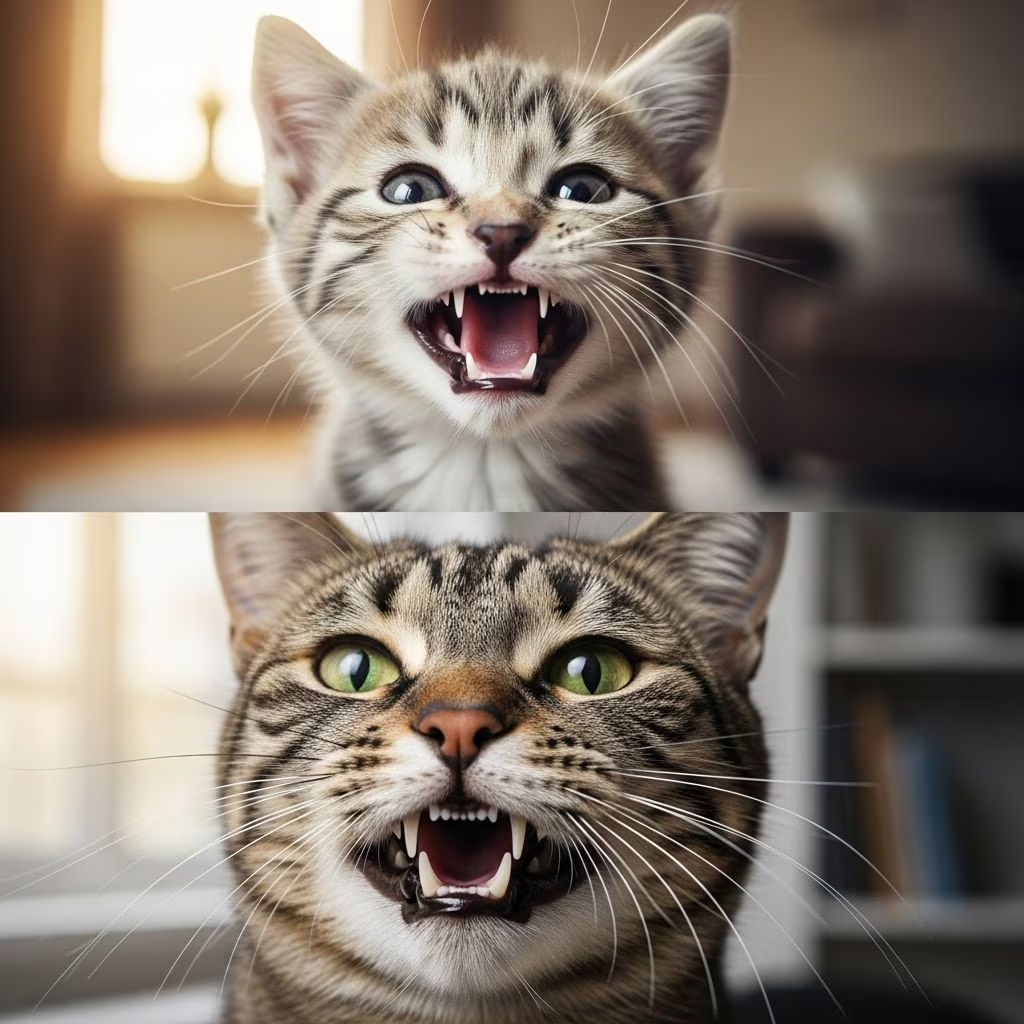
Cats possess a precise number of teeth tailored to their carnivorous lifestyle, transitioning from 26 deciduous teeth in kittenhood to 30 permanent teeth as adults. This dental setup supports cutting, tearing, and grooming essential for survival and daily activities.
The Evolutionary Design of Feline Dentition
Feline teeth reflect adaptations for a meat-based diet, lacking flat grinding surfaces found in herbivores. Instead, they feature sharp edges for slicing flesh. Adult cats maintain 30 teeth: 12 incisors, 4 canines, 10 premolars, and 4 molars. Kittens start with 26 baby teeth, fewer due to the absence of molars.
These teeth align in the maxillary (upper) and mandibular (lower) jaws symmetrically. The upper jaw holds 3 incisors, 1 canine, 3 premolars, and 1 molar per side, while the lower mirrors this with minor variations in premolar count. This arrangement ensures efficient prey handling and food processing.
Dental Milestones: From Birth to Maturity
Newborn kittens emerge toothless, with deciduous teeth erupting progressively. Incisors appear first at 2-4 weeks, aiding early weaning. Canines follow shortly, then premolars by 5-6 weeks, completing the 26-tooth set.
| Tooth Type | Deciduous Eruption (Weeks) | Permanent Eruption (Months) |
|---|---|---|
| Incisors | 2-4 | 3.5-5.5 |
| Canines | 3-4 | 5.5-6.5 |
| Premolars | 5-6 | 4-5 |
| Molars | N/A | 5-6 |
Permanent dentition begins around 3-6 months, replacing baby teeth as roots resorb. By 6-7 months, the full 30 permanent teeth are in place, marking dental maturity.
Breaking Down the Types of Cat Teeth
- Incisors: Small front teeth (6 upper, 6 lower) for nibbling, grooming, and precise cutting. They help remove fur and debris during self-cleaning.
- Canines: Long, pointed fangs (2 upper, 2 lower) ideal for grasping prey, defense, and tearing tough meat.
- Premolars: Transitional teeth (6 upper, 4 lower) that hold and slice food, with the upper fourth premolar acting as a key shearer.
- Molars: Rear teeth (2 upper, 2 lower), including carnassials for powerful shearing action, pulverizing bone and sinew.
The carnassial pair—the maxillary fourth premolar and mandibular first molar—forms a scissor-like mechanism unique to carnivores, enhancing bite efficiency.
In-Depth Anatomy of a Cat’s Tooth
Each feline tooth comprises distinct layers for strength and vitality. The crown, the exposed part, features enamel—a hard, protective outer shell—and dentin beneath, providing structure. Roots, hidden below the gumline, are coated in cementum for anchorage.
The pulp chamber runs centrally, housing nerves, blood vessels, and dentin-producing cells. In young cats, this cavity is wide, narrowing with age as dentin accumulates. Multiple root canals and apical foramina connect pulp to surrounding tissues, aiding nutrient flow.
Supporting structures include the periodontium: gingiva (gums) forming a shallow sulcus (<0.5mm deep), periodontal ligament anchoring roots to alveolar bone, and cementum thickening over time.
Understanding Root Configurations
Root numbers vary by tooth position, influencing extraction complexity. Upper incisors and canines typically have single roots; premolars range from 1-3, with the fourth premolar often tri-rooted. Lower counterparts mirror this, molars usually dual-rooted.
| Jaw | Tooth | Root Count |
|---|---|---|
| Maxillary | P1 | 1 |
| Maxillary | P2-P3 | 2 |
| Maxillary | P4, M1-M2 | 3 |
| Mandibular | P1 | 1 |
| Mandibular | P2-P4, M1-M2 | 2 |
This setup provides stability for the forces of biting and chewing.
Oral Features Beyond Teeth
The cat’s mouth extends functionality with a ridged hard palate for manipulating food, a papilla behind incisors aiding taste, and a rough tongue covered in caudally-pointed papillae for lapping water and grooming. Four salivary gland pairs lubricate and initiate digestion.
Common Dental Challenges in Cats
Despite robust design, cats face issues like plaque buildup, gingivitis, and tooth resorption, where dentin erodes internally. Baby teeth may persist if permanent ones fail to erupt, risking malocclusion. Trauma from fights or falls can fracture teeth, exposing pulp.
Young cats’ wide pulps make them prone to rapid infection spread; older cats develop narrower canals but thicker cementum.
Spotting Dental Problems Early
- Bad breath or drooling excessively.
- Red, swollen gums or bleeding.
- Difficulty eating, pawing at mouth, or dropping food.
- Visible tartar, broken teeth, or loose ones.
- Facial swelling or nasal discharge from root issues.
Annual vet checks with dental charts confirm tooth count and health.
Proactive Dental Care Strategies
Prevent issues with daily brushing using cat-safe toothpaste, dental diets, treats, and water additives reducing tartar. Toys promote chewing to control plaque. Professional cleanings under anesthesia remove deep buildup.
Avoid human products; fluoride is toxic to cats. Monitor during teething for stuck deciduous teeth.
When Extraction Becomes Necessary
Vets use closed techniques for small, mobile teeth like incisors, elevating periodontal ligaments. Larger teeth may require sectioning into root segments with burs for safe removal, preventing fractures.
FAQs on Feline Dental Health
How many teeth do kittens have?
Kittens have 26 deciduous teeth.
At what age do cats get permanent teeth?
Permanent teeth erupt between 3-6 months.
Why do cats need dental cleanings?
To prevent periodontal disease affecting up to 70% of cats over age 3.
Can cats regrow lost teeth?
No, like humans, cats have only two sets.
What is the dental formula for cats?
Adult: 2(3/3, 1/1, 3/2, 1/1) = 30; Deciduous: 2(3/3, 1/1, 3/2, 0/0) = 26.
References
- Applied Feline Oral Anatomy and Tooth Extraction Techniques — NIH/PMC. 2024. https://pmc.ncbi.nlm.nih.gov/articles/PMC11044610/
- Normal Tooth Anatomy in Dogs and Cats — Texas Veterinary Dental Center. 2023. https://texasveterinarydentalcenter.com/normal-tooth-anatomy-in-dogs-and-cats/
- Dental Development of Cats — MSD Veterinary Manual. 2025. https://www.msdvetmanual.com/cat-owners/digestive-disorders-of-cats/dental-development-of-cats
- Dentition and Dental Nomenclature of Animals — Merck Veterinary Manual. 2025. https://www.merckvetmanual.com/digestive-system/dental-development-and-anatomy/dentition-and-dental-nomenclature-of-animals
- Dental Anatomy of Cats — Colorado State University. 2022. https://vivo.colostate.edu/hbooks/pathphys/digestion/pregastric/catpage.html



