

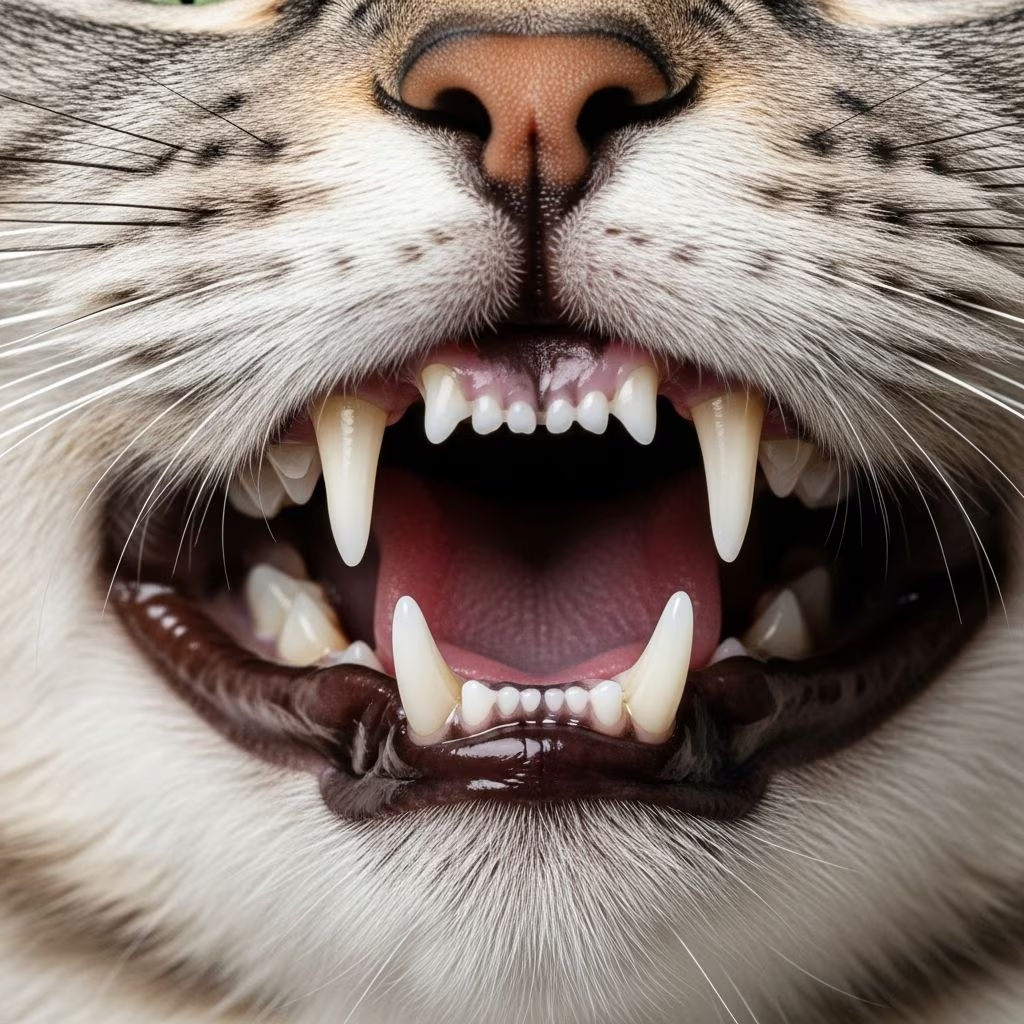
Adult cats possess exactly 30 permanent teeth, a precise dental formula tailored for their carnivorous lifestyle. Kittens begin with 26 deciduous teeth that give way to these adult structures around 3 to 6 months of age. This configuration supports cutting, tearing, and processing meat efficiently.
The Evolutionary Design of Feline Dentition
Cats, as obligate carnivores, have teeth specialized for predation and consumption of raw flesh rather than grinding plant matter. None of their molars feature flat grinding surfaces; instead, they prioritize shearing and puncturing capabilities. The dental arcade reflects this: sharp incisors for initial grasping, robust canines for killing prey, and carnassial cheek teeth for slicing tough tissues.
This setup contrasts with herbivores or omnivores, emphasizing the cat’s meat-exclusive diet. Understanding this foundation helps owners appreciate why dental issues arise from modern kibble diets lacking the abrasive action of whole prey.
Deciduous vs. Permanent Teeth: A Developmental Timeline
Kittens erupt their first 26 baby teeth between 2 and 6 weeks, providing early functionality for nursing transition to solids. These deciduous teeth are smaller and more delicate, designed for temporary use.
- Weeks 2-4: Incisors emerge first, aiding in weaning.
- Weeks 4-6: Canines and premolars follow, enabling soft food consumption.
By 3.5 to 7 months, permanent teeth push out the baby set, reaching the full adult count of 30. This replacement ensures stronger, larger structures suited for lifelong mastication. Delays or abnormalities in this process warrant veterinary evaluation to rule out nutritional deficiencies or congenital issues.
Detailed Breakdown of Adult Cat Teeth by Type and Location
The adult feline dental formula is I 3/3, C 1/1, P 3/2, M 1/1 per side, totaling 30 teeth. Here’s a quadrant-by-quadrant view:
| Quadrant | Incisors (I) | Canines (C) | Premolars (P) | Molars (M) |
|---|---|---|---|---|
| Maxillary (Upper) | 3 | 1 | 3 | 1 |
| Mandibular (Lower) | 3 | 1 | 2 | 1 |
Incisors (12 total): Six per jaw, these chisel-like front teeth handle cutting, grooming, and fine prehension. Numbered as central (I1), intermediate (I2), and lateral (I3).
Canines (4 total): One per quadrant, these elongated fangs excel at stabbing, holding prey, and self-defense. Their pointed tips and robust roots provide piercing power.
Premolars (10 total): Upper jaws have three (P2, P3, P4), lowers two (P3, P4). These versatile teeth grasp, break, and tear food.
Molars (4 total): One per quadrant (M1), with the upper P4 and lower M1 forming the carnassial pair—the “shearing blades” for processing sinew and bone.
Microscopic and Structural Layers of Cat Teeth
Each tooth comprises layered tissues ensuring durability and vitality. The crown, visible above gums, features:
- Enamel: Outermost, hardest body tissue (96% minerals like hydroxyapatite), translucent and protective but non-regenerative.
- Dentin: Bulk inner layer, porous yellow structure produced lifelong by odontoblasts for repair.
Below gums, the root is coated in cementum, which thickens with age and anchors via the periodontal ligament (PDL) to alveolar bone. The central pulp cavity houses nerves, vessels, and cells, narrowing over time as dentin deposits increase—wider in youth, slimmer in seniors.
The cemento-enamel junction (CEJ or “neck”) marks the crown-root transition, where gingiva attaches. Feline gingival sulcus depth norms under 0.5-1 mm; exceedances signal pathology.
Supporting Oral Structures Essential for Dental Health
Beyond teeth, the periodontium—gingiva, PDL, cementum, alveolar bone—maintains stability. Free gingiva forms the sulcus; attached gingiva binds firmly. Alveolar bone’s lamina dura appears radiographically as a dense line around roots.
The hard palate’s rugae aid food manipulation, while the tongue’s caudal-pointing papillae enable lapping, bolus formation, and grooming. Four major salivary gland pairs (parotid, mandibular, sublingual, zygomatic) plus minor ones lubricate and initiate digestion.
Common Dental Challenges and Extraction Insights
Feline teeth face resorption, fractures, and periodontal disease. Young cats’ wide pulps heighten endodontic risks; closed extractions suit mobile incisors or select premolars, avoiding root fractures requiring open surgical approaches.
Owners note signs like halitosis, drooling, or pawing at mouth. Radiographs reveal hidden issues, as 60-70% of disease lurks subgingivally.
Proactive Dental Care Strategies for Cats
Maintain that 30-tooth smile through daily brushing with enzymatic toothpaste, dental diets, chews, and annual vet cleanings under anesthesia. Water additives and rinses supplement but don’t replace mechanical action.
| Age Group | Key Care Focus | Frequency |
|---|---|---|
| Kittens (0-6 months) | Monitor eruption; soft chews | Weekly checks |
| Adults (1-7 years) | Brushing, treats | Daily/2-3x weekly |
| Seniors (7+ years) | Resorption screening, professional cleanings | Bi-annual vet visits |
Avoid human toothpaste (toxic xylitol). Genetic predispositions like Persian tooth crowding amplify needs.
FAQs on Feline Dental Anatomy
Q: How many teeth does a kitten have?
A: Kittens have 26 deciduous teeth, replaced by 30 permanent ones.
Q: What are carnassial teeth in cats?
A: The upper P4 and lower M1, specialized for shearing meat.
Q: Can cat teeth regrow?
A: No, permanent teeth do not regrow; extractions are permanent.
Q: What’s normal gum depth in cats?
A: Gingival sulcus ≤0.5-1 mm; deeper indicates disease.
Q: Why do cats lose teeth?
A: Common causes: resorption (60%+ cases), periodontitis, trauma.
Advanced Veterinary Perspectives on Feline Oral Health
Recent studies highlight odontoclastic resorption lesions affecting up to 70% of cats over 5 years, often painless until advanced. Endodontic vitality persists via continuous dentinogenesis, but pulp exposure invites infection.
Imaging protocols include full-mouth radiographs for extractions, confirming root integrity. Multimodal pain management enhances recovery in dental procedures.
For breeders, symmetric dentition confirms health; anomalies link to inbreeding. Nutritional balances—taurine, calcium-phosphorus ratios—underpin eruption timelines.
In clinical practice, tooth numbering follows Triadan system: 101-108 (upper right incisors-canines), etc., standardizing charts.
References
- Applied Feline Oral Anatomy and Tooth Extraction Techniques — PMC/NCBI. 2024. https://pmc.ncbi.nlm.nih.gov/articles/PMC11044610/
- Normal Tooth Anatomy in Dogs and Cats — Texas Veterinary Dental Center. 2023. https://texasveterinarydentalcenter.com/normal-tooth-anatomy-in-dogs-and-cats/
- Cat & Dog Teeth Anatomy — Brunker Road Veterinary Centre. 2024. https://brunkerroadvets.com.au/article/dental-anatomy-of-the-cat-and-dog/
- Dental Anatomy – OSU CVM Veterinary Clinical and Professional Skills Laboratory Handbook — Ohio State University Pressbooks. 2023. https://ohiostate.pressbooks.pub/osuvcpslhandbook/chapter/saclin_oraldentalone_charting_dental-anatomy/
- Dental and Oral Anatomy in Cats — FirstVet. 2024. https://firstvet.com/us/articles/dental-and-oral-anatomy-in-cats



