

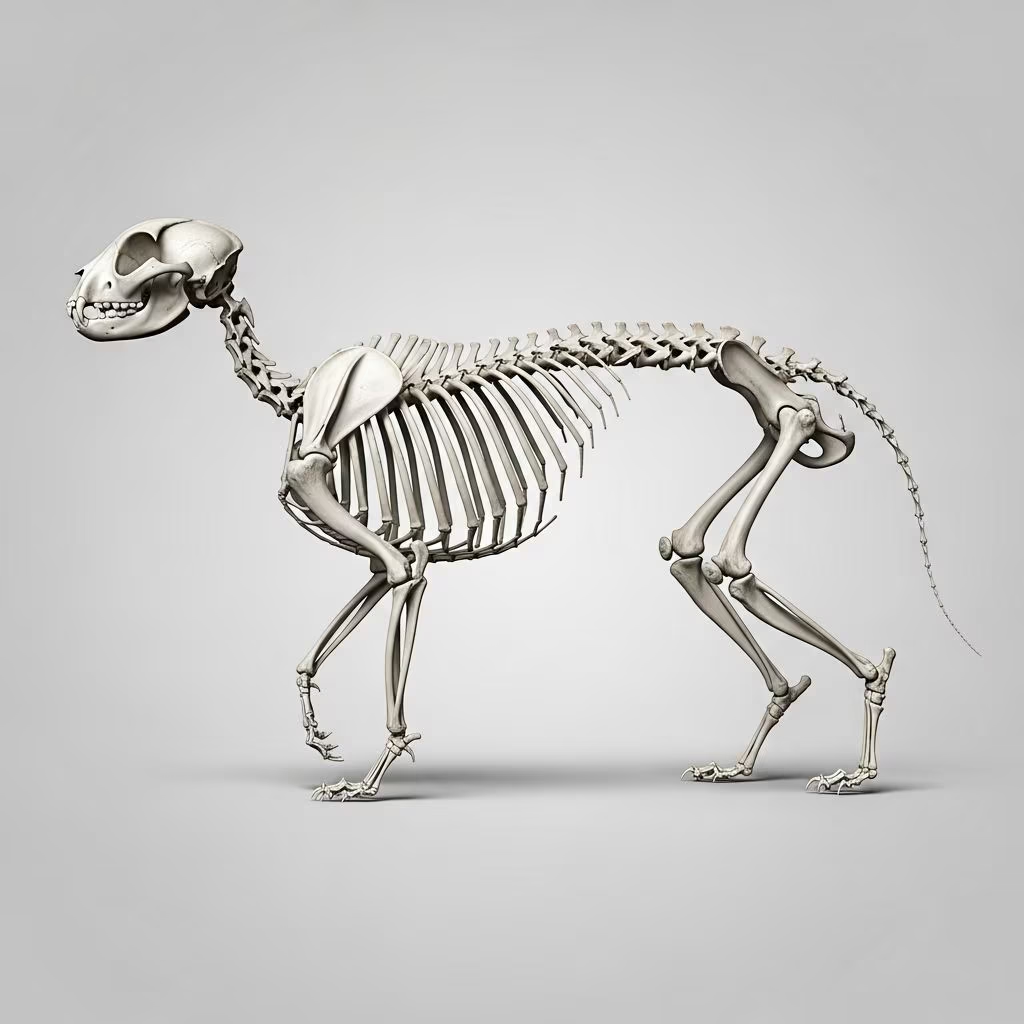
The feline skeleton comprises approximately 230 bones, exceeding the human count of 206, enabling remarkable agility and flexibility vital for a cat’s predatory lifestyle. This guide dissects the axial and appendicular skeletons, emphasizing structures relevant to veterinary diagnostics, surgery, and injury assessment.
Overview of Feline Skeletal Composition
Cats possess a lightweight yet robust skeleton divided into the axial skeleton (skull, vertebral column, ribs, sternum) and appendicular skeleton (limbs and girdles). Adaptations like a highly flexible spine and reduced clavicles enhance leaping and twisting capabilities. Understanding these components aids in identifying fractures, luxations, and congenital anomalies during clinical exams.
- Axial Skeleton: Forms the central body axis, protecting vital organs.
- Appendicular Skeleton: Supports locomotion with specialized joints for speed and precision.
- Total Bones: 230, with variations in caudal vertebrae.
Cranial Anatomy: The Skull and Facial Bones
The cat skull is dolichocephalic, elongated for enhanced olfactory and visual acuity. Key bones include the frontal, parietal, and occipital, forming a sturdy cranium housing the brain. The mandible features a prominent angular process and mental foramina for neurovascular passage.
Ventrally, the tympanic bulla provides resonance for vocalization, while the cribriform plate separates nasal and cranial cavities. In veterinary practice, skull radiographs reveal dental issues or trauma, with the zygomatic process anchoring jaw muscles.
| Bone | Key Features | Veterinary Relevance |
|---|---|---|
| Frontal | Forms orbital roof | Trauma assessment |
| Occipital | Condyles for atlas articulation | Atlanto-occipital luxation |
| Mandible | Dentary angle, symphysis | Fracture repair |
Vertebral Column: Flexibility and Support
The spine consists of cervical (7), thoracic (13), lumbar (7), sacral (3 fused), and caudal (20-27 variable) regions. The atlas and axis enable head rotation, crucial for hunting. Cats lack nuchal and supraspinous ligaments, granting superior vertebral flexion compared to dogs.
Thoracic vertebrae feature elongated spinous processes for muscle attachment, while lumbar ones prioritize lordosis for jumping. Sacral fusion stabilizes the pelvis, and caudal vertebrae taper for tail balance. Common issues include intervertebral disc disease and spondylosis.
- Cervical: Atlas neural arch, axis odontoid process.
- Thoracic: Rib articulation facets.
- Lumbar: Transverse processes for psoas support.
Thoracic Cage: Protection and Respiration
Thirteen pairs of ribs articulate with thoracic vertebrae, forming true ribs (first nine attaching directly to sternum via costal cartilages) and false ribs. The sternum has eight sternebrae, ending in xiphoid cartilage. This structure safeguards heart and lungs while allowing thoracic expansion for breathing.
In trauma cases, rib fractures compromise respiration; veterinary imaging distinguishes costal attachments for surgical planning.
Forelimb: Shoulder Girdle and Paws
Cats lack a functional clavicle, relying on a ‘floating’ scapula for shock absorption during leaps. The scapula’s spine divides deltoideus muscles, prominent in felines. Humerus, radius, and ulna form the brachium, with olecranon process enhancing elbow extension.
The carpus includes scapholunar, pisiform, and carpals, leading to five metacarpals and phalanges. Digits feature retractile claws via elastic ligaments, a hallmark feline trait.
| Structure | Bones Involved | Function |
|---|---|---|
| Shoulder | Scapula, humerus | High mobility |
| Elbow | Radius, ulna | Hinge joint |
| Manus | Metacarpals, phalanges | Grip, climb |
Hindlimb: Power and Propulsion
The pelvis is rectangular with prominent ischiatic tuberosity and ilium crest. Femur includes trochanters, patella (pear-shaped), and condyles. Tibia and fibula support the crus, with tarsus featuring talus, calcaneus, and cuneiforms.
Hind paws have four metacarpals, optimized for sprinting. The soleus muscle, deep to gastrocnemius, contributes to the calcanean tendon for powerful jumps. Hip dysplasia, though rarer in cats, affects acetabular fit.
Joints and Articulations in Feline Anatomy
Joints vary: synarthroses (immobile, e.g., skull sutures), amphiarthroses (slightly mobile, e.g., intervertebral), and diarthroses (freely mobile, e.g., ball-and-socket hip). Cartilage cushions synovial joints, reducing friction.
Cats’ shoulder is a gliding joint for flexibility; stifle (knee) includes patella for quadriceps leverage. Ligament tears, like cranial cruciate, mimic canine injuries but present differently due to agility demands.
Unique Feline Skeletal Adaptations
Reduced ossification sites minimize weight; prominent scapular landmarks aid muscle power. Gluteofemoralis muscle originates from caudal vertebrae, enhancing hindlimb propulsion. Brachioradialis development supports forearm flexion.
- Absent clavicle: Increases stride length.
- Pear-shaped patella: Stabilizes stifle.
- Flexible vertebrae: Enables 180-degree twists.
Veterinary Applications and Clinical Insights
Skeletal knowledge informs radiology: lateral scapula views reveal humeral heads; orthogonal pelvic shots assess acetabula. Fractures heal rapidly due to high bone density, but growth plates close later in felines.
Nutritional secondary hyperparathyroidism from high-phosphate diets causes ‘rubber jaw.’ Orthopedic surgeries, like FHO for hip luxation, leverage anatomical flexibility.
Comparative Anatomy: Cat vs. Other Species
| Feature | Cat | Dog | Human |
|---|---|---|---|
| Bone Count | 230 | ~320 | 206 |
| Clavicle | Rudimentary | Present | Full |
| Vertebrae Flexibility | High (no ligaments) | Moderate | Low |
| Patella Shape | Pear | Rectangular | Triangular |
These differences underscore cats’ predatory evolution.
Common Skeletal Disorders in Cats
- Fractures: High-velocity impacts from falls.
- Arthritis: Degenerative joint disease in seniors.
- Patellar Luxation: Medial common, genetic basis.
- Nutritional Osteodystrophy: All-meat diets erode bones.
FAQs on Cat Skeleton Anatomy
How many bones does a cat have?
A typical cat skeleton has 230-250 bones, varying by tail length.
Why do cats have more bones than humans?
Extra caudal vertebrae and unfused elements support tail function and flexibility.
What makes the cat spine so flexible?
Absence of nuchal/supraspinous ligaments allows greater motion.
Are cat bones denser than dogs’?
Yes, aiding rapid healing but increasing fracture energy needs.
How does the cat paw skeleton differ?
Retractile phalanges with sesamoids enable claw sheathing.
References
- Cat Skeleton Anatomy Guide — Scribd. N/A. https://www.scribd.com/document/342061828/Skeleton-of-the-Cat
- 2024 Ultimate Guide to Cat Anatomy — VetCheck. 2024. https://vetcheck.it/cat_anatomy/
- Dissection Lab Guide for Dog and Cat Anatomy — University of Minnesota Pressbooks. N/A. https://pressbooks.umn.edu/dogcatanatomylabguide/back-matter/appendix/
- Components of the Musculoskeletal System in Cats — MSD Veterinary Manual. 2023. https://www.msdvetmanual.com/cat-owners/bone-joint-and-muscle-disorders-of-cats/components-of-the-musculoskeletal-system-in-cats
- Components of the Musculoskeletal System in Cats — Merck Veterinary Manual. 2023. https://www.merckvetmanual.com/cat-owners/bone-joint-and-muscle-disorders-of-cats/components-of-the-musculoskeletal-system-in-cats



