

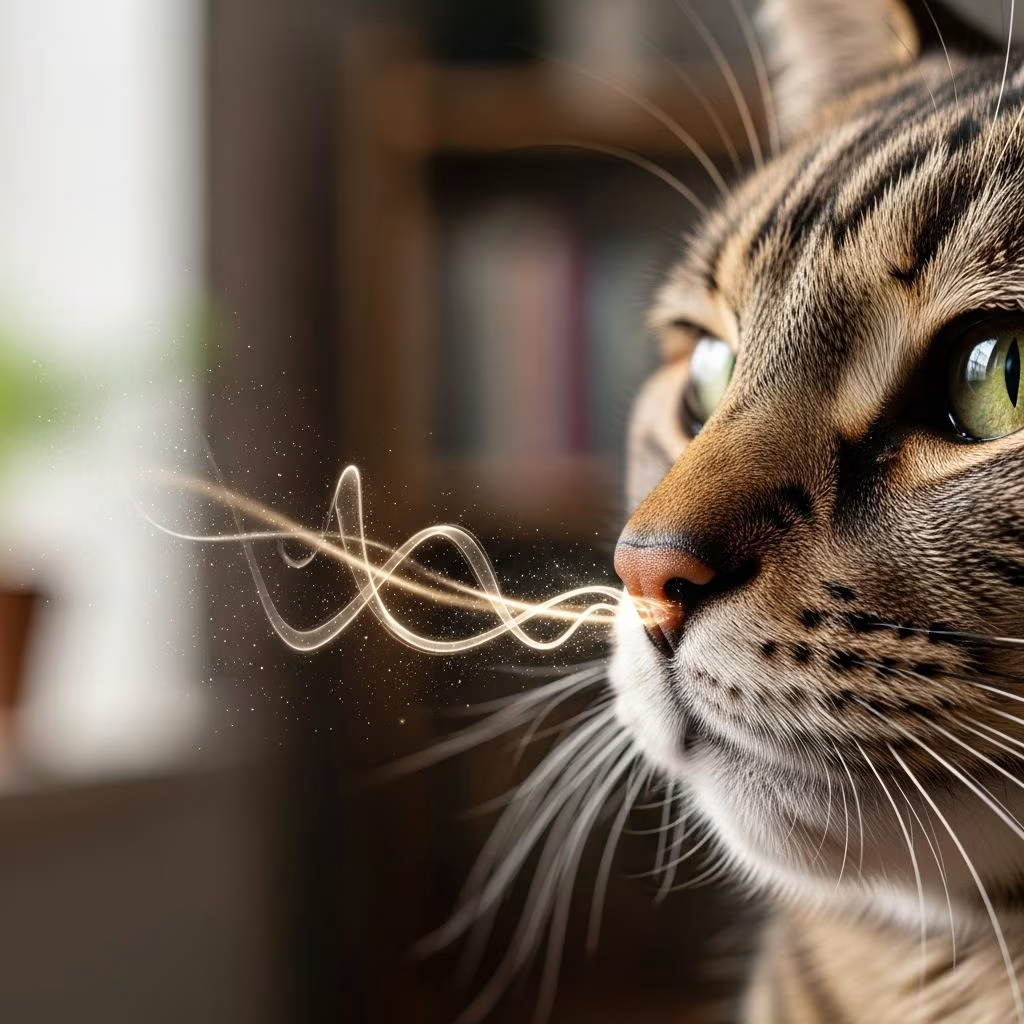
Cats rely heavily on their sense of smell to navigate their world, mark territories, and communicate with others. Their scents, produced through specialized glands, can linger on surfaces for varying durations depending on environmental factors and the type of marking. Understanding this persistence helps owners manage household hygiene and feline stress.
The Remarkable Olfactory World of Cats
Cats possess an extraordinary sense of smell, far surpassing humans, which drives their scent-based interactions. With around 200 million olfactory receptors in their nasal cavity—compared to humans’ mere 5-6 million—cats detect odors at concentrations 14 to 40 times lower than we can. This heightened sensitivity allows them to identify subtle chemical signals left by themselves or others.
The nasal structure of cats acts like a natural gas chromatograph, efficiently separating and processing odor molecules. Research from Ohio State University modeled cat nasal airflow, revealing two distinct streams: one for respiration and another delivering scents rapidly to the olfactory region via coiled turbinates. This design enables quick detection and prolonged processing, making scents highly memorable.
Additionally, the vomeronasal organ (VNO), or Jacobson’s organ, in the roof of the mouth specializes in pheromones. Cats exhibit the flehmen response—curling lips and inhaling—to analyze these signals, crucial for social and reproductive communication.
Sources of Feline Scents and Pheromones
Cats produce scents via multiple glands distributed across their body. These include facial glands on cheeks, chin, and forehead; paw pads; tail base; and anal glands. Rubbing against objects or people deposits these pheromones, signaling familiarity and ownership.
- Facial rubbing: Leaves ‘happy pheromones’ indicating safety.
- Urine spraying: Strong territorial markers with high persistence.
- Claw scratching: Combines visual and scent signals from paw glands.
- Grooming: Spreads saliva-based scents onto fur and surfaces.
Pheromones serve as a chemical language, conveying identity, mood, and status. Unlike visual or auditory cues, scents provide enduring messages in a cat’s environment.
Factors Influencing Scent Persistence
How long a cat’s scent lasts varies widely. Porous materials like fabrics trap odors longer than smooth surfaces. Environmental conditions play a key role:
| Surface Type | Average Duration | Influencing Factors |
|---|---|---|
| Fabrics (couches, beds) | 2-4 weeks | High absorption, low airflow |
| Hard floors, plastics | 1-3 days | Easily cleaned, volatile evaporation |
| Cardboard, wood | 1-2 weeks | Porosity traps molecules |
| Metal, glass | Hours to 1 day | Minimal adhesion |
Humidity prolongs scents by slowing evaporation, while ventilation and cleaning accelerate dissipation. Stronger marks, like urine, endure due to volatile compounds, whereas subtle facial pheromones fade quicker.
Scientific Insights into Scent Longevity
Studies highlight scents’ potency. A PubMed-published study showed cat fur odor induces long-lasting fear conditioning in rats, with avoidance persisting 9 days post-exposure, linked to elevated stress hormones. This demonstrates biological scents’ durability and impact.
Cats’ scent memory reinforces persistence; they recall and react to old marks, refreshing them through re-marking. A 2025 Tokyo University study found cats distinguish human odors, sniffing unfamiliar ones 2-3 times longer, then face-rubbing to claim territory—illustrating active scent management.
Implications for Multi-Cat Households
In homes with multiple cats, overlapping scents can cause tension. New cats introduce foreign odors, prompting spraying or scratching to overwrite them. Persistent rival scents signal intruders, heightening stress.
Owners notice increased marking during changes like new pets or moves. Synthetic pheromones, mimicking natural ones, reduce conflicts by promoting familiarity.
Health Indicators in Lingering Scents
Scent changes often signal health issues. Stronger urine odors may indicate infections; altered anal gland scents suggest dietary problems. Owners attuned to normal baselines detect issues early.
Excessive marking points to stress or urinary conditions. Veterinary checks, including urinalysis, are advised for persistent changes.
Practical Strategies for Scent Control
Maintaining a balanced scent environment benefits cat well-being:
- Regular cleaning: Use enzymatic cleaners for urine; avoid ammonia-mimicking scents.
- Ventilation: Fans and open windows disperse odors.
- Pheromone products: Diffusers like Feliway recreate safe scents, calming cats.
- Scratching posts: Provide textured alternatives absorbing paw scents.
- Bathing: Rare water baths or wipes reduce intense odors.
For absent cats, scents fading prompts re-marking upon return, signaling disrupted routines.
Environmental and Seasonal Variations
Seasons affect scent life: dry winters extend indoor persistence; humid summers aid outdoor dissipation. Heat volatilizes compounds faster.
Urban vs. rural settings differ—less airflow in homes prolongs scents compared to breezy outdoors.
Comparing Cat and Dog Scent Dynamics
Dogs, with 220-300 million receptors, excel in tracking but mark similarly. Cats focus on close-range, persistent territorial scents versus dogs’ transient urine posts.
FAQs
How long does cat urine smell linger?
Untreated urine can persist weeks on porous surfaces due to uric acid crystals; enzymatic cleaners break them down effectively.
Do cat pheromones fade completely?
Yes, over days to weeks, depending on surface and exposure, prompting cats to refresh marks.
Can I remove old cat scents from furniture?
Vacuum, steam clean with enzymes, and use baking soda; air out to fully eliminate.
Why does my cat keep marking the same spot?
Lingering foreign scents or stress trigger re-marking; address underlying causes like new pets.
Are synthetic pheromones as effective as natural ones?
They mimic facial pheromones, reducing anxiety effectively in studies, though not identical.
Enhancing Your Cat’s Scent Comfort
Enrich environments with vertical spaces and familiar items to minimize stress-marking. Monitor for over-marking, consulting vets for persistent issues. Understanding scent longevity fosters harmonious living.
References
- Cat’s Sense Of Smell — AskAnimalweb. 2025. https://askanimalweb.com/cats-sense-of-smell/
- Cat odor causes long-lasting contextual fear conditioning — PubMed (Horm Behav). 2009-08-20. https://pubmed.ncbi.nlm.nih.gov/19699202/
- How the cat nose knows what it’s smelling — Ohio State News. 2023-06-29. https://news.osu.edu/how-the-cat-nose-knows-what-its-smelling/
- Feline olfaction and the extraordinary superpower of cat smell — Felidae Fund. N/A. https://felidaefund.org/news/general/feline-olfaction-and-the-extraordinary-superpower-of-cat-smell
- The Secret Language of Cats — Insightful Animals (Substack). N/A. https://insightfulanimals.substack.com/p/the-secret-language-of-cats



