

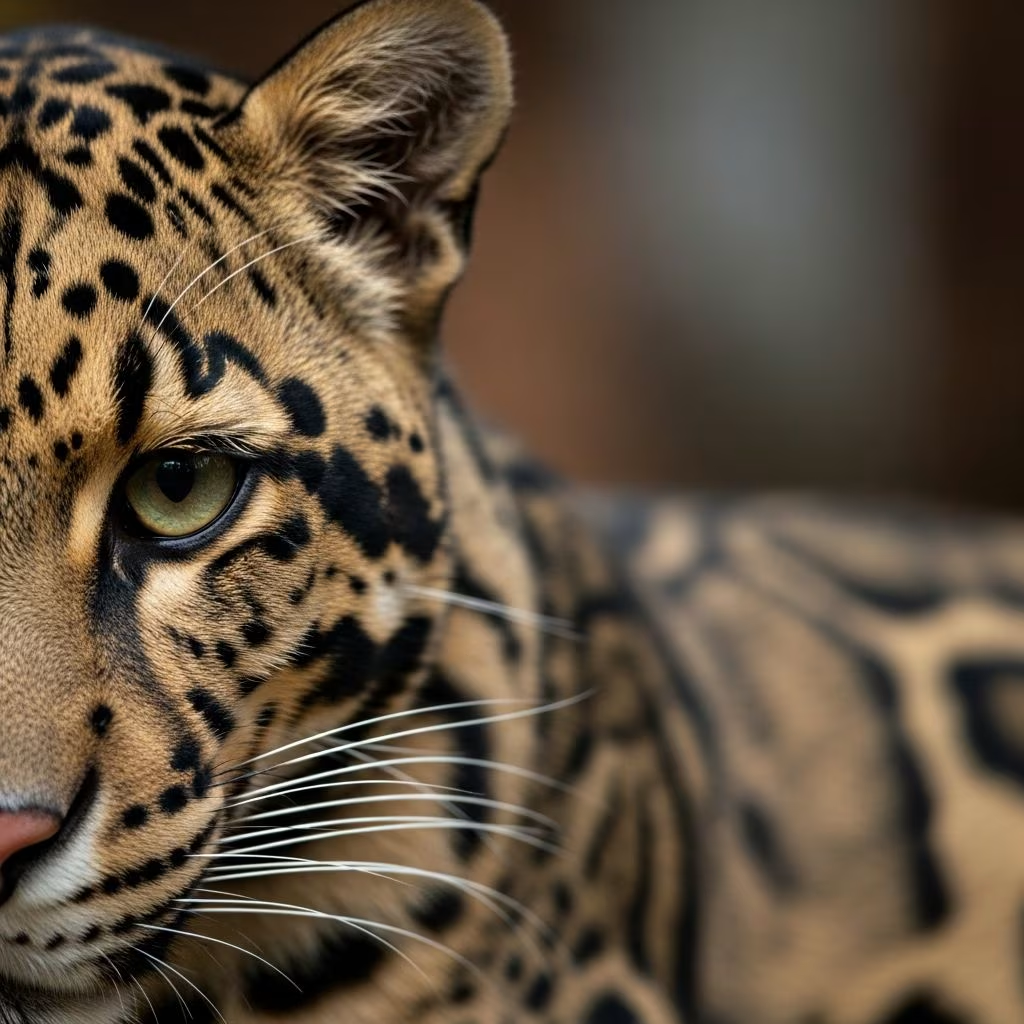
Rosette patterns on cats are distinctive rose-like markings formed by contrasting colors that create a two-toned spotted appearance against the base coat. These patterns, seen in both wild and domestic felines, arise primarily from interactions involving the agouti gene variant linked to tabby formations and more complex mechanisms like the Dkk4 gene.
Defining Rosette Markings in Felines
Rosettes manifest as circular or rose-shaped spots with a darker outline and lighter interior, blending seamlessly into the cat’s overall coat. Unlike simple solid spots, they feature intricate edges that mimic foliage or shadows, providing a natural disguise. This pattern appears on the fur and skin, often clustered or blotched for added complexity.
In domestic cats, rosettes vary in size and sharpness, from delicate outlines on Bengals to bolder forms in breeds mimicking wild ancestors. The contrast between the spot’s center and edge stems from localized pigment production differences during fetal development.
The Evolutionary Role of Rosettes
Rosettes serve as **disruptive coloration**, breaking up the cat’s body outline to confuse prey about its shape, speed, and direction. This camouflage is vital for stalking predators like leopards and ocelots, where shifting shadows simulated by rosettes help them remain undetected.
Research confirms that these patterns create false depth edges, making the hunter harder to track visually. In wild environments, such adaptations improve hunting success rates by allowing closer approaches to prey.
Genetic Foundations of Rosette Formation
Cat coat patterns, including rosettes, emerge from a reaction-diffusion process theorized by Alan Turing in the 1950s. Molecules that activate and inhibit pigment production diffuse at different speeds, generating periodic patterns like spots and stripes.
The **agouti gene variant** is a leading candidate for rosette development, as it influences banded hairs in tabby cats, extending to spotted variants. However, definitive causation remains under study.
Key breakthroughs identify the **Dkk4 gene** (Dickkopf 4) as a Wnt signaling inhibitor. Expressed in fetal cat skin, Dkk4 marks future dark-pigmented areas, with broader domains forming pattern precursors before hair follicles develop.
- Dkk4 inhibits Wnt, halting pigment in lighter zones while allowing it in spots.
- Mutations in Dkk4 produce ‘Ticked’ patterns, like in Abyssinians, erasing tabby marks.
- Wnt activators (e.g., Wnt10b, Wnt5a) pair with Dkk4 inhibitors for spatial patterning.
Single-cell analysis of fetal skin reveals epidermal cells predestined for color patterns pre-melanocyte migration, confirming early molecular control.
Breeds Showcasing Prominent Rosettes
Certain domestic breeds selectively bred for wild-like aesthetics display vivid rosettes, inheriting traits from Asian Leopard Cats or other wild felids.
| Breed | Rosette Style | Genetic Notes |
|---|---|---|
| Bengal | Leopard-like, glittered spots | Hybrid from Asian Leopard Cat; 15-year studies on ~1,000 cats. |
| Egyptian Mau | Random, vivid spots | Natural mutation; ebony ticking enhances contrast. |
| Ocicat | Spotted with rosette hints | Crossbreed origin; thumbprint on back paws. |
| Savannah | Large, bold rosettes | Servals influence; F1 generations most wild-like. |
These breeds highlight how selective breeding amplifies recessive traits for aesthetic appeal.
Comparing Rosettes to Other Feline Patterns
Rosettes differ from stripes (mackerel tabby), blotches (classic tabby), and ticks (Abyssinian). They represent an intermediate complexity, blending spot clusters with internal contrast.
- Spots: Solid, uniform color without inner variation.
- Stripes: Linear, often from dominant tabby alleles.
- Ticked: Banded hairs masking patterns via Dkk4 loss.
- Rosettes: Rose-shaped, multi-toned for depth illusion.
Genetics like the sp locus (spotted vs. mackerel) interact with agouti (A) and tabby (Taqpe) for diversity.
Developmental Timeline of Coat Patterns
Pattern establishment occurs in fetal skin stages:
- Early epidermal signaling via Wnt-Dkk sets color domains.
- Melanoblasts migrate, following pre-patterned cues.
- Hair follicles form in placodes, locking pigment fate.
- Post-birth, patterns refine with growth.
This aligns with Turing’s model, validated in cats after 70 years.
Health and Care for Rosette-Patterned Cats
Breeds with rosettes, often hybrids, may carry hybrid vigor but risk hypertrophic cardiomyopathy (HCM) or patellar luxation. Regular vet checks are essential. Grooming maintains glitter effects in Bengals, while diet supports coat sheen.
No direct health links to rosettes exist, but pattern genes influence broader pathways relevant to pigmentation disorders.
FAQs on Cat Rosettes
Are rosettes rare in domestic cats?
They appear mainly in specific breeds like Bengals, not common household tabbies.
Can any cat develop rosettes?
Genetics determine potential; random mutations are unlikely without breeding.
Do rosettes affect cat behavior?
No direct link, but camouflage heritage suits agile hunters.
How to identify true rosettes?
Look for contrasting center-outline; not just spots.
Are rosette genes dominant?
Complex; agouti dominant, but Dkk4 inhibitory role varies.
Future Research Directions
Ongoing studies expand Turing models to mammals, linking cat patterns to human health via pigment pathways. CRISPR editing may unlock pattern engineering, aiding conservation of spotted wild cats.
References
- Rosettes on Cats: What They Are and Why They Happen — Catster. 2023. https://www.catster.com/lifestyle/rosettes-on-cats/
- Rosette (zoology) — Wikipedia. Accessed 2026. https://en.wikipedia.org/wiki/Rosette_(zoology)
- The Science of Cat Colors and Patterns Explained — CatsForLife. 2024. https://catsforlife.co/blogs/cat-health/the-science-of-cat-colors-and-patterns-explained
- How cats get their stripes — Science | AAAS. 2024-05-21. https://www.science.org/content/article/how-cats-get-their-stripes
- HudsonAlpha researchers discover mechanism of cat fur color pattern establishment — HudsonAlpha Institute for Biotechnology. 2024. https://www.hudsonalpha.org/hudsonalpha-researchers-discover-mechanism-of-cat-fur-color-pattern-establishment/
- Developmental genetics of color pattern establishment in cats — PMC (Peer-reviewed). 2021-09-01. https://pmc.ncbi.nlm.nih.gov/articles/PMC8423757/



