

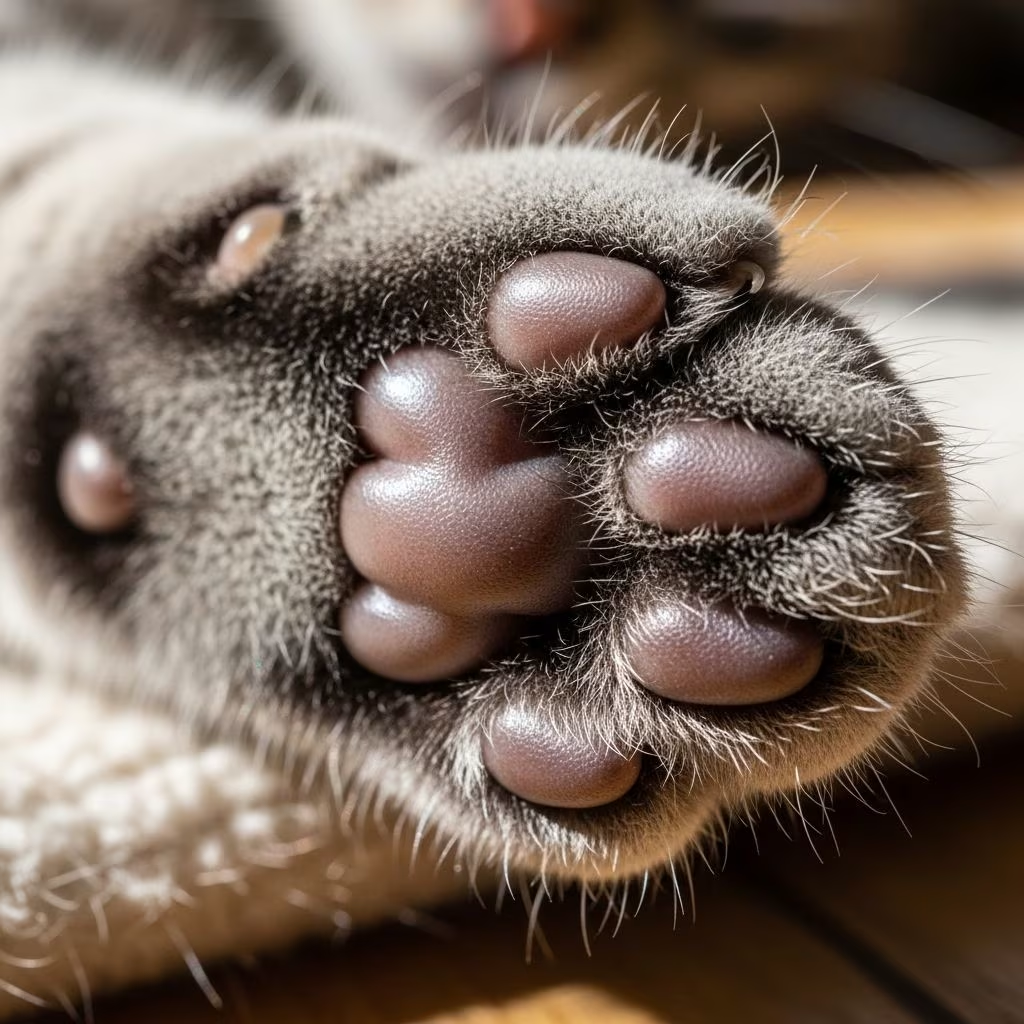
Cat Paw Facts: Understanding Your Feline’s Fascinating Feet
Cat paws are among nature’s most remarkable anatomical structures, perfectly engineered through millions of years of evolution to make felines exceptional hunters, climbers, and acrobats. These adorable toe beans are far more complex and functional than they appear at first glance. From their retractable claws to their unique sensory capabilities, cat paws represent a masterpiece of biological engineering. Understanding the intricacies of your cat’s paws not only helps you appreciate your feline companion better but also enables you to provide superior care and recognize potential health issues. In this comprehensive guide, we’ll explore the fascinating world of cat paw anatomy, functions, and quirks that make them truly special.
1. They Act Like Sheaths That Hide Your Cat’s Claws
One of the most distinctive features of cat paws is their remarkable ability to retract and conceal claws. Unlike dogs and most other animals, cats have evolved a sophisticated mechanism that allows them to keep their claws hidden when they’re not actively hunting, climbing, or playing. This unique adaptation is one of the defining characteristics that separates felines from other carnivores.
All cats except cheetahs possess retractable claws, a feature that provides numerous advantages in their daily lives. When a cat isn’t using their claws, they keep them tucked inside sheaths located at the end of each toe. This retraction system works through a network of specialized tendons and ligaments that allow the cat to extend or withdraw their claws on demand. The mechanism is so efficient that the claws remain protected and razor-sharp even after years of use, as they spend most of their time nestled safely within the toe pads.
If cats kept their claws extended at all times like other animals do, they would constantly snag on everything they encounter. Furniture, bedding, carpets, and even the ground beneath their feet would become entangled in their claws, severely limiting their mobility and causing constant wear on these vital tools. The sheath system solves this problem elegantly, allowing cats to move freely without damaging their claws or the surfaces around them.
The hidden sheaths provide additional benefits beyond simple protection. When claws are retracted, they don’t make contact with the ground, which means cats can move almost silently through their environment. This stealth is crucial for wild cats stalking prey, but it also explains why your own cat can sneak up on you so effectively or creep toward a water bowl to dip their paws without making a sound. When your cat needs to hunt, climb, or defend itself, the paw pads release the claws, which have the extremely important job of gripping surfaces so your cat doesn’t fall or lose balance.
2. The Front Paws Have More Digits Than the Back Paws
If you’ve ever had the opportunity to examine your cat’s paws closely, you may have noticed that the front paws appear to have an extra little digit compared to the back paws. This observation is absolutely correct and reveals an interesting aspect of feline anatomy that contributes to their remarkable dexterity and climbing abilities.
Most cats have five digits, or toes, on each front foot and only four on each back foot. This means the total number of toes across all four paws is eighteen. The extra toes on each front paw are called dewclaws, and they function somewhat like thumbs for cats. These dewclaws are positioned slightly higher up on the leg than the other toes, giving them a unique vantage point and range of motion that regular toes don’t possess.
The dewclaws serve several important functions in a cat’s daily activities. They play a significant role in climbing, as cats can use them to gain additional grip and stability on trees and vertical surfaces. When hunting, the dewclaws help cats grasp and manipulate prey more effectively, providing extra control during the crucial moment of capture. Additionally, cats use their front dewclaws when grooming themselves, scratching, and even when kneading their favorite humans or soft blankets. This extra digit gives cats greater dexterity in their front paws, making them much more versatile tools for interaction with their environment compared to the back paws.
In contrast, the back paws are streamlined with four toes each, optimized for power, speed, and balance rather than manipulation. This asymmetrical design reflects the different roles these paws play in feline locomotion and hunting behavior. The back paws are primarily responsible for propulsion and stability, while the front paws handle grasping and fine motor control.
3. Cats Can Have Extra Toes
While the standard feline foot contains eighteen toes total, some cats are born with a genetic variation that results in significantly more toes than normal. This condition, known as polydactyly, causes affected cats to develop six or more toes on each paw, complete with additional claws. Polydactyl cats have been documented throughout history and have even become somewhat famous in popular culture.
Polydactyly is a genetic condition that occurs naturally in certain cat populations, with some regions having higher prevalence rates than others. Cats with this condition often have the extra toes fully functional with complete bone structure, joints, and claws. The extra digits typically appear on the inner or outer edges of the paw, and cats can usually control them just as effectively as their regular toes.
While polydactyl cats don’t face significant disadvantages from their extra toes, they may require special attention to nail trimming since they have more claws to maintain. Some polydactyl cats show increased agility or climbing ability due to their additional grip options, though this varies from individual to individual. The condition is generally harmless and many cat lovers find polydactyl cats endearing, referring to them as “Hemingway cats” after the famous author who had a colony of them.
Understanding Cat Paw Pad Anatomy
The paw pads themselves are extraordinary structures composed of fatty tissue, known as adipose tissue, which is bound together by collagen and covered with thick, protective skin. Each pad functions as a fluid-filled sac containing blood vessels, nerves, and scent glands that contribute to multiple feline functions. The pads are hairless, which is unusual for most of a cat’s body, but this hairlessness serves important purposes.
Each cat paw contains multiple distinct pads serving different functions. On the front paws, there’s a central metacarpal pad, along with individual pads under each toe. The front paws also feature a small pad higher up on the leg called the carpal pad. Back paws have a metatarsal pad and toe pads. These different pads work together to distribute weight evenly and provide optimal shock absorption and traction.
The thick, tough skin covering these pads provides excellent protection while maintaining sensitivity. This seemingly contradictory combination of toughness and sensitivity is exactly what makes cat paws so remarkable. The skin is rough enough to withstand constant contact with various surfaces, yet sensitive enough to detect minute environmental changes and vibrations.
Key Functions of Cat Paw Pads
Stability and Cushioning
Cat paw pads function as natural shock absorbers, protecting the delicate bones and joints in their feet during high-impact activities. Cats are known for their incredible jumping ability, capable of leaping up to six times their own body height. During these extraordinary jumps and subsequent landings, the paw pads compress and absorb the impact energy that would otherwise be transmitted directly to the bones and joints. This shock-absorption capability, combined with a cat’s flexible spine and muscular legs, explains why cats can often walk away uninjured from falls that would severely hurt other animals. The pads also provide traction and stability, allowing cats to maintain their balance on various surfaces from smooth floors to rough tree bark.
Silent Movement
The cushioned nature of cat paw pads contributes significantly to their famous silent movement. Because their feet are padded rather than hard like a dog’s paws or human shoes, cats can walk without creating noise. Combined with their retractable claws that keep their feet from clicking against the ground, this allows cats to move through environments virtually soundlessly. This stealth is an evolutionary advantage that helps wild cats sneak up on unsuspecting prey, and it also explains why your indoor cat can suddenly appear in your lap without you hearing their approach.
Temperature Sensing and Regulation
Cat paw pads contain temperature-sensitive nerve endings that allow cats to quickly determine whether surfaces are hot or cold. This capability helps cats avoid injury from extreme temperatures and allows them to evaluate their environment before committing their full body weight to a surface. The pads also contain sweat glands that help regulate body temperature. Unlike humans who sweat all over their bodies, cats’ limited sweat glands are concentrated in their paw pads, making these pads instrumental in temperature regulation. When cats are nervous, anxious, or stressed, these sweat glands may activate, which is why cats often leave sweaty paw prints on the examination table during veterinary visits.
Scent Marking and Communication
Cat paw pads contain scent glands that release pheromones when cats scratch or walk. These chemical markers serve multiple communication purposes, helping cats claim territory, mark objects as their own, and communicate with other cats. When your cat kneads your lap or scratches furniture, they’re not just expressing contentment or maintaining their claws—they’re also depositing their unique scent signature on these objects and places.
Unique Identification
Each cat’s paw pads are unique, much like human fingerprints. The pattern of ridges and texture on each paw pad is distinctive to that individual cat. This uniqueness contributes to their individual character and serves as a form of biological identification. No two cats have identical paw pad patterns, making this one of nature’s ways of ensuring individuality even within a species.
The Remarkable Structure of Cat Claws
Cat claws are dramatically different from human fingernails or dog claws. While human fingernails grow from the flesh at the end of our fingers and dog claws grow from bone but in a relatively straightforward manner, cat claws have a unique structure that makes them extraordinary hunting and climbing tools. Cat claws actually grow out of the bones at the end of their paws, making them an integral part of the skeletal structure rather than just keratin attachments.
This fundamental difference in claw structure explains why declawing is such a serious procedure. Declawing isn’t simply trimming the nails as one might think. To remove a cat’s claws, the last bone in every paw must be amputated. This is equivalent to amputating the tips of human fingers at the last knuckle. This invasive procedure can cause chronic pain, behavioral problems, and mobility issues throughout a cat’s life. Understanding this fundamental fact helps explain why veterinarians and animal welfare organizations strongly discourage the practice of declawing except in rare medical circumstances.
Front Paws vs. Back Paws: Different Roles, Different Designs
Front paws and back paws have evolved to serve distinctly different purposes in a cat’s life, which is reflected in their structural differences. The front paws, with their five toes including the dewclaw, are designed for manipulation, climbing, and hunting. They’re the cat’s primary tools for interacting with their environment, gripping objects, and controlling prey. Cats use their front paws to play, groom, and interact with toys and people.
The back paws, with their four toes each, are optimized for power and propulsion. They’re specifically designed for jumping, running, and maintaining balance. While the back paws are less dexterous than the front paws, they provide the explosive power necessary for the remarkable jumps and sprints cats are famous for. The back paws are also crucial for the precise, graceful movement that characterizes feline locomotion.
Common Paw-Related Health Considerations
Because cat paws are so complex, with numerous joints, bones, tendons, and ligaments, each individual joint can potentially develop joint disease. Cats can suffer from osteoarthritis in every digit and moving part of their paws, just as humans can develop arthritis in their ankles, wrists, toes, and fingers. As cats age, monitoring them for signs of pain or mobility changes becomes increasingly important. Signs of paw problems may include limping, reluctance to jump or climb, excessive licking of the paws, or sensitivity when the paws are touched.
Other common paw issues include claw overgrowth, paw pad injuries, infections, and parasitic infestations. Regular inspection of your cat’s paws, combined with appropriate nail trimming and prompt veterinary attention for any abnormalities, helps ensure your cat maintains optimal paw health throughout their life.
Why Cat Paws Matter: The Evolutionary Advantage
Cat paws represent millions of years of evolutionary refinement, creating a structure that gives felines exceptional advantages as hunters and survivors. The combination of retractable claws, sensitive pads, shock-absorbing tissue, and precise muscular control allows cats to be among nature’s most successful predators. Understanding and appreciating the remarkable engineering of cat paws helps us recognize why cats are such special creatures and why they deserve our respect and proper care.
Frequently Asked Questions (FAQs)
Q: Why do cats have different numbers of toes on their front and back paws?
A: Cats have five toes on front paws (including the dewclaw) and four on back paws because they evolved for different functions. Front paws need extra digits for grasping and climbing, while back paws are optimized for power and propulsion.
Q: Are polydactyl cats healthy?
A: Yes, polydactyl cats with extra toes are generally just as healthy as regular cats. They may require slightly more frequent nail trimming due to having more claws, but the condition rarely causes problems.
Q: What causes the sweaty paw prints cats leave at the vet?
A: Cats have sweat glands concentrated in their paw pads. When stressed or anxious, these glands activate, causing visible moisture on their paws.
Q: How often should I trim my cat’s claws?
A: Most cats need claw trimming every 2-3 weeks, though this varies depending on individual growth rates and whether they spend time scratching on appropriate surfaces.
Q: Why can cats jump so high without getting hurt?
A: Cats can land safely from great heights due to shock-absorbing paw pads, flexible spines, and their ability to rotate their bodies mid-fall to land on their feet.
Q: Do all cats have retractable claws?
A: All cats except cheetahs have retractable claws. Cheetahs have semi-retractable claws, which helps them maintain better traction while running at high speeds.
References
- Cat Paw Pads: Vet-Verified Anatomy & Functions Explained — Catster. 2024. https://www.catster.com/lifestyle/cat-paw-pads-anatomy/
- Cat Paw Facts for Cat Lovers — Chewy. 2024. https://www.chewy.com/education/cat/general/cat-paw-facts
- Cat Paws: 11 Fun Facts About Your Kitty’s Tootsies — Elite Veterinary Care. 2024. https://www.eliteveterinarycare.com/blog/cat-paws-11-fun-facts-about-your-kittys-tootsies
- Cat Paw Anatomy: A Closer Look at Paw Structure — Toe Beans. 2024. https://www.toe-beans.com/blogs/pet-blog/cat-paw-anatomy-structure
- The Ultimate Guide to Your Cat’s Paws — The Comforted Kitty. 2024. https://comfortedkitty.com/understanding-cat-paws-guide/



