

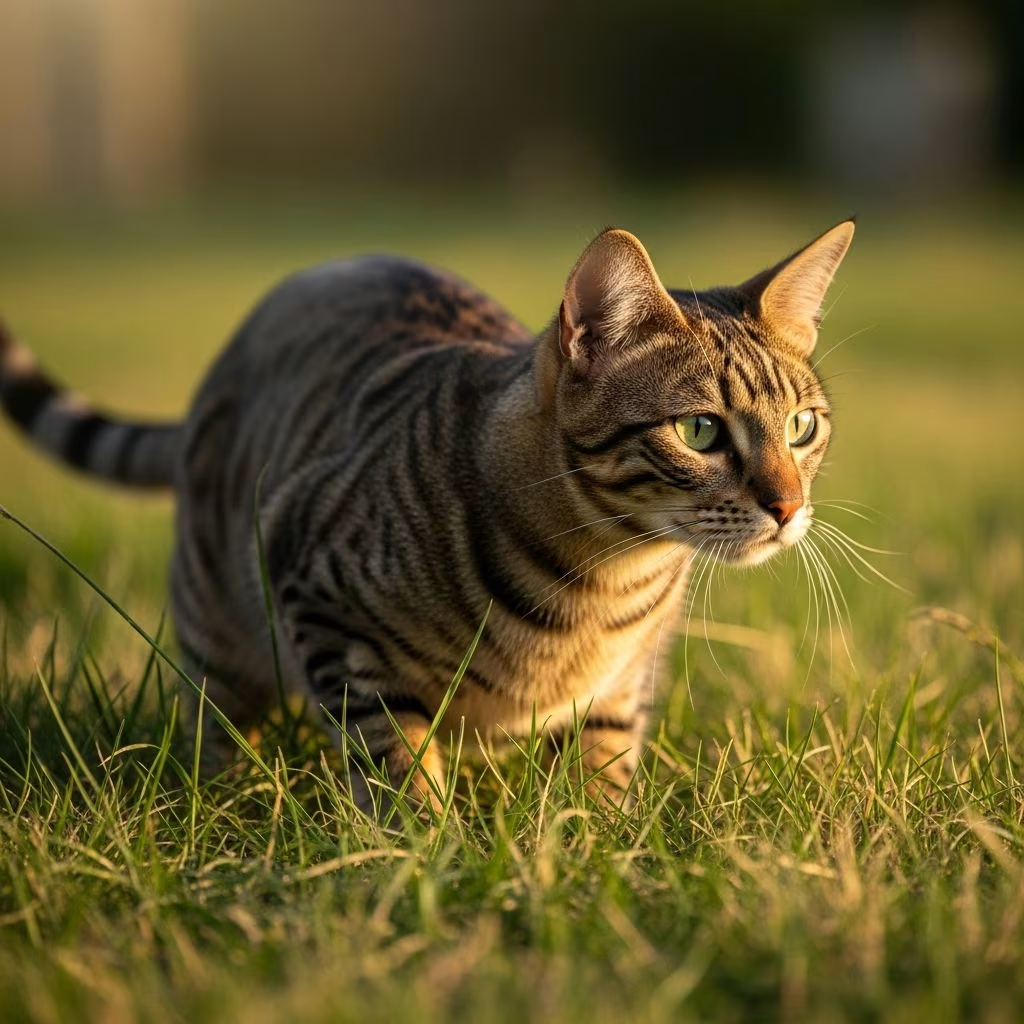
Your domestic cat carries within its DNA the powerful legacy of millions of years of evolution as a predator. Even the most pampered house cat, spending its days lounging on soft furniture, retains the fundamental drive to hunt. This isn’t a behavioral flaw or something to discourage—it’s a core aspect of what makes a cat feline. Understanding this instinct and learning how to appropriately channel it is essential for responsible cat ownership and ensuring your pet’s psychological well-being.
The Evolutionary Foundation of Hunting Behavior
Cats didn’t become hunters overnight. Their predatory nature evolved over countless generations in response to environmental pressures and survival needs. Historically, only the most skilled hunters survived and successfully reproduced, meaning that today’s domestic cats are descended from exceptionally adept hunters. This selective pressure created a species with an incredibly strong and persistent hunting drive.
The domestication of cats occurred relatively recently in evolutionary terms, and there has been minimal selective breeding aimed at eliminating or reducing hunting behavior. This is fundamentally different from how humans bred dogs, where specific traits were actively selected for or against. Because of this, the hunting instinct in cats remains virtually unchanged from their wild ancestors.
The reason humans initially domesticated cats was practical: to protect food supplies and crops from rodent populations. Ancient civilizations recognized that cats naturally controlled pest problems, making them invaluable to early agricultural communities. Though this utilitarian need has largely disappeared for modern pet cats, the biological imperative to hunt persists in their behavioral repertoire.
How Much Time Do Cats Spend Hunting?
The extent of hunting-related behavior in cats is often underestimated by pet owners. Cats engage in three to ten hours per day of typical hunting behavior, which includes locating prey, lying in wait, stalking, and pouncing. This isn’t a small fraction of their daily activity—for many cats, hunting occupies a significant portion of their waking hours.
Even indoor cats without access to live prey still exhibit these behaviors through play and interaction with toys. The absence of actual prey doesn’t suppress the drive; it merely redirects it. This is why enrichment activities and hunting-simulation play are so critical for indoor cat well-being.
The Distinction Between Instinct and Learned Behavior
One of the most important insights from behavioral research is that killing is a learned behavior rather than pure instinct. While all cats possess an innate drive to chase and hunt, the actual act of successfully killing and consuming prey is something that must be learned and refined.
How Cats Learn to Hunt
Mother cats play the primary role in teaching their offspring hunting skills. Kittens who observe their mothers hunting become better hunters than those who don’t have this advantage. The teaching process follows a structured progression:
- Mother cats initially present dead animals to their kittens
- She demonstrates consumption by eating in front of the litter
- Kittens gradually become accustomed to viewing this predatory behavior
- Kittens are encouraged to participate and learn through observation
- Play with littermates reinforces coordination and timing skills
Interestingly, most kittens who never observe their mothers hunting can still instinctually figure out hunting on their own. This demonstrates the powerful combination of instinctual drive and the capacity for independent learning in cats. Even without formal training, the innate predatory patterns guide young cats toward successful hunting techniques.
Skill Development Through Play
Play serves as the training ground for hunting abilities. Kittens develop essential hunting skills through play, learning to run, jump, pounce, and chase. During these interactions, they develop crucial capabilities:
- Spatial awareness and distance judgment through pouncing practice
- Speed adjustment to match the velocity of moving objects
- Coordination between visual tracking and physical movement
- Timing and precision in capturing moving targets
- Sensory integration, using sight and sound to locate prey
The Hunting Sequence Explained
Cats follow a remarkably consistent pattern when hunting prey. The predatory sequence consists of search, stalk, chase, and pounce. Understanding each phase provides insight into why cats behave as they do:
Search Phase
The hunting sequence begins with environmental scanning. A cat uses her senses to find prey, often by sniffing the air or visually spotting a target. When a cat has locked onto prey, her pupils will noticeably dilate, indicating focused predatory attention.
Stalk and Approach
Cats usually approach prey by stalking, moving in a crouched position with their head extended. The stalking phase involves deliberate, controlled movement. Initially, movements are slow and calculated, designed to avoid alerting the prey. As the cat closes the distance, speed gradually increases, creating a crescendo of tension.
Capture Phase
Once the cat reaches striking distance, they hold themselves in a tense position before launching a brief sprint and spring forward to strike the prey with one or both front paws. The capture itself is explosive and precise, the culmination of seconds or minutes of patient stalking.
Subsequent Manipulation
After capture comes the phase many cat owners observe: the cat appears to play with or toy with the prey. This behavior warrants special attention and understanding.
Why Do Cats Play With Their Prey?
One of the most misunderstood aspects of cat behavior is their tendency to seem to play with or toy with captured prey before consuming it. By playing with prey, cats cause confusion and fatigue, making it easier to kill without putting themselves at risk of injury. This isn’t cruel for cruelty’s sake—it’s a survival strategy.
Playing with prey may reflect the cat’s way of responding to the prey’s movements to protect themselves from injury. Small animals like mice and rats, despite their size disadvantage, can bite and scratch with surprising ferocity. A cat’s apparently playful behavior is often a calculated approach to incapacitating prey while minimizing its own risk of harm.
Additionally, if a cat performs this behavior after they’ve already killed the prey, it could simply mean they aren’t hungry enough to eat. Hunger status affects not just whether a cat hunts, but also what they do with successfully captured prey. A well-fed cat may hunt entirely for the stimulation and practice, without any intention of consuming the catch.
Another theory suggests that in domesticated cats, this behavior stems from pent-up hunting instinct. Unlike wild or feral cats, which don’t typically engage in extended play with mature prey, domestic cats may prolong this phase because they spend much of their time in environments without hunting opportunities. The accumulated predatory drive seeks outlet in available prey.
Is Hunger the Primary Motivation?
Many cat owners assume their cats hunt because they’re hungry, but the reality is more nuanced. One study found that domestic cats only eat 30 percent of prey they kill. If cats relied solely on their own hunting for sustenance, they would need to capture approximately 10 to 20 animals daily to meet their energy needs.
The distinction between hunting motivation and eating motivation is crucial. Cats have learned to be opportunistic feeders, changing their activity patterns based on food availability, and will hunt if the opportunity presents itself regardless of whether they’re hungry. This behavior makes evolutionary sense: in the wild, a cat cannot afford to wait until hunger strikes to hunt, as successful captures are far from guaranteed.
The motivation to hunt prey is only partly related to hunger. Instead, cats are driven by the instinctual knowledge that they must hunt when opportunities arise, or risk going without food later. Hunger does influence whether a cat will actually kill and consume what they catch—cats are far more likely to kill and eat their prey if they’re hungry at the point of hunting.
Why Cats Change Their Prey Preferences
Pet owners sometimes notice their cats shifting from one favorite food to another. Cats naturally change their prey from time to time to avoid becoming dependent on a single species. This dietary variation serves an important survival function: if a cat depended entirely on one type of prey and that species became unavailable, the cat would face starvation.
Cats have retained this mechanism despite being cared for by humans, meaning that even well-fed house cats occasionally need variety in their diet and hunting activities. This preference for diversity is hardwired and shouldn’t be viewed as fickleness or behavioral problems.
Supporting Natural Hunting Instincts Indoors
For indoor cats, the challenge is providing meaningful hunting experiences without exposing them to actual rodents or allowing them to become threats to wildlife. Fortunately, cats can satisfy their predatory needs indoors through play and appropriate enrichment. The key is consistency and engagement.
Enrichment Strategies
- Interactive play sessions: Use wand toys, laser pointers, and ball toys to simulate prey movement and encourage pouncing, stalking, and chasing
- Puzzle feeders: Require cats to work for their food, engaging their problem-solving abilities alongside predatory instincts
- Rotating toy selection: Regularly introduce new toys to maintain novelty and sustained interest
- Environmental enrichment: Provide climbing structures, hiding spots, and observation perches that support natural behaviors
- Scheduled hunting time: Establish daily play sessions that simulate the hunting sequence from search through capture
Behavioral Considerations
To keep a cat in a manner consistent with its needs and avoid behavioral problems, it’s important to channel the hunting instinct into constructive play. Cats whose predatory drives go unsatisfied often develop behavioral issues including aggression, anxiety, and destructiveness. Providing adequate outlets isn’t indulgent—it’s essential care.
Even an indoor cat that isn’t constantly confronted with stimuli to pursue and catch prey has within it the hunting instinct and the desire to act on it. This means that all indoor cats, regardless of their environment, require enrichment activities that satisfy these deep-rooted drives.
The Role of Hunger Hormones
An important clarification about hunting motivation: the desire to hunt is not governed by hormones and therefore does not diminish after neutering. Spaying or neutering your cat will not reduce their hunting instinct. This is a critical point for owners who hope that reproductive surgery will decrease their cat’s predatory behavior—it simply won’t.
The hunting drive is a fundamental aspect of feline neurology and psychology, separate from reproductive hormones. This is why even spayed or neutered indoor cats require hunting-related enrichment and play.
Responsible Cat Ownership and Natural Behaviors
You should never punish your cat for hunting, as she’s only expressing her natural instincts. Punishment creates confusion and anxiety while doing nothing to address the underlying biological drive. Instead, responsible ownership means accepting this aspect of feline nature and creating appropriate channels for expression.
Understanding that hunting is a permanent part of a cat’s behavioral repertoire helps owners approach the behavior with compassion rather than frustration. Whether your cat is bringing gifts to your doorstep or pouncing on indoor toys, she’s fulfilling an essential part of her identity as a feline predator.
Conclusion
The hunting instinct in domestic cats represents an unbroken chain connecting today’s beloved companions to their wild ancestors. Through understanding how this behavior develops, why cats engage in seemingly puzzling activities like playing with prey, and how to appropriately support these needs, cat owners can foster healthier, more fulfilled pets. Rather than viewing hunting as a behavioral problem to eliminate, modern cat care recognizes it as a natural drive to channel constructively, ensuring both the cat’s well-being and responsible ownership.
References
- Cats and Their Hunting Behaviour — FOUR PAWS International. https://www.four-paws.org/our-stories/publications-guides/cats-and-their-hunting-behaviour
- Do All Cats Hunt? — Dezi & Roo. https://deziroo.com/blogs/pawsitive-connections/how-cats-hunt
- Why Do Cats Hunt? Learn About Their Behavior — Purina US. https://www.purina.com/articles/cat/behavior/understanding-cats/cat-hunting-behavior
- Understanding the hunting behaviour of cats — International Cat Care. https://icatcare.org/articles/understanding-the-hunting-behaviour-of-cats



