

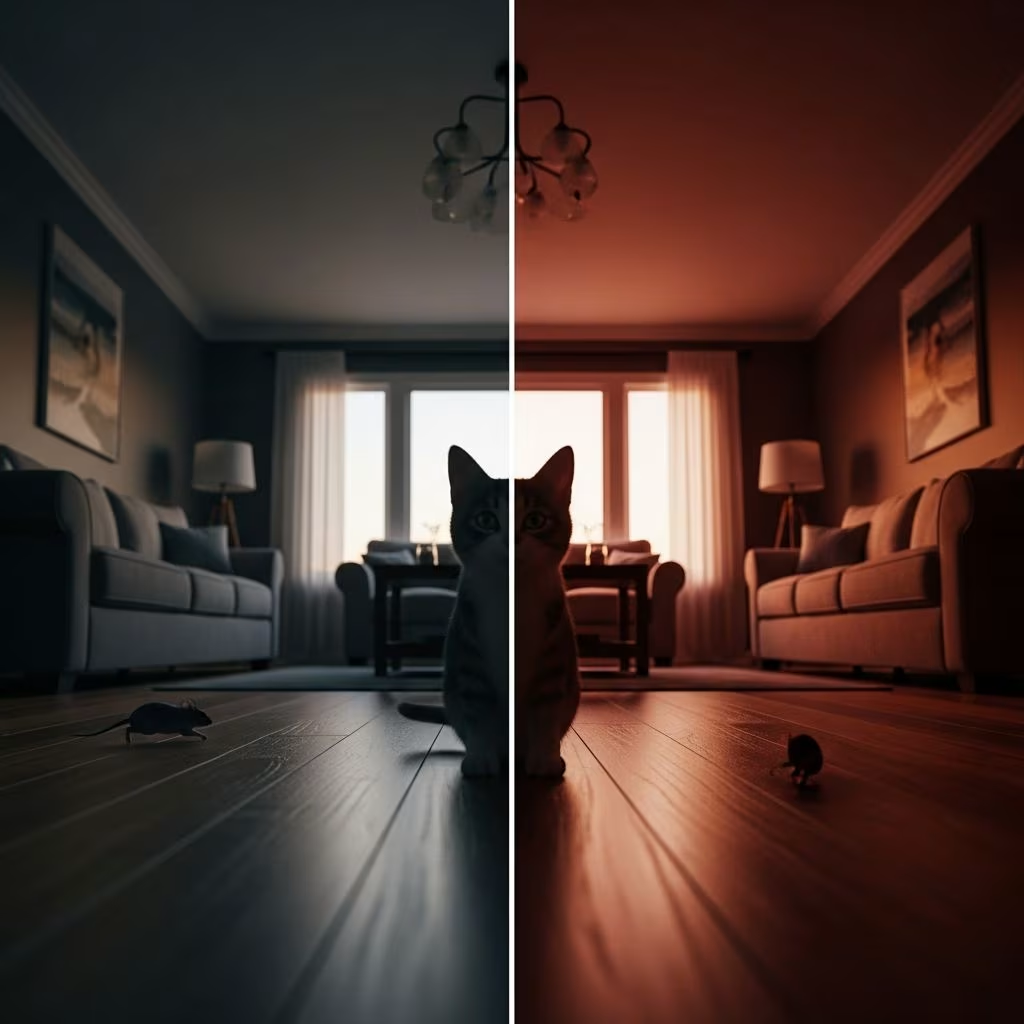
Understanding the nuances of how cats perceive the world compared to humans reveals much about their evolutionary adaptations as skilled predators. Cats possess remarkable abilities tuned for hunting in varied lighting, while human vision prioritizes precision and color richness suited to diurnal lifestyles.
Anatomy of Feline and Human Eyes
The foundation of visual differences lies in eye structure. Cats feature elliptical pupils that adjust rapidly to light changes, enabling precise control in low-light hunts. A nictitating membrane, or third eyelid, protects their eyes during rapid movements. Behind the retina, the tapetum lucidum—a reflective layer—amplifies faint light by bouncing it back through photoreceptors, enhancing night sight.
Humans, by contrast, have round pupils and lack this reflective layer, relying instead on a higher density of cone cells for daylight clarity. Our lenses flex more dynamically to focus across distances, supporting detailed tasks like reading or driving.
- Key anatomical traits in cats: Elliptical pupils, tapetum lucidum, high rod count.
- Key human advantages: Flexible lens, dense cone distribution in the fovea centralis.
Photoreceptors: Rods and Cones at Work
Vision hinges on rods for low-light sensitivity and motion detection, and cones for color and fine detail. Cats boast about 16 times more rods relative to cones than humans, prioritizing dim environments over hue discrimination. This setup allows them to detect subtle movements in twilight, ideal for stalking prey.
Human retinas favor cones, with three types sensitive to red, green, and blue wavelengths, yielding trichromatic vision. This enables us to distinguish millions of shades but falters in darkness, where rod scarcity limits perception.
| Aspect | Cats | Humans |
|---|---|---|
| Rod Density | High (superior night vision) | Moderate |
| Cone Density | Low (dichromatic-like) | High (trichromatic) |
| Light Threshold | 1/6th of human needs | Requires brighter conditions |
Field of View: Peripheral Mastery
Cats enjoy a 200-degree visual field, surpassing the human 180 degrees, thanks to forward-facing eyes spaced for overlap in binocular vision while extending side awareness. This panoramic scope aids in spotting threats or prey from afar without head turns.
Our narrower field demands more eye and head movement, but central overlap enhances depth perception for precise actions. Cats’ edge shines in dynamic scenarios like pouncing on elusive targets.
Clarity and Distance: Acuity Differences
Visual acuity measures sharpness; humans average 20/20, resolving details up to 200 feet. Cats range from 20/100 to 20/200, needing proximity—around 20 feet—to match our distant clarity. Their weaker ciliary muscles limit lens accommodation, suiting close-range predation over long-range scouting.
This nearsightedness aligns with ambush tactics: cats creep near before striking, using whiskers and hearing for final adjustments.
Color Worlds: Muted vs Vibrant
Cats perceive blues and greens effectively but struggle with reds and pinks, akin to human red-green colorblindness. Their two primary cone types yield a desaturated palette, where warm tones fade into grays.
Humans revel in full-spectrum vibrancy, aiding foraging, art, and social cues in bright daylight. Cats’ muted view doesn’t hinder survival, as motion and contrast dominate their cues.
Motion Detection: Predatory Precision
Cats excel at tracking rapid movements, with rod-rich retinas and brain wiring optimized for flickers up to 100 Hz—double human limits. This lets them pursue darting insects or rodents seamlessly.
We detect steadier motions well but blur at high speeds, explaining why laser pointers mesmerize cats while we see steady dots.
Low-Light Supremacy: Twilight Hunters
In dim conditions, cats thrive using one-sixth the light humans require. The tapetum lucidum and rod abundance create a glowing-eye effect, maximizing photon capture for clear silhouettes against skies.
Humans shift to scotopic vision in darkness, seeing grays but losing color and detail rapidly after 10 minutes of adaptation.
Close-Up Focus: Near Vision Trade-offs
Cats focus sharply from 10-20 inches, perfect for scrutinizing prey post-capture. Humans resolve finer details closer, around 5-6 inches, benefiting tool use and text.
This feline sweet spot supports paw inspections and grooming precision.
Evolutionary Reasons for Visual Traits
Cats evolved as crepuscular hunters, active at dawn and dusk when rodents stir. Their vision prioritizes stealthy approaches in shade, compensating weak distance sight with speed and senses.
Humans, as daytime gatherers and tool-makers, developed acuity for spotting ripe fruits afar and crafting intricacies, with social reliance reducing night-foraging needs.
Implications for Cat Owners
Knowing these differences guides enrichment. Provide dim-lit play for night vision, avoid red toys (use blues), and ensure close-range interactives. Laser pointers engage motion instincts but pair with real prey mimics to prevent frustration.
- Use feather wands for tracking practice.
- Dim room puzzles leverage low-light skills.
- Avoid TV reliance; cats see less flicker and color.
Common Myths About Cat Sight
Myth: Cats see in total darkness. Reality: They need some ambient light; pure black is blind to all.
Myth: Cats are fully colorblind. Reality: They discern select hues, just not richly.
Myth: Cat vision mirrors dogs’. Reality: Similar but cats edge in acuity and field width.
Health Considerations for Feline Eyes
Monitor for cloudiness signaling cataracts or retinal atrophy. Regular vet checks catch issues early, as progressive diseases erode rods first, hitting night vision hard.
Bright lights can daze cats temporarily due to pupil limits; gradual exposure helps.
FAQs
Do cats see better than humans overall?
No definitive winner—cats lead in low light and periphery, humans in detail and color. Each suits their niche.
How far can cats clearly see?
Optimal focus at 20 feet max; beyond, details blur significantly.
Are cats colorblind?
Not entirely; they detect blue-green but miss red vibrancy, like mild color deficiency.
Why do cats’ eyes glow?
Tapetum lucidum reflects light, boosting sensitivity and causing the shine.
Can cats watch TV like humans?
Limited appeal; lower frame rates and poor color reduce engagement.
References
- Cat Vision Vs. Human Vision: Who Has Better Vision? — Cats.com. 2023. https://cats.com/cat-vision-vs-human-vision
- Cat Vision vs. Human Vision: Vet-Reviewed Differences — Catster. 2023. https://www.catster.com/lifestyle/cat-vision-vs-human-vision/
- Humans Vs. Animals: Who Has Better Vision? — Eyesite Opticians. 2022. https://www.eyesite.co.uk/news/humans-vs-animals-who-has-better-vision
- Photos Show How Cats See the World Compared to Humans — Business Insider. 2013-10-14. https://www.businessinsider.com/pictures-of-how-cats-see-the-world-2013-10
- Cat Vision — All About Vision. 2023. https://www.allaboutvision.com/eye-care/pets-animals/cat-vision/



