

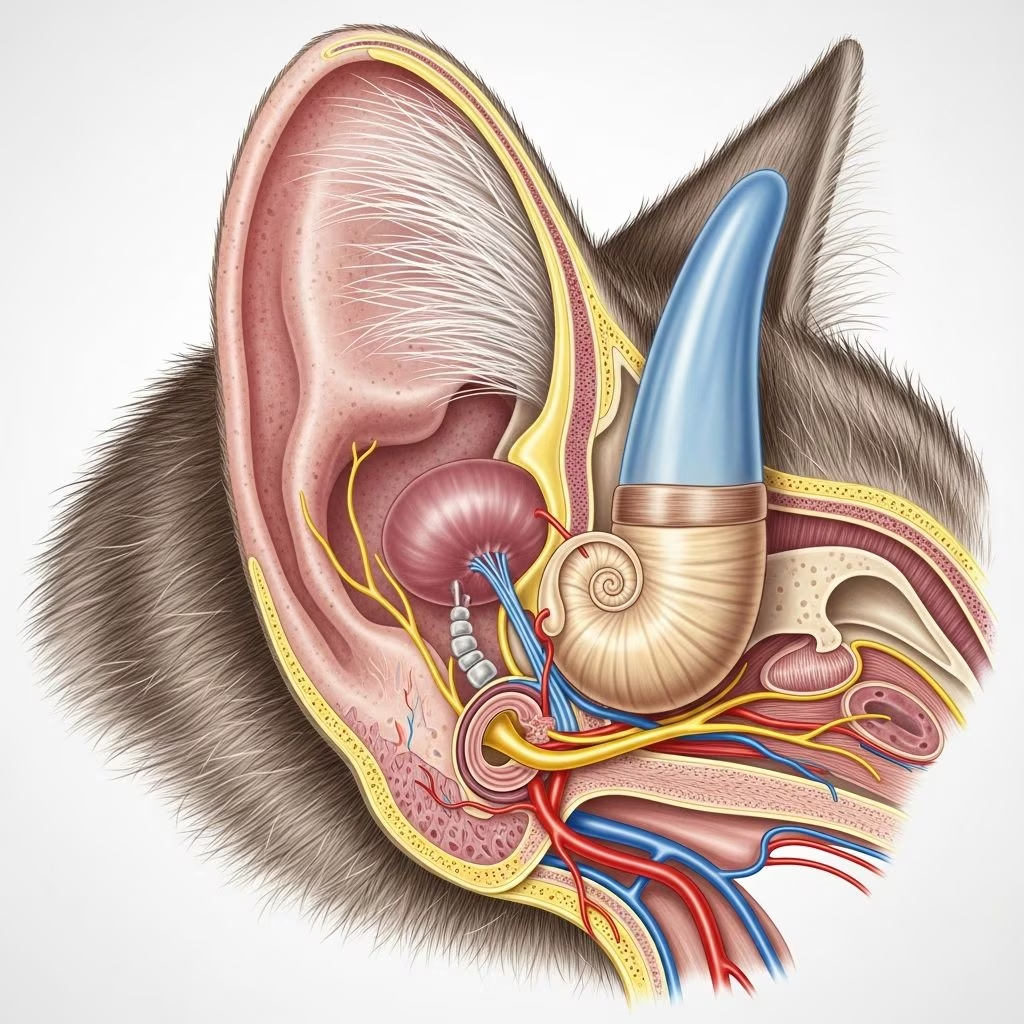
The ears of cats represent a marvel of evolutionary design, enabling these agile creatures to detect the faintest sounds and maintain impeccable balance. Comprising three primary sections—the outer, middle, and inner ear—feline ears facilitate acute hearing and equilibrium, crucial for their predatory lifestyle.
The Outer Ear: Gateway to Sound
The most visible part of a cat’s ear is the **pinna**, a flexible, funnel-like structure made of cartilage wrapped in skin and fur. This feature captures sound waves from all directions and channels them into the ear canal. Cats possess 32 muscles controlling each pinna, allowing independent swiveling up to 180 degrees for precise localization of noises.
Directly connected is the **external ear canal**, an L-shaped passage with a vertical upper section and a longer horizontal lower one. This design, deeper than in humans, enhances sound funneling but can trap debris, wax, and moisture, potentially leading to infections.
- Cartilage components: Include the auricular cartilage forming the pinna and annular cartilage at the canal’s base, providing structural support.
- Skin features: Lined with hair follicles, sebaceous glands, and ceruminous glands that produce protective earwax (cerumen), which traps dirt and keeps the canal moist.
- Mobility advantage: Pinnae twitch and rotate to pinpoint prey rustles or threats, amplifying faint sounds by up to 10 decibels.
The canal terminates at the **tympanic membrane** (eardrum), a thin, taut layer that vibrates upon sound impact, marking the transition to the middle ear.
Middle Ear Mechanics: Amplifying Vibrations
Behind the eardrum lies the **middle ear**, a small air-filled chamber called the tympanic cavity or bulla, encased in bone for protection. This space houses three tiny ossicles: the malleus (hammer), incus (anvil), and stapes (stirrup). These bones form a chain that amplifies and transmits vibrations from the eardrum to the inner ear, increasing sound pressure 20-fold.
The **auditory tube** (Eustachian tube) connects the middle ear to the pharynx, equalizing pressure and draining fluids to prevent imbalances.
| Ossicle | Shape & Role | Function in Cats |
|---|---|---|
| Malleus | Hammer-like | Attaches to eardrum, initiates vibration chain. |
| Incus | Anvil-shaped | Links malleus to stapes, refines transmission. |
| Stapes | Stirrup-shaped | Pushes against oval window, enters inner ear. |
This efficient system ensures cats hear frequencies up to 64 kHz—far beyond human limits of 20 kHz—ideal for detecting high-pitched rodent calls.
Inner Ear Wonders: Hearing and Balance Mastery
Deep within the skull’s petrous temporal bone resides the **inner ear**, featuring the bony labyrinth filled with fluid and membranes. Key structures include the **cochlea**, a spiral tube converting vibrations into electrical nerve impulses via hair cells, processed as sound by the brain.
The **vestibular system**—comprising the vestibule and three semicircular canals—detects head position and motion. Fluid shifts within these canals trigger nerve signals, enabling rapid reflexes for agility during leaps and turns. Cats’ highly developed canals explain their legendary righting reflex and balance.
The vestibulocochlear nerve (8th cranial nerve) carries all signals to the brain, integrating hearing and equilibrium seamlessly.
- Cochlea role: Transduces mechanical waves to neural signals for auditory perception.
- Semicircular canals: Oriented in three planes, sense rotation in any direction.
- Vestibule: Monitors linear acceleration and gravity via otoliths.
How Cats Hear: A Step-by-Step Process
Sound waves enter the pinna, travel the canal, and vibrate the eardrum. Ossicles amplify these, pushing the stapes against the oval window to ripple perilymph fluid in the cochlea. Hair cells bend, generating impulses sent via the cochlear nerve to the brain’s auditory cortex.
Balance detection involves endolymph fluid movement in semicircular canals, stimulating hair cells in ampullae to signal the brainstem, prompting corrective muscle actions.
This dual functionality makes cats superior hunters, localizing sounds within 4 degrees accuracy.
Common Ear Conditions in Cats
Despite robust design, cat ears face issues:
- Otitis externa: Inflammation from wax buildup, allergies, or mites; symptoms include head shaking and odor.
- Ear mites (Otodectes cynotis): Parasites causing dark debris and itching, common in multi-pet homes.
- Middle ear infections: Bacterial spread via perforated eardrum, leading to pain and balance loss.
- Aural hematomas: Blood-filled swellings from trauma, often requiring drainage.
Breeds like Persians with folded ears (e.g., Scottish Folds) are prone to chronic infections due to poor ventilation.
Daily Ear Care for Optimal Health
Routine checks prevent problems:
- Inspect weekly: Look for redness, discharge, or odor; gently fold pinna to view canal.
- Clean sparingly: Use vet-approved solutions for wax; avoid Q-tips to prevent injury.
- Monitor behavior: Tilting head, scratching, or balance issues signal vet visits.
- Prevent mites: Monthly parasiticide treatments for outdoor cats.
Nutrition with omega-3s supports skin health, reducing inflammation risks.
Feline Ear Variations Across Breeds
Ear shapes vary:
- Siamese: Large, pointed pinnae for enhanced sound capture.
- Scottish Fold: Folded cartilage from genetic mutation, increasing infection risk.
- Sphynx: Exposed skin requires extra cleaning sans fur protection.
These adaptations influence care needs.
FAQs on Cat Ear Anatomy
Why do cats’ ears twitch so much?
Over 30 muscles per ear allow pinpointing sounds; twitching expresses emotion or alerts to stimuli.
Can cats hear better than dogs?
Yes, cats detect higher frequencies (up to 64 kHz vs. dogs’ 45 kHz), suited for small prey.
What causes a cat to hold one ear back?
Often pain from infection, abscess, or hematoma; seek veterinary care promptly.
Do all cats have the same ear canal shape?
The L-shape is universal, but depth varies by breed, affecting cleaning ease.
How does the inner ear aid jumping?
Semicircular canals detect motion, triggering reflexes for mid-air corrections.
Evolutionary Advantages of Cat Ears
Cats’ ears evolved for nocturnal hunting: mobile pinnae amplify whispers, high-frequency sensitivity spots vermin, and vestibular prowess ensures acrobatics. Compared to humans, feline ears offer directional hearing and broader range, underscoring their predatory edge.
References
- Structure and Function of the Ear in Cats — PetPlace.com. Accessed 2026. https://www.petplace.com/article/cats/pet-health/structure-and-function-of-the-ear-in-cats
- Ear Structure and Function in Cats — MSD Veterinary Manual. Accessed 2026. https://www.msdvetmanual.com/cat-owners/ear-disorders-of-cats/ear-structure-and-function-in-cats
- What’s with that slit on your cat’s ear, and more on feline anatomy — Ann Arbor Animal Hospital. Accessed 2026. https://annarboranimalhospital.com/blog/whats-slit-cats-ear-anatomy/
- How Do Cat Ears Work? — Cat Care Clinic. Accessed 2026. https://catcare.com/blog/how-do-cat-ears-work/
- Anatomy Of The Ear—Cats and Dogs — Oakleigh Central Vet. Accessed 2026. https://www.oakleighcentralvet.com.au/single-post/anatomy-of-the-ear-cats-and-dogs
- Anatomy of the Canine and Feline Ear — Veterian Key. Accessed 2026. https://veteriankey.com/anatomy-of-the-canine-and-feline-ear/



