

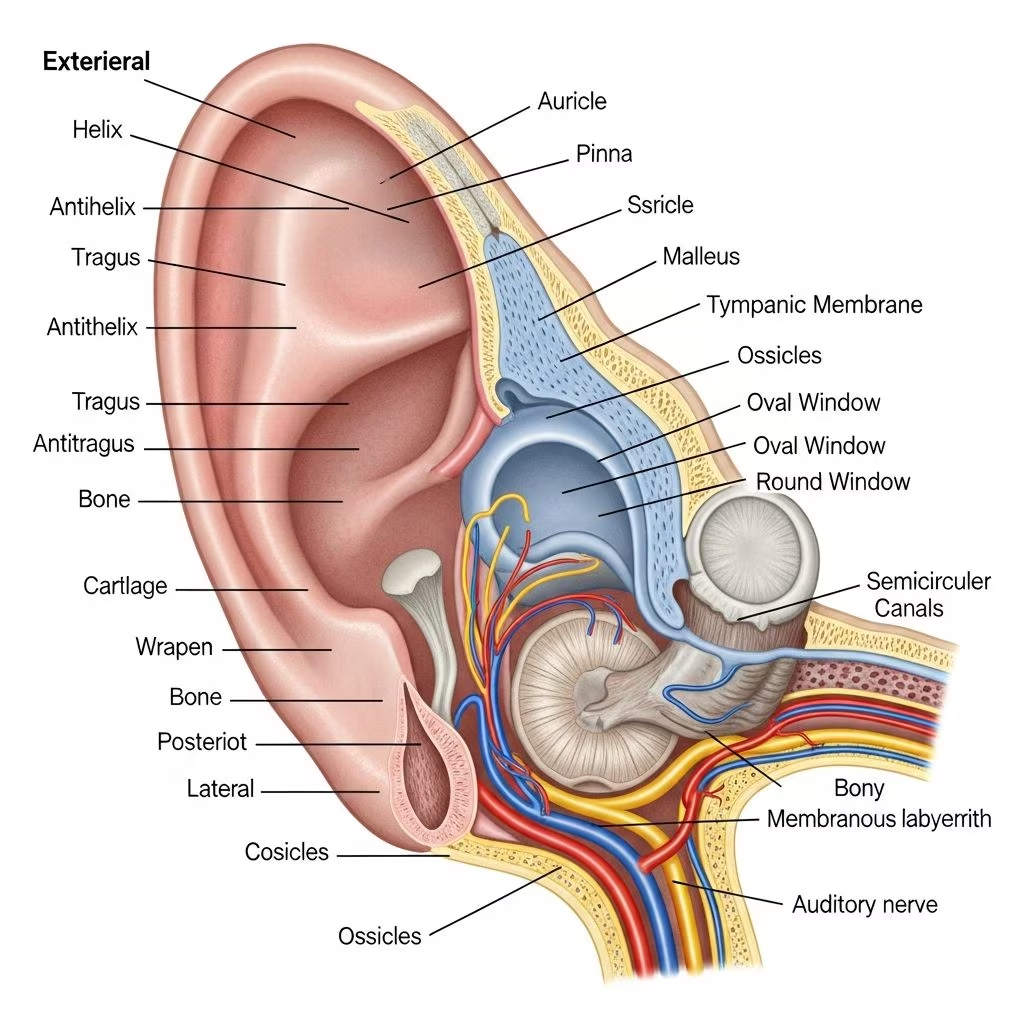
The ears of cats represent a remarkable feat of evolutionary engineering, serving dual roles in acute hearing and precise balance. These organs enable felines to detect faint rustles of prey or navigate high jumps with unerring accuracy. Delving into their structure reveals why cats possess such exceptional sensory capabilities compared to other pets.
The Visible Marvel: Outer Ear Components
The outer ear captures and funnels sounds into deeper regions. It includes the prominent flap known as the pinna and the tubular passage called the ear canal. The pinna, a mobile structure of skin and cartilage, swivels to pinpoint noises from all directions.
- Pinna Mobility: Over 20 muscles control its movements, allowing 180-degree rotation independently on each side.
- Sound Collection: Its funnel shape amplifies faint sounds by up to 15 decibels before they reach the canal.
- Skin and Fur Cover: Fine hairs and glands produce protective wax to trap debris.
The ear canal forms an L-shaped path, starting vertical then bending horizontal toward the skull base. This design, about 1-1.5 inches long in adults, protects the sensitive inner parts while directing vibrations efficiently. Vertical sections trap dirt easily, explaining common infections here.
Bridging Worlds: Middle Ear Mechanics
Beyond the canal lies the middle ear, separated by a thin, taut eardrum or tympanic membrane. This vibrates with incoming sound waves, initiating the amplification process.
Inside a bony chamber called the tympanic bulla reside three minuscule bones: malleus (hammer), incus (anvil), and stapes (stirrup). These ossicles form a lever system magnifying vibrations 20-fold before passing them to the inner ear.
| Component | Function | Unique Feature |
|---|---|---|
| Malleus | Attaches to eardrum | Long handle amplifies motion |
| Incus | Links malleus to stapes | Saddle shape for stability |
| Stapes | Pushes inner ear fluid | Smallest bone in body |
An Eustachian tube connects this cavity to the throat, equalizing pressure during yawns or flights. Blockages here can cause discomfort, mimicking human earaches.
Deep Core: Inner Ear’s Sensory Powerhouse
Encased in the skull’s petrous bone, the inner ear handles final sound processing and equilibrium. Fluid-filled chambers form the membranous labyrinth within a bony shell.
- Cochlea: Spiral tube lined with hair cells that convert vibrations into electrical signals via the vestibulocochlear nerve (cranial nerve VIII).
- Vestibule: Detects linear acceleration, like forward lunges.
- Semicircular Canals: Three loops at right angles sense rotational movements for agile turns.
Hearing range spans 45 Hz to 64 kHz, far surpassing humans’ 20 Hz-20 kHz, ideal for ultrasonic prey calls. Balance systems trigger reflexes, stabilizing gaze during pounces.
How Sound Travels: Step-by-Step Journey
Sound waves enter the pinna, travel the canal, strike the eardrum causing oscillation. Ossicles amplify this to the oval window, displacing cochlear fluid. Hair cells bend, firing nerve impulses to the brain’s auditory cortex for interpretation.
Balance works similarly: head tilts shear fluid against canal sensors, signaling position adjustments via brainstem reflexes. Cats shake heads post-activity to resettle fluids, maintaining equilibrium.
Protective Features and Vulnerabilities
Skin linings produce cerumen (earwax) from ceruminous glands, trapping bacteria and insects. Hair follicles and self-cleaning motions prevent buildup. Yet, the L-shaped canal predisposes to otitis externa from moisture or allergies.
Breeds like Persians with folded ears face higher risks due to poor ventilation. Regular checks catch wax plugs or mites early.
Breeds and Variations in Ear Design
Ear shapes vary: Siamese boast tall, pointed pinnas for pinpoint accuracy; Scottish Folds have uniquely bent cartilage, potentially impacting mobility but not hearing. Sphynx lack fur, making cleaning crucial.
| Breed | Ear Trait | Implication |
|---|---|---|
| Siamese | Tall, erect | Enhanced directionality |
| Scottish Fold | Folded forward | May limit swivel range |
| Persian | Small, low-set | Increased infection risk |
| Abyssinian | Large, cupped | Superior sound capture |
Caring for Your Cat’s Delicate Ears
Monthly inspections reveal redness, odor, or discharge signaling issues. Use vet-approved cleaners; avoid Q-tips that push debris deeper. Vaccinations prevent respiratory links to ear problems.
- Trim fur around bases in long-haired cats.
- Monitor post-bathing for trapped water.
- Seek prompt vet care for head shaking or tilting.
Signs of Ear Trouble and When to Act
Common woes include mites (dark crumbly wax), infections (yellow pus, foul smell), or tumors. Balance loss shows as circling or nystagmus (eye flicking). Early intervention preserves hearing.
Fun Facts About Feline Hearing Prowess
- Cats localize sounds in 0.1 seconds.
- Pinnas twitch at 10-20 Hz for prey tracking.
- Inner ear fluids adjust in microseconds for leaps.
FAQs on Cat Ear Anatomy
Why do cats have such mobile ears?
The 32 ear muscles allow independent 180-degree pivots, aiding hunting in low light.
Can cats hear infrasound or ultrasound?
Yes, up to 64 kHz ultrasound for rodent squeaks, beyond human range.
How does the L-shaped canal benefit cats?
It protects the eardrum from trauma while funneling sounds effectively.
What causes head shaking in cats?
Often fluid realignment or irritation from wax/infection.
Do all cats have the same ear structure?
Core anatomy is uniform, but pinna shape varies by breed.
Advanced Insights: Neural Pathways
The vestibulocochlear nerve splits: cochlear branch to temporal lobe for sound, vestibular to cerebellum for coordination. Damage here from toxins or aging impairs both senses.
Cats detect amplitude changes as small as 0.5 dB, outperforming dogs. This acuity stems from dense cochlear hair cells regenerating partially unlike in humans.
In veterinary practice, otoscopy visualizes canals, while tympanometry tests eardrum integrity. Advanced imaging like CT scans map bulla infections.
References
- Structure and Function of the Ear in Cats — PetPlace.com. 2023-05-15. https://www.petplace.com/article/cats/pet-health/structure-and-function-of-the-ear-in-cats
- Wired for Sound: Cool Facts About Cat Ear Anatomy — Fear Free Happy Homes. 2022-11-10. https://www.fearfreehappyhomes.com/wired-for-sound-cool-facts-about-cat-ear-anatomy/
- How Do Cat Ears Work? — Cat Care Clinic. 2024-03-20. https://catcare.com/blog/how-do-cat-ears-work/
- Anatomy of the Ear—Cats and Dogs — Oakleigh Central Vet. 2023-08-05. https://www.oakleighcentralvet.com.au/single-post/anatomy-of-the-ear-cats-and-dogs
- Anatomy of the Canine and Feline Ear — Veterian Key. 2021-07-12. https://veteriankey.com/anatomy-of-the-canine-and-feline-ear/



