

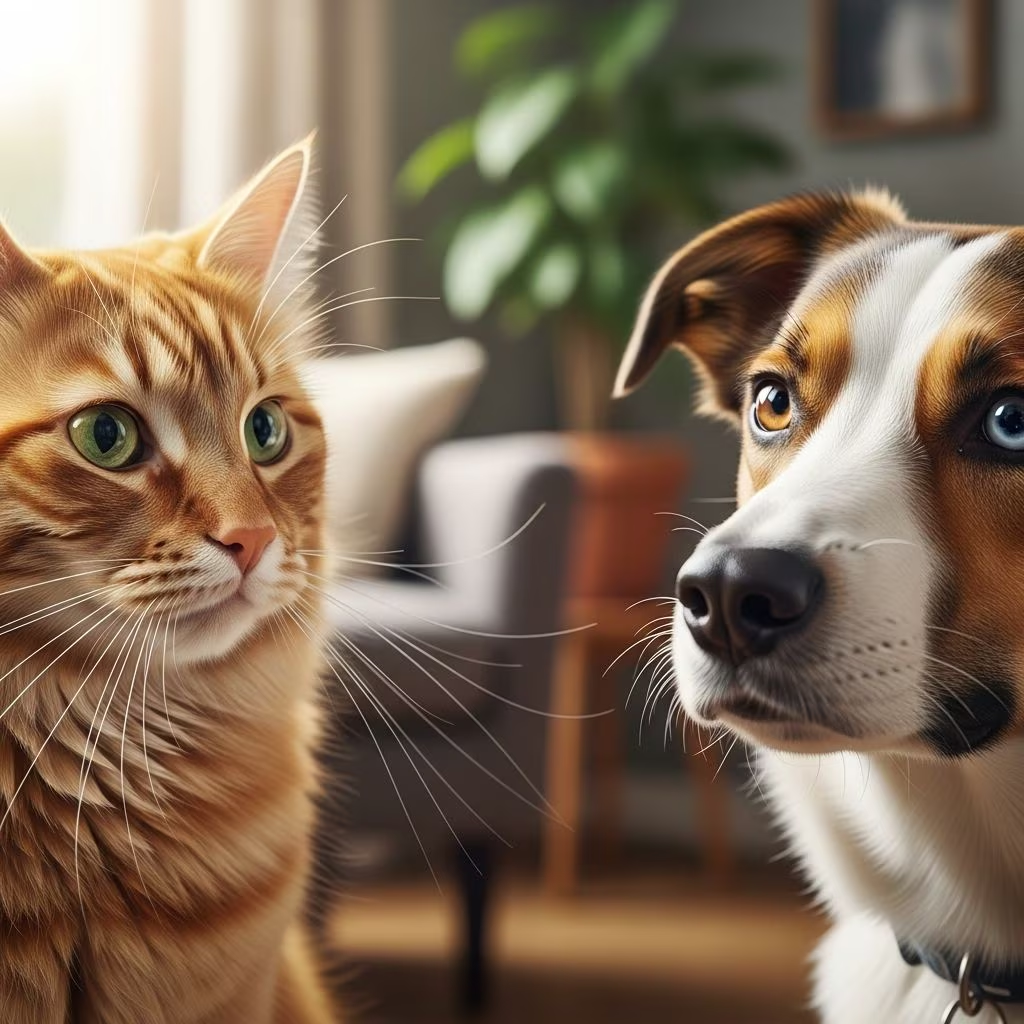
Many pet owners wonder whether their feline companions can genuinely understand the animals sharing their home. The question of cat comprehension extends beyond simple curiosity—it touches on how we manage multi-pet households, prevent conflicts, and foster positive relationships between different species. Research into animal communication reveals that cats do possess sophisticated mechanisms for interpreting signals from both other cats and canine housemates, though the effectiveness of this cross-species understanding depends heavily on context and individual experiences.
The Foundation of Animal Communication Systems
Before examining whether cats understand other animals, it’s essential to understand how communication works across species. Animals rely on multiple channels to convey information, each playing a distinct role in transmitting messages about emotional states, intentions, and boundaries. Rather than depending solely on one method, both cats and dogs employ an integrated approach that combines several communication modalities to ensure their messages are received and properly interpreted.
The primary communication channels include visual signals, which encompass body postures, facial expressions, ear positions, and tail movements. These visual cues form the foundation of how animals express themselves to one another. Vocal communication represents the second major channel, utilizing barks, meows, growls, hisses, and purrs to convey specific information. The third channel, olfactory communication, relies on scent marking through urine, feces, and glandular secretions—a sense that humans largely cannot perceive but plays a crucial role in animal-to-animal interaction.
How Cats Decode Feline Companions
When it comes to understanding other cats, felines have evolved sophisticated recognition systems that allow them to identify and interpret signals from their own species. Facial expressions and ear positioning serve as critical indicators of a cat’s emotional state and intentions toward another feline. Cats that genuinely enjoy each other’s company display characteristic facial patterns: their ears remain forward and alert, whiskers extend prominently forward, and they engage in slow blinking—a behavior that communicates trust and affection.
In contrast, cats experiencing tension or potential conflict show distinctly different facial configurations. Their ears rotate backward and flatten against their heads, pupils constrict noticeably, and facial muscles tense. This distinction becomes particularly important for understanding whether two cats in a household are bonding or developing antagonistic relationships. The ability to read these nuanced facial cues prevents misunderstandings that could escalate into conflict.
Inter-Cat Play and Social Recognition
One of the most telling demonstrations of cat-to-cat comprehension occurs during play interactions. When cats engage in playtime with other felines, they employ a series of nonverbal cues that signal playful intent rather than aggressive behavior. The cat initiating play typically approaches another cat and may engage in behaviors such as gentle tapping, rolling on their back in front of the potential playmate, or performing exaggerated play bows.
If the other cat reciprocates these signals—returning a tap, rolling back, or assuming a similar play posture—both animals understand that the interaction is social rather than confrontational. This mutual recognition allows for wrestling matches and chasing games that would appear aggressive to outside observers but are actually expressions of social bonding and enjoyment.
Key feline play signals include:
- Slow, deliberate approaches with relaxed body posture
- Gentle paw taps rather than swipes with extended claws
- Rolling onto the back while maintaining eye contact
- Ears held forward and relaxed
- Soft vocalizations such as chirps or quiet meows
- Play bows with the rear end elevated
Scent Communication Among Cats
Beyond visual and vocal signals, cats utilize scent marking extensively to communicate with other cats. This olfactory channel provides information about territorial boundaries, reproductive status, and individual identity. Cats possess specialized glands located on their cheeks, chin, flanks, and near their tail base that release pheromones unique to each individual. When cats rub their heads or bodies against each other, they’re not just showing affection—they’re exchanging identity information and creating shared scent profiles that strengthen social bonds.
The ability to interpret these scent messages allows cats to recognize familiar versus unfamiliar felines, understand another cat’s emotional state, and assess whether a newcomer poses a threat or offers an opportunity for social connection. This represents a sophisticated form of cat-to-cat communication that operates largely invisible to human observers.
Comprehending Canine Behavior: Where Understanding Breaks Down
While cats demonstrate clear comprehension of other cats, their ability to understand dogs proves considerably more complex. The fundamental challenge stems from the stark differences in how cats and dogs evolved to communicate. These species developed their signaling systems independently, resulting in behaviors that can appear contradictory or confusing when interpreted across species boundaries.
The Tail Position Paradox
Perhaps no animal signal creates more potential for misunderstanding than tail position. In dogs, a loose, wagging tail typically indicates friendliness, happiness, and a desire to engage. A cat observing this tail movement, however, encounters a visual message that appears identical to their own warning sign: a tail whipping rapidly back and forth, often held lower and more aggressively. For cats, this tail movement signals agitation, irritation, or preparation for confrontation.
A dog’s friendly tail wag can therefore trigger defensive or aggressive responses in cats who misinterpret the signal as a threat. This represents one of the most common sources of miscommunication between household dogs and cats, often leading to avoidance behaviors or conflict.
Greeting Rituals and Social Protocol
The way cats and dogs approach and greet one another reveals fundamental differences in their social protocols. When two cats encounter each other for the first time or after an absence, they typically engage in a nose-to-nose touch. This behavior allows them to exchange scent information and verify identity. The greeting is characteristically reserved and involves minimal physical contact beyond the nasal region.
Dogs, by contrast, approach greetings with considerably more enthusiasm and directness. Canine social protocol emphasizes nose-to-rear investigation, a practice that allows dogs to gather comprehensive scent information about another animal’s reproductive status, diet, and recent activities. For a cat unfamiliar with this canine greeting custom, a dog’s enthusiastic approach toward their rear end feels intrusive, disrespectful, and potentially threatening. Cats often interpret this as inappropriate behavior or even an attack, leading them to hiss, swat, or flee.
Vocalizations: A Tower of Babel
The vocal languages of cats and dogs have virtually no overlap in structure or meaning. Dogs bark—a sound cats do not produce—with different barks conveying different messages: alarm barking for intruders, play barking for social engagement, and distress barking for separation anxiety. Cats meow, a vocalization dogs rarely use and cannot easily interpret. Notably, cats have evolved their meowing primarily for human communication rather than cat-to-cat dialogue, further limiting dogs’ ability to understand this sound.
Where some cross-species vocal understanding does occur involves universal signals of distress. Both species recognize hisses, growls, and shrieks as warnings or expressions of pain and fear. The cat’s hiss appears to be particularly effective at communicating danger to dogs; research indicates that dogs find hissing intrinsically unpleasant and typically respond by retreating or increasing distance, demonstrating that dogs can indeed comprehend this feline warning signal.
Body Postures: Conflicting Messages
Specific body postures create significant potential for cross-species misunderstanding. When a dog rolls onto its back, this almost universally signals submission and friendliness—the dog is essentially saying, “I mean no harm and I trust you.” Rolling exposes the dog’s vulnerable abdomen, an act of trust and de-escalation.
When a cat assumes the identical posture—rolling onto their back—the message differs dramatically. A cat on its back is typically preparing for combat, not demonstrating trust. From this position, the cat can employ all four claws and their teeth in defense or attack. What appears to a dog as an invitation to friendly interaction actually represents a cat preparing for potential conflict. Similarly, a cat raising a paw often serves as a warning gesture, yet dogs may interpret this identical behavior as playful or attention-seeking, leading to a paw swipe rather than the positive interaction the dog anticipated.
Ear Signals and the Subtlety of Intent
One of the more subtle yet significant sources of miscommunication involves ear positioning. Cats hold their ears forward and upright when content and alert, but rotate them backward and flatten them against their heads when experiencing fear, stress, or aggression. Dogs show the opposite pattern: ears held back and flat indicate fear, while forward-standing ears signal alert interest or aggression.
Without knowledge of these inverse patterns, a dog might mistake a fearful cat for a content animal, or interpret an aggressive cat’s ear posture as fearfulness. This misreading of emotional state can lead dogs to approach when they should retreat, resulting in defensive cat behavior that the dog perceives as unprovoked aggression.
Building Bridges: Facilitating Inter-Species Understanding
Despite the inherent communication challenges between cats and dogs, many households successfully maintain peaceful and even affectionate relationships between these species. Understanding how to foster positive inter-species comprehension requires recognizing both what animals can intuitively understand and what requires careful management.
Universal Signals That Bridge Species
Certain communication elements transcend species boundaries and provide foundation points for mutual understanding:
- Soft eye contact and slow blinking: Both cats and dogs recognize this as a sign of non-threat and affection
- Gentle approach and relaxed body posture: Both species understand calm, non-threatening movement as positive
- Pain vocalizations and distress signals: Shrieks, yelps, and growls communicate fear or injury across species
- Allogrooming (mutual grooming): When cats and dogs groom each other, this represents one of the highest forms of affection and understanding
The Importance of Signal Intensity Recognition
Animals communicate with varying intensities depending on how strongly they need their message understood. A subtle ear rotation or whisker repositioning might convey a message effectively between two cats who share similar communication systems. The same subtle signal will likely be missed by a dog, who must rely on more obvious cues.
Recognizing these intensity levels helps pet owners intervene at appropriate moments. When animals display subtle distance-increasing signals—the feline equivalent of “please give me space”—intervention allows them to learn that their boundaries will be respected. Waiting until animals resort to obvious, aggressive signals means intervention occurs only after negative emotions have intensified, making aggressive behaviors more likely to escalate in future encounters.
Frequently Asked Questions
Can cats understand that dogs are different species?
Research suggests that cats recognize dogs as distinct creatures but interpret their behavior through their own communication framework. Cats may not conceptually understand “species” but rather recognize individual dogs as creatures with different behavioral patterns that require adjusted responses.
Do cats and dogs ever truly become friends?
Yes, though success depends on early exposure, individual temperament, and careful introduction. Cats and dogs that grow up together or are introduced slowly develop mutual understanding and may display genuine affection, including mutual grooming and comfortable shared resting spaces.
Why do some cats and dogs get along while others don’t?
Individual personalities, early socialization experiences, and prior negative encounters significantly influence compatibility. A dog raised with cats from puppyhood learns to interpret feline signals more accurately than a dog with no early exposure. Similarly, cats who encountered gentle dogs early in life develop different behavioral expectations than cats whose first encounter involved an aggressive canine.
How can I help my cat understand my dog better?
Slow introductions, separate spaces initially, monitoring early interactions, and rewarding calm behavior from both animals help establish positive associations. Teaching the dog to respond to training commands reduces unpredictable behavior that might frighten or confuse the cat.
Conclusion: Mutual Understanding as a Process
The question of whether cats understand dogs and other cats reveals that animal comprehension exists on a spectrum rather than as a simple yes-or-no answer. Cats clearly understand other cats through sophisticated visual, vocal, and olfactory systems refined through millennia of feline evolution. Understanding dogs presents greater challenges due to fundamentally different communication systems, yet successful cohabitation demonstrates that mutual comprehension can develop through exposure and experience.
The takeaway for pet owners is that creating harmonious multi-pet households requires actively facilitating understanding between species with different communication styles. By recognizing the signals each species uses, respecting individual boundaries, and allowing gradual relationship development, cats and dogs can move beyond mere coexistence toward genuine social bonds based on real, if imperfect, cross-species comprehension.
References
- How Cats And Dogs Communicate — Rover Time. Accessed January 29, 2026. https://www.rover-time.com/how-cats-and-dogs-communicate/
- Learn to Speak Dog and Cat: Step 1 to a Better Relationship — Insightful Animals. Accessed January 29, 2026. https://insightfulanimals.substack.com/p/decoding-your-pets-body-language
- The Ultimate Guide to Cats and Dogs Living Together — Freak On A Leash Dog Training. Accessed January 29, 2026. https://freakonaleashdogtraining.com/when-two-worlds-collide-cats-and-dogs/
- How Do Dogs & Cats Communicate With Us? Expert Insights — VetTech Colleges. Accessed January 29, 2026. https://www.vettechcolleges.com/blog/pet-communication-and-behavior
- Understanding Your Pet’s Body Language: What Cats and Dogs Are Really Saying — Animal Medical Center of New York. August 6, 2025. https://www.amcny.org/blog/2025/08/06/understanding-your-pets-body-language-what-cats-and-dogs-are-really-saying/



