

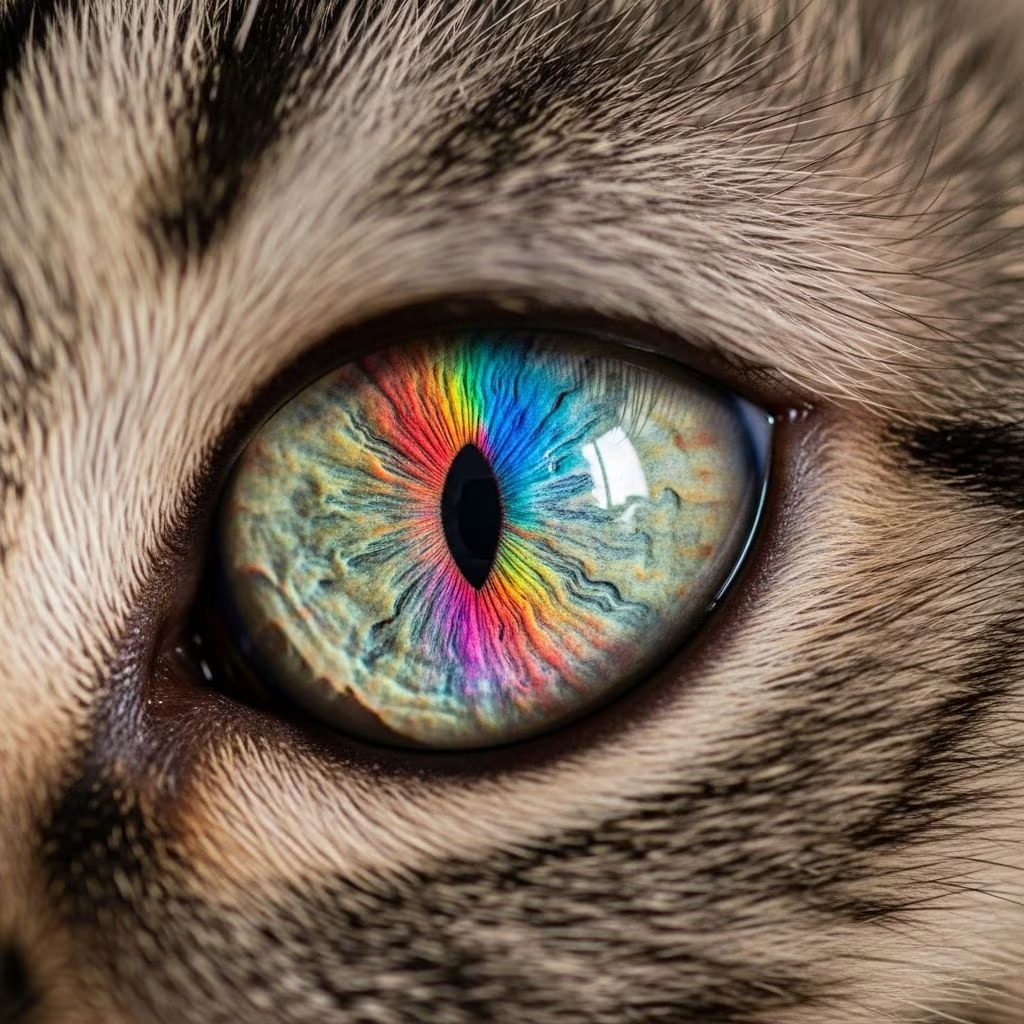
Cats perceive the world through a dichromatic lens, primarily distinguishing blues and greens while struggling with reds, which often appear as muted grays. This unique visual system, evolved for nocturnal hunting, prioritizes motion detection and low-light performance over the vibrant spectrum humans enjoy.
The Building Blocks of Feline Eyesight
At the heart of cat vision lies the retina, lined with photoreceptor cells: rods for dim light and motion, and cones for color and detail. Felines boast far more rods than cones compared to humans, granting them superior twilight vision but a narrower color range. Human retinas feature three cone types sensitive to red, green, and blue wavelengths, enabling trichromatic sight; cats manage with just two, tuned to blue-violet (around 460 nm) and yellow-green (around 560 nm).
This setup renders a cat’s world in pastel tones. Blues pop vividly, greens hold clarity, but reds and oranges blend into shadowy browns or grays. A 2016 behavioral study confirmed this by testing domestic cats with LED lights: they flawlessly differentiated wavelengths from 456-497 nm and 510-524 nm but hit a neutral point at 505 nm, where colors indistinguishable from white light proved their dichromatic nature.
How Cats Excel in the Dark
Beyond color, cats dominate low-light environments. Their eyes require only one-sixth the illumination humans need, thanks to abundant rods and a reflective tapetum lucidum layer behind the retina. This “mirror” bounces missed photons back for a second chance at detection, amplifying faint light and creating that eerie eyeshine.
Pupils expand to near-full dilation in darkness, corneas are larger relative to eye size, and rod density peaks in the central retina. Result? Cats spot subtle movements—like a scurrying mouse—at dusk when humans see mere shadows. Field of view spans 200 degrees versus our 180, aiding peripheral threat scanning.
Comparing Cat and Human Vision
| Aspect | Humans | Cats |
|---|---|---|
| Cone Types | 3 (Red, Green, Blue) | 2 (Blue-Violet, Yellow-Green) |
| Color Range | Full spectrum | Muted blues, greens, grays |
| Low-Light Sensitivity | Requires 6x more light | Excels in 1/6th human light levels |
| Visual Acuity | Sharper detail (20/20 equivalent) | Blurry at distance (20/100-20/200) |
| Field of View | 180-200° | ~200° |
| Motion Detection | Good | Superior, especially peripheral |
This table highlights trade-offs: cats sacrifice color richness and fine detail for predatory edges in dim conditions.
Decoding the Feline Color Palette
- Blues and Violets: Most vibrant; cats discern shades effortlessly, mirroring human protanopia where these hues dominate.
- Greens: Visible but muted; some studies note greenish-yellow sensitivity around 500-520 nm, though not a third cone.
- Yellows: Detectable, akin to dogs, blending into their yellow-green cone response.
- Reds and Oranges: Fade to dark grays or browns; a red laser toy might register as shadowy movement only.
- Purples and Pinks: Appear blue-ish or gray; lacking red sensitivity confuses these.
Neutral point testing solidifies this: at 505 nm (cyan-green), monochromatic lights matched white, invisible to color discrimination. Unlike debated trichromacy claims, rigorous designs eliminated brightness cues, affirming dichromacy.
Evolutionary Roots of Cat Sight
Cats descended as crepuscular hunters, active at dawn and dusk when prey stirs. Vision optimized for these hours: high rod count for silhouettes against twilight skies, dual cones for enough contrast to stalk without alerting colorful birds or rodents. Limited cones conserve energy for rod dominance, irrelevant for monochromatic night hunts.
Domestic cats retain wild ancestors’ traits. Siamese breeds show minor variations, but core dichromacy holds across felines. This parallels human deuternopes (green-weak), positioning cats as models for color vision deficiencies.
Practical Tips for Cat Owners
Understanding vision informs enrichment. Opt for blue, green toys—they stand out, boosting play. Avoid red-only items; pair with motion or bells for visibility via rods. Vertical spaces leverage wide fields; low-light zones mimic natural prowls.
Health checks matter: cloudiness signals cataracts, common in seniors; tearing hints infections. Annual vet exams catch issues early, preserving sight. Laser pointers amuse but frustrate—cats chase invisible dots, risking stress.
Myths and Misconceptions Busted
- Cats see only black and white: False; dichromatic means two colors, not none.
- Perfect night vision: No true night sight; enhanced dim-light only—no infrared.
- Trichromatic like humans: Overlapping medium-wavelength hints debunked by neutral point tests.
- Blind as bats by day: Day vision suffices, just blurrier afar.
FAQs on Feline Vision
Can cats see TV?
Partially; fast frames blur for their motion bias, colors muted. High-contrast cartoons engage more.
Do all cats see identically?
Mostly; breeds vary slightly, but dichromacy universal.
Why do cats’ eyes glow?
Tapetum lucidum reflects light, aiding low-light rods.
Improve cat vision indoors?
Natural light, blue/green toys, perches for 200° views.
Age-related vision loss?
Common; cataracts dim colors further—vet antioxidants help.
Enhancing Your Cat’s Visual World
Simulate hunts: feather wands in blues, shadow play at dusk. Multi-level trees exploit fields; dimmable lights match crepuscular peaks. Track behavior: hesitation at reds? Swap colors. Science-backed tweaks yield happier, active cats.
Future research probes cone genetics, potentially breed-specific tweaks. For now, respect their palette: prioritize blues, motion, night prowess over rainbows.
References
- Neutral point testing of color vision in the domestic cat — PubMed/NCBI. 2016-10-11. https://pubmed.ncbi.nlm.nih.gov/27720709/
- Can Cats See Color? — Purina. Accessed 2026. https://www.purina.com/articles/cat/behavior/understanding-cats/can-cats-see-color
- Cat Vision: How Do They See the World? — Hill’s Pet Nutrition. Accessed 2026. https://www.hillspet.com/cat-care/behavior-appearance/cat-vision
- Discovering the Colors that Cats and Dogs See — Assil Eye Institute. Accessed 2026. https://assileye.com/blog/colors-that-cats-and-dogs-see/
- Cat Eyes: A Fascinating Look at Feline Vision — Fulton County Vet Clinic. Accessed 2026. https://fultoncountyvetclinic.com/blog/cat-eyes/



