

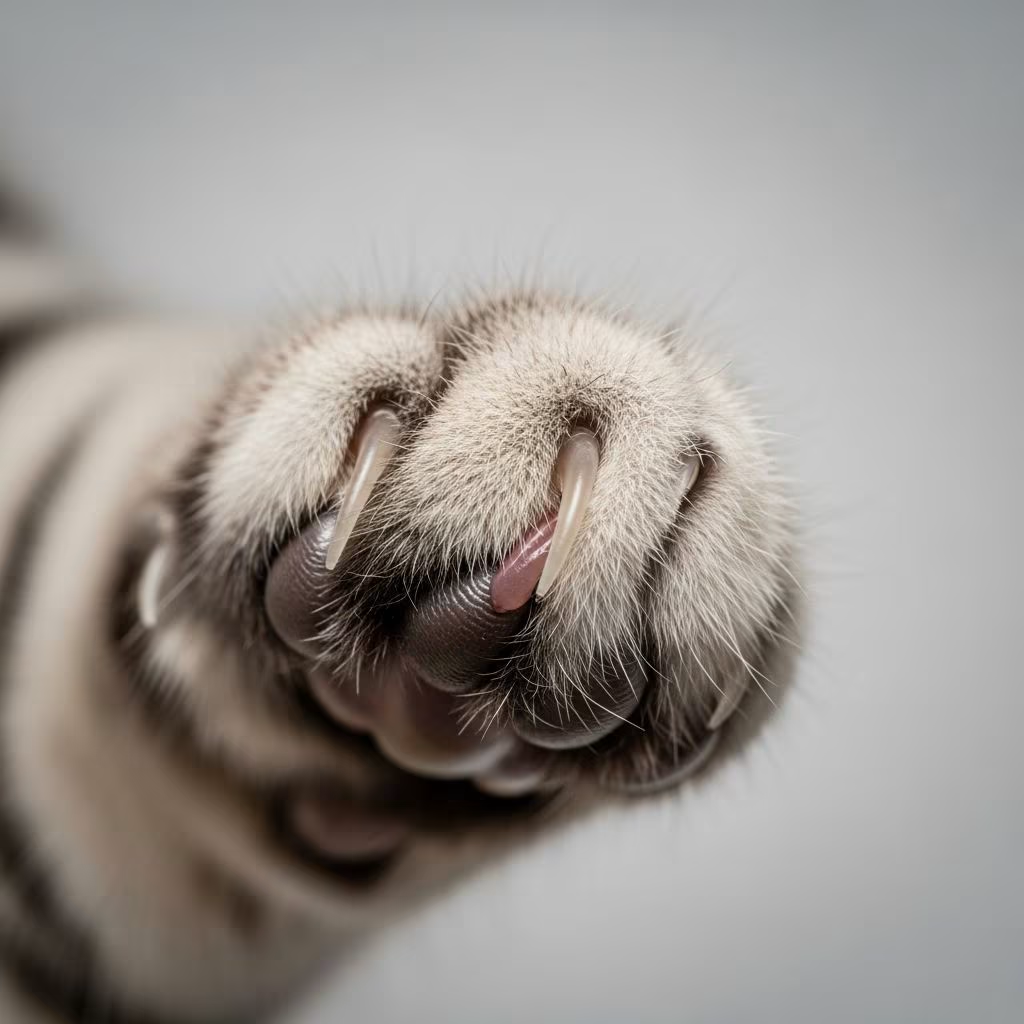
Cat claws represent a pinnacle of evolutionary design, serving as versatile instruments for survival and daily activities. Composed primarily of keratin, these structures enable precise movements while remaining protected when not in use. This article delves into their composition, operational mechanics, biological purposes, and maintenance strategies.
The Building Blocks of Feline Claws
At their core, cat claws consist of keratin, a durable protein also found in human nails, hair, and animal hooves. This material forms layered sheaths that grow continuously from the underlying quick—a vascularized tissue rich in blood vessels and nerves. Unlike flat human nails, feline claws curve sharply, encasing the quick in a tapered form that ensures lethality and durability.
The growth process relies on nutrients from the quick, allowing claws to renew outer layers periodically. This shedding, often visible as translucent husks near scratching posts, maintains sharpness without compromising the claw’s integrity. Front paws typically feature five claws, including a dewclaw, while hind paws have four, adapting to specialized roles.
| Claw Location | Number per Paw | Key Adaptations |
|---|---|---|
| Front Paws | 5 (incl. dewclaw) | Highly curved, razor-sharp for gripping prey |
| Hind Paws | 4 | Straighter, suited for propulsion and balance |
Mechanics of Extension and Retraction
The retractable nature of cat claws distinguishes them from canine counterparts, relying on a sophisticated interplay of bones, tendons, ligaments, and muscles. Each claw anchors to the distal phalanx, the terminal toe bone, forming a hinge-like system.
Extension occurs when the deep digital flexor tendon contracts, pulling the distal phalanx forward. This action, powered by flexor muscles in the foreleg, unsheathes the claw instantaneously, akin to drawing a blade. Conversely, retraction is passive: dorsal elastic ligaments draw the bone backward, nestling the claw into a protective skin fold amid paw fur. This default retracted state preserves sharpness by minimizing ground contact during walking or running.
- Flexor Tendon Activation: Tightens to protract claw for action.
- Elastic Ligament Pull: Relaxes muscles to sheath claw safely.
- Muscle Relaxation: Allows natural return to protected position.
Observing this in action is straightforward—gently compress a relaxed paw pad to trigger extension, revealing the fluid motion firsthand.
Biological Imperative: Why Retraction Matters
Retraction evolved as a survival adaptation for felids. Keratin claws, though tough, are slender and prone to fracture if constantly exposed. Damage near the quick causes significant pain and bleeding, impairing hunting efficacy. By elevating claws off surfaces, cats achieve silent stalking, crucial for ambush predation.
This mechanism also facilitates digitigrade locomotion—walking on toes—which enhances agility for leaping and climbing. The dewclaw on front paws provides extra grip, while the carpal pad acts as a shock absorber during high-speed descents.
Multifaceted Roles in Feline Life
Hunting and Predation
Claws are primary weapons, enabling cats to seize, hold, and dispatch prey. Their curve secures struggling quarry, while retraction ensures prolonged sharpness for repeated strikes. In domestic settings, this instinct manifests in play-hunting toys.
Defense and Combat
Facing threats, cats deploy claws for slashing and grappling. Retraction prevents self-injury during non-combat movement, balancing offense with mobility.
Climbing and Navigation
Front claws dig into bark or fabric for ascent, with hind claws providing thrust. This prowess allows access to elevated safe havens.
Territorial Marking and Grooming
Scratching posts deposit scent glands from paw pads, delineating territory. The action simultaneously exfoliates outer keratin layers, honing edges. Claws aid in fur grooming, removing debris and parasites.
Claw Health Indicators and Challenges
Healthy claws are smooth, sharp, and free of discoloration. Overgrowth signals insufficient scratching opportunities, leading to curvature or embedding. Conversely, brittle claws may indicate nutritional deficiencies like poor protein intake.
Common issues include:
- Split or Torn Claws: From rough surfaces; monitor for infection.
- Quick Exposure: Bleeding requires cleaning and veterinary assessment.
- Non-Retraction: Possible tendon injury; professional evaluation needed.
Polydactyl cats, with extra toes, demand vigilant monitoring to prevent overgrown hidden claws.
Optimal Care Routines for Cat Owners
Supporting natural behaviors prevents most problems. Provide diverse scratchers—sisal, cardboard, wood—to match preferences and encourage use. Rotate options to sustain interest.
Trimming, when necessary, targets the translucent tip beyond the quick. Use cat-specific clippers, rewarding cooperation. Frequency varies: active outdoor cats may need less intervention than indoors ones.
- Acclimate with treats near tools.
- Press paw gently to extend claw.
- Clip small amounts, avoiding pink quick.
- Praise profusely post-session.
For seniors or declawed cats (not recommended due to welfare concerns), soft pads and mobility aids compensate. Regular vet checks ensure tendon health and early issue detection.
Comparative Insights: Cats vs. Other Animals
Unlike dogs’ non-retractable claws for traction, feline versions prioritize precision. Big cats mirror domestics, underscoring shared ancestry. Birds’ talons and bear claws offer parallels in keratin durability but lack retraction finesse.
Frequently Asked Questions
Do cat claws fully retract into the paw?
No, they tuck into skin folds and fur, remaining partially visible but protected.
How often should I trim my cat’s claws?
Every 4-6 weeks for indoor cats; less for outdoor ones with natural wear.
Why do cats scratch furniture?
To mark territory, sharpen claws, and stretch muscles—a innate drive.
Is declawing safe for cats?
Veterinary consensus opposes it; it causes chronic pain and behavioral issues.
Can broken claws heal on their own?
Yes, if not into the quick; clean and monitor, seeking vet care for deep injuries.
Advanced Anatomy: Tendons and Ligaments in Detail
The superficial and deep digital flexor tendons orchestrate movement. The former links atop the distal phalanx, the latter beneath, creating pivot action. Forearm extensors and flexors amplify force, while ligaments provide elastic recoil.
This system’s efficiency minimizes energy use: active protraction, passive sheathing. Peer-reviewed analysis confirms ligaments, not extensors, drive retraction, enabling wrist flexion sans protrusion.
Evolutionary Perspective
Felid claws trace to arboreal ancestors, refining for terrestrial predation. Unique phalange shapes facilitate mechanics absent in other carnivores. Modern domestics retain this legacy, adapting to homes via scratching enrichment.
References
- How Do Cat Claws Work? How They Come Out & Retract — Catster. 2023. https://www.catster.com/ask-the-vet/how-do-cat-claws-work/
- How to Support Your Cat’s Normal Scratching Behavior — TVMF. 2024. https://www.tvmf.org/articles/feline-scratching-behavior/
- How Does a Cat Use Their Claws & Why Are They So Sharp? — YouTube (Video Transcript). 2023. https://www.youtube.com/watch?v=kOHHKmo9ph8
- Cat Claws: The Complete Guide to Natural Care & Health — Best Life 4 Pets. 2024. https://www.bestlife4pets.com/blogs/pet-blog-tips/cat-claws
- Understanding Cat and Dog Claw Anatomy and Their Essential Uses — Pet Nation Omaha. 2024-10-15. https://www.petnationomaha.com/blog/understanding-cat-and-dog-claw-anatomy-and-their-essential-uses-20241015
- Claws — Cats Fandom Wiki. 2024. https://cats.fandom.com/wiki/Claws
- The form and function of retractile claws in the Felidae — PubMed (Peer-Reviewed). 1975. https://pubmed.ncbi.nlm.nih.gov/1127699/



