

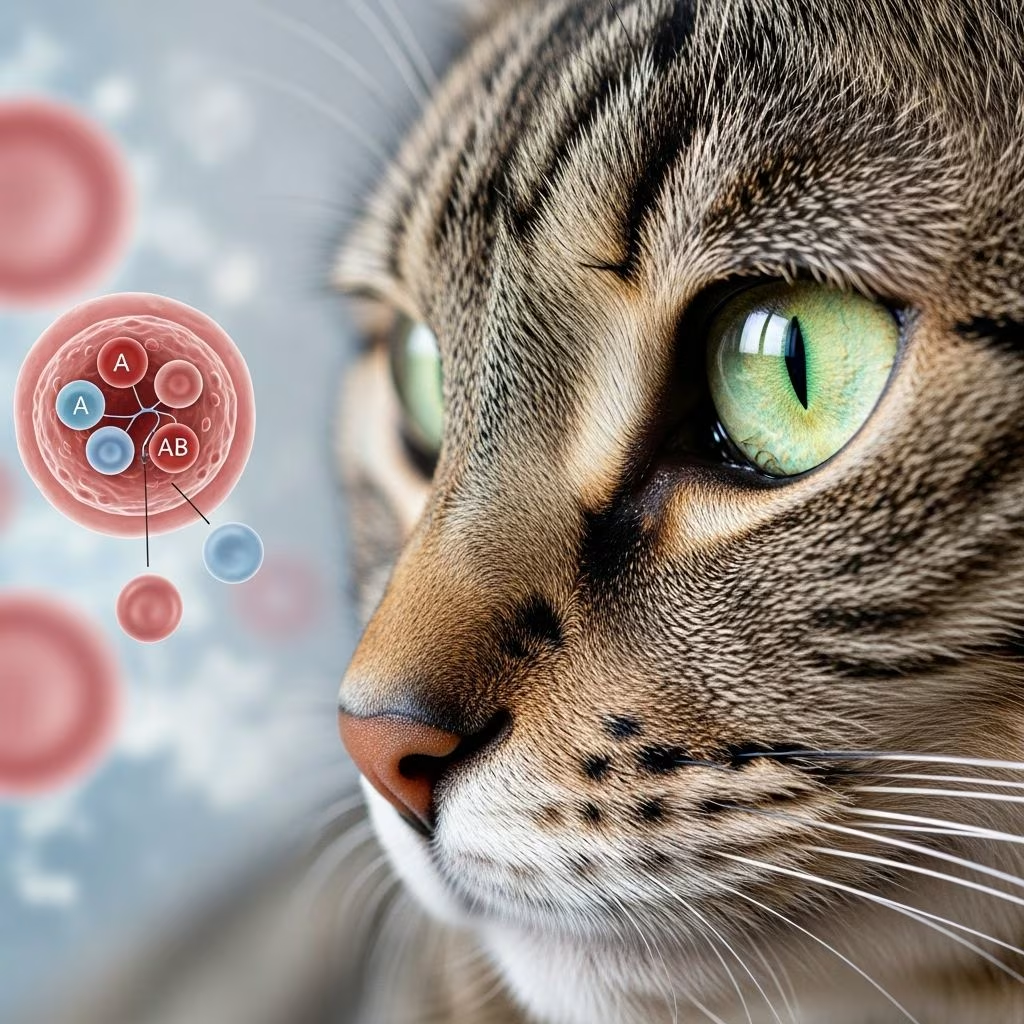
Understanding blood types in cats is crucial for veterinary care, especially in emergencies involving transfusions or breeding programs. Cats primarily have three blood groups—A, B, and the rare AB—determined by specific antigens on red blood cells. These groups influence compatibility for blood donations and can lead to severe complications if mismatched.
The Science Behind Feline Blood Groups
Feline blood types are governed by the AB blood group system, where antigens like NeuGc and NeuAc on red blood cells define the categories. Type A cats feature mostly NeuGc with minor NeuAc, type B cats have only NeuAc, and type AB shows low levels of both due to reduced CMAH enzyme activity. Unlike humans, cats naturally produce antibodies against non-matching types without prior exposure, making mismatches immediately dangerous.
The genetics involve three alleles: N (for A, dominant), c (for AB), and b# (variants b1, b2, b3 for B). Dominance order is A > c > b, with homozygous b#/b# yielding type B, c/c or c/b# producing AB, and N/N or N/carrier as type A.
Blood Type Distribution Across Populations
Type A dominates globally, comprising 72-86% of cats depending on region. In American and Asian breeds, A reaches 84-86%, while European (76%) and Oceanian (72%) breeds show higher B frequencies at 21-27%. In the US, A is about 99% in some populations, but B rises to over 25% in Australia.
Non-pedigree cats in areas like Beijing show 88.2% A, 11.4% B, and 0.4% AB.
Breed-Specific Blood Type Patterns
Certain breeds exhibit elevated B or AB frequencies, guiding breeders in mate selection. Below is a table summarizing key breeds and their approximate B/AB prevalences based on studies:
| Breed | Primary Type | B Frequency | AB Notes |
|---|---|---|---|
| American Curl | A | High (>30%) | Rare |
| Cornish Rex | A | High (>30%) | Rare |
| Devon Rex | A | High (>30%) | Rare |
| Ragdoll | A | Low-Moderate | Present (c allele) |
| European Shorthair | A | Moderate | Observed |
| RagaMuffin | A | Low | Observed |
| Scottish Fold | A | Low | Observed |
Pedigree breeds from Europe often have higher B rates, while AB appears sporadically in Ragdolls and random-bred cats.
Transfusion Compatibility Essentials
Matching blood types prevents hemolytic reactions. Type A cats have low anti-B antibodies; type B has strong anti-A; AB lacks both, acting as universal recipients but poor donors. A single mismatch can cause rapid red cell destruction, shock, or death—no sensitization needed.
- Type A donor: Safe for A or AB recipients.
- Type B donor: Only for B recipients.
- Type AB donor: Risky; prefer typed matches.
- Universal recipient: AB (no antibodies).
Vets must type cats before any transfusion, using clinic tests or labs like UC Davis for DNA confirmation.
Genetic Testing for Blood Types
DNA tests detect b# (B) and c (AB) alleles, reporting N for typical A. Genotypes predict phenotypes:
- N/N: Type A
- N/b#: A carrier (B risk)
- N/c: A carrier (AB risk)
- c/c: AB
- c/b#: AB carrier B
- b#/b#: B
Rare unknown alleles may lead to discrepancies, but tests enable early screening for breeders.
Neonatal Isoerythrolysis: A Breeding Hazard
NI occurs when a type B queen (high anti-A antibodies) mates with A or AB tom, producing A/AB kittens. Colostrum antibodies destroy kitten red cells, causing anemia, jaundice, or death within days.
Prevention:
- Test queens and toms pre-breeding.
- Avoid B queen x A/AB tom matings.
- Milk replacer for at-risk litters first 24 hours.
- Monitor kittens closely.
Breeds with high B need vigilant typing.
Rare Types: AB and Mik
AB is scarce (<1% overall), more in specific breeds, with no anti-A/B antibodies. Mik, a fourth group, is minimally reported, identified in few studies.
Practical Testing and Veterinary Protocols
Blood typing uses agglutination cards or PCR for DNA. Labs like VGL UC Davis offer breed-specific panels ($44/test). Recent guidelines (2024-2025) stress pre-transfusion typing.
For emergencies, type A is default donor in A-dominant areas, but cross-matching advised.
FAQs on Cat Blood Types
What are the main cat blood types?
A, B, and rare AB. A is dominant worldwide.
Why test my cat’s blood type?
Essential for safe transfusions and breeding to prevent NI.
Can I breed a type B queen?
Yes, but only with type B toms to avoid NI.
Is AB a universal donor?
No—universal recipient; lacks antibodies but has both antigens.
How common is type B in my breed?
Check breed data; high in Rex breeds, low in most US cats.
Key Takeaways for Owners and Breeders
Proactive typing safeguards health. With rising pedigree breeding, awareness of regional/breed variations prevents tragedies. Consult vets for testing.
References
- AB Blood Group in Domestic Cat Breeds — Veterinary Genetics Laboratory, UC Davis. 2023. https://vgl.ucdavis.edu/test/bloodgroup-cat
- Understanding Feline Blood Types — Wisdom Panel. 2023. https://www.wisdompanel.com/en-us/blog/understanding-feline-blood-types
- Blood Groups and Blood Incompatibility in Cats — International Cat Care. 2025-03-14. https://icatcare.org/articles/blood-groups-and-blood-incompatibility-in-cats
- Feline Blood Groups: A Systematic Review — PMC/NCBI (Peer-reviewed). 2021. https://pmc.ncbi.nlm.nih.gov/articles/PMC8698024/
- Feline Blood Typing — Pet Blood Bank UK. 2023. https://www.petbloodbankuk.org/vet-professionals/i-need-advice/blood-typing/feline-blood-typing/
- Blood Groups and Blood Transfusions in Cats — MSD Veterinary Manual. 2023. https://www.msdvetmanual.com/cat-owners/blood-disorders-of-cats/blood-groups-and-blood-transfusions-in-cats



