

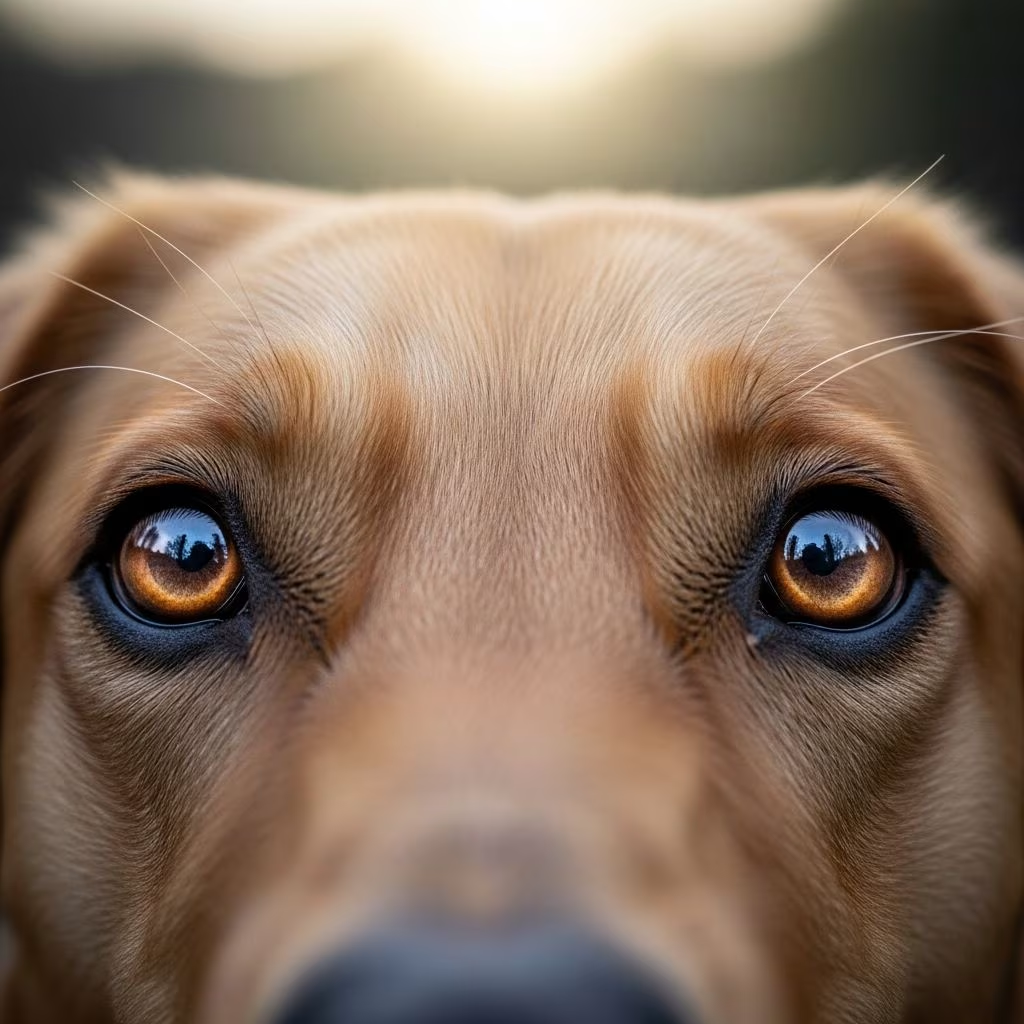
Dogs experience the world through a unique visual system finely tuned for their predatory and social needs. Unlike human eyes, canine eyes prioritize motion detection and low-light performance over color detail and sharp distance vision. This article delves into the structure of dog eyes, their functional adaptations, prevalent health concerns, and practical maintenance strategies.
Fundamental Components of the Dog Eye
The canine eye operates as a sophisticated optical instrument, comprising multiple layers and structures that work in harmony to capture and process light. At its core, the eye forms a spherical structure protected within the bony orbit, which houses muscles, nerves, and glands essential for movement and lubrication.
The outermost layer includes the **sclera**, a durable white fibrous coat that encases most of the eyeball, providing structural integrity. Continuous with the sclera is the **cornea**, a transparent dome at the front that not only shields the inner eye but also refracts light to initiate focusing. Covering the sclera and lining the eyelids is the **conjunctiva**, a thin mucous membrane that keeps the surface moist and combats infections.
- Sclera: Tough outer shell, often visible as the eye’s white.
- Cornea: Clear front window for light entry and initial bending.
- Conjunctiva: Protective inner lining prone to inflammation from irritants.
Internally, the **uveal tract** forms the middle vascular layer, consisting of the iris, ciliary body, and choroid. The **iris**, the colored portion surrounding the pupil, regulates light intake via sphincter and dilator muscles. Parasympathetic signals constrict the pupil in bright conditions, while sympathetic ones dilate it in dim light.
Inner Workings: Lens, Retina, and Fluid Chambers
Behind the iris lies the **lens**, a flexible structure that fine-tunes focus by altering shape through ciliary muscle action. Dogs have more limited accommodation than humans, excelling at near-to-mid-range clarity suited to hunting. Light passes through to the **retina**, the neurosensory lining packed with photoreceptors: rods for low-light and motion sensitivity, and fewer cones for color discernment.
Dogs possess a **tapetum lucidum**, a reflective layer behind the retina absent in humans, enhancing night vision by bouncing light back to photoreceptors. The retina’s **area centralis** serves as the high-acuity zone, akin to the human fovea but less specialized for fine detail.
| Structure | Function in Dogs | Human Comparison |
|---|---|---|
| Lens | Limited shape change for mid-range focus | Greater accommodation for near/far |
| Retina (Rods/Cones) | More rods for motion/low light | More cones for color/sharpness |
| Tapetum Lucidum | Reflects light for night vision | Absent |
Two fluid-filled chambers maintain shape: the anterior (aqueous humor) nourishes front structures, while the posterior (vitreous humor) supports the retina and lens.
Lacrimal System and Eyelid Dynamics
Healthy vision demands constant moisture from the tear film, a tri-layered coating of aqueous (from lacrimal glands), lipid (from meibomian glands), and mucus (from goblet cells). This film prevents evaporation, lubricates, and fights microbes. Tears drain via nasolacrimal ducts into the nasal cavity.
Eyelids, powered by the orbicularis oculi muscle, facilitate blinking to spread tears evenly. Many breeds suffer conformational flaws like ectropion or entropion, impairing blink efficiency and fostering dry eye or ulcers. Notably, dogs feature a **third eyelid** (nictitating membrane) at the medial canthus, offering extra protection and debris clearance; it protrudes during illness or anesthesia.
How Dogs Perceive the World
Canine vision emphasizes survival: superior motion detection via rod dominance and larger pupils, dichromatic color vision (blue-yellow spectrum), and a 240-250 degree field versus humans’ 200 degrees. They detect flickering lights faster, aiding pursuits, but struggle with fine print or red-green hues.
Puppies’ eyes open around 10-14 days, maturing fully by 6-8 weeks. Vision stabilizes as the retina develops, though lifelong adaptations like the tapetum enhance performance.
Common Ocular Afflictions in Dogs
Breeds like Bulldogs, Pugs, and Shih Tzus face heightened risks due to brachycephalic features promoting exposure and lagophthalmos (incomplete lid closure). Frequent issues include:
- Cherry Eye: Prolapsed third eyelid gland, common in young dogs; surgical tacking often resolves.
- Corneal Ulcers: Scratches exposing stroma; fluorescein staining reveals defects.
- Dry Eye (Keratoconjunctivitis Sicca): Insufficient tears causing pain and pigmentation.
- Cataracts: Lens opacities, hereditary in breeds like Labradors; early surgery restores sight.
- Glaucoma: Elevated intraocular pressure damaging the optic nerve; acute pain requires immediate intervention.
Trauma from play or allergens triggers conjunctivitis, while systemic diseases like diabetes accelerate cataracts.
Spotting Trouble: Symptoms and When to Act
Owners should monitor for redness, squinting, discharge, cloudiness, or behavioral shifts like hesitancy on stairs. A healthy eye appears clear, moist, and symmetrical. Routine checks during grooming reveal issues early.
For diagnostics, vets use tonometry for pressure, Schirmer tear tests, and ophthalmoscopy. Prompt care prevents blindness; for instance, untreated ulcers deepen rapidly.
Preventive Measures for Lifelong Eye Wellness
Daily wiping with saline cleans debris. Protect from UV with dog goggles during hikes. Balanced diets rich in antioxidants (vitamins A, C, E) bolster retinal health. Avoid irritants like smoke.
Annual vet exams catch breed predispositions. For at-risk breeds, lubricate with artificial tears. Neutering may reduce some hormonal influences on dry eye.
Breed-Specific Vulnerabilities
| Breed Group | Common Issues | Management Tips |
|---|---|---|
| Brachycephalic (e.g., Pug) | Ulcers, dry eye, entropion | Topical lubricants, surgery if needed |
| Hunting (e.g., Labrador) | Cataracts, PRA | Genetic screening, early detection |
| Sighthounds (e.g., Greyhound) | Glaucoma, retinal atrophy | Regular pressure checks |
Advanced Care and Innovations
Recent advancements include anti-VEGF injections for vascular issues and gene therapies for inherited blindness like progressive retinal atrophy (PRA). Stem cell treatments show promise for corneal repairs.
Frequently Asked Questions
Why do dogs have a third eyelid?
It protects the eye during rapid head movements and aids in tear distribution, becoming visible in illness.
Can dogs see in complete darkness?
No, but their tapetum and rods enable superior low-light vision compared to humans.
How often should I check my dog’s eyes?
Weekly during grooming, with professional exams biannually or more for seniors.
Is blue eye color linked to vision problems?
In breeds like Huskies, it’s genetic (merle dilution) and may correlate with higher deafness or eye defects risks.
What home remedies soothe irritated eyes?
Sterile saline rinses; avoid human drops. Consult a vet for persistent issues.
References
- Understanding the anatomy of the eye (cats and dogs) — Dechra UK. Accessed 2026. https://www.dechra.co.uk/companion-animal/ophthalmology/anatomy-of-the-eye
- Eye Structure and Function in Dogs — MSD Veterinary Manual. Accessed 2026. https://www.msdvetmanual.com/dog-owners/eye-disorders-of-dogs/eye-structure-and-function-in-dogs
- Dog Vision and Eye Anatomy: How Dogs See — PetMD. Accessed 2026. https://www.petmd.com/dog/general-health/how-do-dogs-see-world
- Dogs Eye Anatomy: Everything You Need To Know About Them — Zigzag.dog. Accessed 2026. https://zigzag.dog/en-us/blog/puppy-health/new-puppy-health/dog-eye-anatomy/
- The Eye — PMC (PubMed Central). 2020-05-26. https://pmc.ncbi.nlm.nih.gov/articles/PMC7271175/
- Structure of the Canine Eye — Whole Dog Journal. Accessed 2026. https://www.whole-dog-journal.com/health/structure-of-the-canine-eye/



