

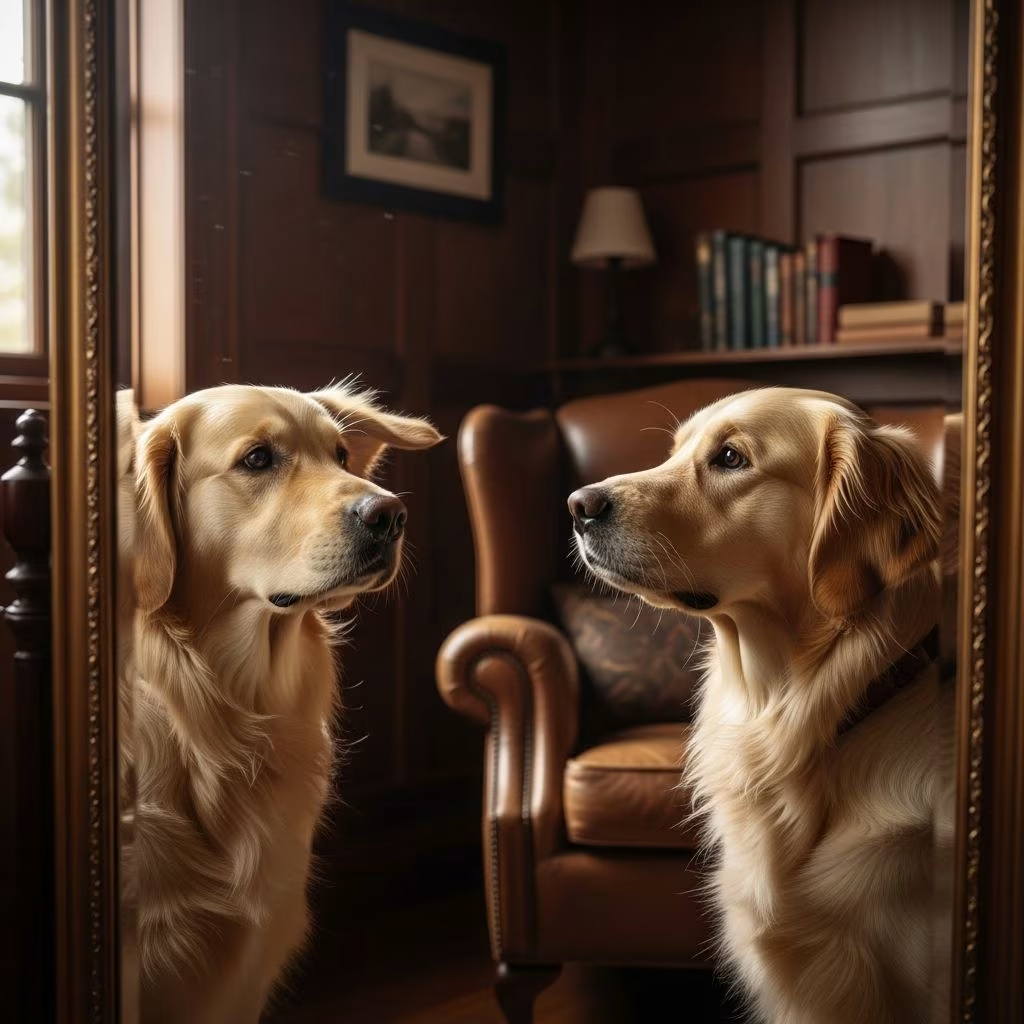
The question of whether dogs can recognize themselves in mirrors has fascinated pet owners and scientists alike for decades. While the answer is more nuanced than a simple yes or no, recent research reveals that dogs possess forms of self-awareness that differ fundamentally from human self-recognition. Understanding these differences helps pet owners appreciate their dogs’ intelligence on their own terms rather than through human-centered measures.
The Traditional Mirror Test and Why Dogs Fail
The mirror test, formally known as the mark test or self-recognition test, was developed by psychologist Gordon Gallup Jr. to measure self-awareness in animals. In this classic experiment, researchers place a mark on an animal’s body in a location the animal cannot see without a mirror. If the animal touches or examines the mark while looking in the mirror, researchers interpret this as evidence of self-recognition and self-awareness.
Several species have successfully passed this visual test, including great apes, dolphins, elephants, and magpies. Dogs, however, consistently fail the mirror test. Most dogs respond to their reflection as if encountering another dog, displaying behaviors such as barking, tail wagging, playful posturing, or sniffing around with curiosity. After initial interest, many dogs eventually lose interest in the mirror entirely.
This failure might seem to suggest dogs lack self-awareness, but this interpretation overlooks a critical biological reality: dogs rely on entirely different sensory systems to navigate the world compared to humans.
Why Vision-Based Testing Fails Dogs
The primary limitation of the mirror test when applied to dogs involves a fundamental mismatch between the test and canine sensory biology. Dogs do not rely primarily on vision to understand themselves or their environment. Instead, their world is dominated by olfaction—scent—followed by hearing. Vision ranks as only the third-strongest sense for most dogs.
When a dog looks into a mirror, they see a visual image, but critically, that image produces no scent cues. A mirror reflection also fails to exhibit the behavioral responses of a real dog, such as movement patterns or social signals that might reinforce the image as another animal. This sensory disconnect creates confusion rather than recognition. The dog’s initial response—barking, wagging, or investigating—may reflect social instincts triggered by the appearance of another dog, not a failure to understand the reflection.
Additionally, unlike humans who develop familiarity with mirrors early in life and use visual feedback as a foundational component of self-awareness, most dogs have limited exposure to mirrors in natural settings. Without early habituation and without the scent information their brains expect, the mirror remains a puzzling object rather than a tool for self-examination.
Olfactory Evidence of Self-Recognition
Research has revealed that when self-recognition testing is adapted to match canine sensory strengths, dogs demonstrate clear evidence of self-awareness. Scientists have developed what researchers call an “olfactory mirror” test, which exploits the dog’s natural reliance on scent.
In this innovative approach, dogs are presented with various canisters containing different odorous stimuli. The critical test involves presenting the dog with their own urine—an olfactory image of themselves—alongside versions where the odor has been modified by adding another scent. Researchers measure how long dogs investigate each canister.
The results are striking: dogs investigate their own odor significantly longer when it has been modified by an additional scent than when it remains unaltered. This behavior indicates that dogs recognize the scent as belonging to themselves and notice when it has been changed. Such extended investigation suggests the dog is processing the novelty of a familiar odor that has been altered—a response pattern consistent with self-recognition.
To confirm that this response reflects true self-recognition rather than mere novelty preference, researchers conducted additional tests. When dogs were presented with odors of other dogs—both familiar and unfamiliar—they spent less time investigating those odors than they spent investigating their own urine. This preference for investigating their own scent over others’ scents strongly supports the conclusion that dogs possess olfactory-based self-recognition.
Body Awareness and Proprioceptive Understanding
Beyond scent-based recognition, recent research has identified another dimension of canine self-awareness: body awareness and proprioception. Scientists at Eötvös Loránd University conducted experiments demonstrating that dogs possess understanding of their own body and the consequences of their actions.
This form of body awareness represents a more fundamental level of self-awareness than the mirror test measures. Dogs show an implicit understanding of where their body is in space, how their movements affect their environment, and the relationship between their actions and outcomes. This cognitive capability underlies many of the complex behaviors dog owners observe daily: navigating around furniture without colliding, adjusting their body to fit through tight spaces, and modulating their movement intensity during play with smaller animals or humans.
The researchers concluded that dogs’ behavioral patterns reflect body awareness and understanding of behavioral consequences—not a perfect equivalent to mirror self-recognition, but a meaningful indicator of self-awareness operating through different mechanisms.
Partial Recognition and Habituation Processes
An intriguing pilot study examining dishabituation to mirrors in dogs suggests that canine responses to mirrors may involve more nuance than previously recognized. The study compared dogs’ reactions to mirrors when alone (MS-) and when another dog was positioned behind the mirror (MS+), as well as their reactions to glass barriers under similar conditions.
Key findings showed that when another dog appeared behind the mirror, dogs spent more time gazing at the mirror, demonstrating increased interest in their reflection. This phenomenon, called dishabituation, occurs when a habituated response is temporarily recovered after exposure to a new stimulus. The research suggests that dogs initially habituate to their mirror reflection—they learn it is not a real social interaction—but their interest can be rekindled under certain conditions.
The behavioral patterns observed could indicate a form of partial self-recognition or at minimum suggest that dogs understand their reflection is not a stranger. Rather than complete failure, this evidence points to a more complex reality: dogs may possess limited mirror recognition abilities that differ from the all-or-nothing outcomes traditional testing suggests.
Comparing Canine and Human Self-Awareness
| Aspect of Self-Awareness | Dogs | Humans |
|---|---|---|
| Visual Mirror Recognition | Typically fail | Pass consistently |
| Olfactory Self-Recognition | Pass (strong evidence) | Not applicable (weak sense) |
| Body Awareness | Demonstrated | Demonstrated |
| Recognition of Own Odor | Yes (with modifications) | Limited to other contexts |
| Memory and Event Recognition | Yes | Yes |
| Empathy and Social Awareness | Yes | Yes |
Sophisticated Cognitive Abilities Beyond Mirror Tests
Dogs have demonstrated numerous sophisticated cognitive abilities that indicate genuine self-awareness and intelligence, even if they fail traditional mirror tests. These capabilities include imitation learning, empathy toward other animals and humans, and episodic memory—the ability to remember specific past events.
Dogs recognize their own odor, distinguish between their scent and that of other dogs, and use olfactory information to navigate their social and physical environments. They demonstrate understanding of how their actions affect outcomes—as anyone who has trained a dog using positive reinforcement can attest. Novice agility dogs eventually learn to precisely place their feet on obstacles, and dogs learn quickly which behaviors result in rewards.
These capabilities collectively paint a picture of animals with functional self-awareness, even if that awareness operates through sensory and cognitive channels different from human experience.
Practical Implications for Dog Owners
Understanding that dogs lack traditional mirror self-recognition should not diminish appreciation for canine intelligence. Rather, this knowledge should inform how owners engage their dogs and structure their environments.
If your dog shows interest in mirrors—chasing their reflection, barking, or displaying playful behavior—this is completely normal and does not indicate confusion or lack of intelligence. Many puppies show animated responses to mirrors simply because everything novel is stimulating and fun. As dogs mature and experience repeated interactions with mirrors, they typically learn that reflections behave differently from real animals and offer no scent information, leading them to disengage.
Rather than attempting to teach dogs to recognize themselves in mirrors, owners can leverage their dogs’ actual strengths. Games involving scent work—such as hide-and-seek with treats or toys—align with how dogs genuinely explore and understand their world. Agility training, obedience work, and interactive puzzle games that rely on scent, problem-solving, and physical engagement create meaningful enrichment.
Frequently Asked Questions About Canine Self-Recognition
Q: Does my dog recognize themselves in the mirror?
A: Most likely not in the traditional visual sense. Dogs typically respond to mirror reflections as if seeing another dog, then lose interest. However, they do recognize themselves through scent.
Q: Does failing the mirror test mean my dog isn’t self-aware?
A: No. The mirror test is biased toward vision-based animals. Dogs demonstrate self-awareness through scent recognition, body awareness, memory, and other cognitive abilities.
Q: Can I test my dog’s self-awareness at home?
A: Testing scent-based self-recognition requires controlled conditions. However, observing how your dog responds to their own scent versus other dogs’ scents can provide informal evidence of self-recognition.
Q: Why does my puppy bark at the mirror?
A: Puppies are exploring novel stimuli. The mirror image looks like another dog but has no scent, creating a confusing social signal that triggers curiosity and play responses.
Q: Should I remove mirrors from my home?
A: Not necessary. While most dogs learn mirrors are not threats, some enjoy playful interactions with their reflections as a harmless form of enrichment.
The Broader Picture of Animal Cognition
Research on canine self-recognition contributes to a larger understanding of how different species achieve self-awareness through their own evolved sensory and cognitive strengths. The discovery that dogs can recognize themselves through scent when testing methods align with their biology has implications beyond dog science.
It suggests that many species previously labeled as lacking self-awareness may actually possess forms of self-recognition that researchers have failed to detect because testing relied on inappropriate sensory modalities. This realization encourages more nuanced and species-appropriate approaches to studying animal cognition.
Dogs represent an excellent case study in how intelligence and self-awareness are not monolithic traits but rather multifaceted capabilities that vary across species and individuals. A dog’s failure at a mirror test reflects nothing about the dog and everything about the test itself.
Conclusion: Appreciating Canine Self-Awareness on Their Terms
Dogs do not recognize themselves in mirrors the way humans do, but they possess genuine self-awareness expressed through modalities suited to their evolutionary history and sensory biology. They recognize their own scent, understand their body in space, remember specific events, and demonstrate empathy and social awareness.
Rather than judging canine cognition by human visual standards, owners and researchers benefit from appreciating how dogs connect with their environment through scent, sound, body awareness, and social intelligence. The mirror test may produce a negative result, but that result opens the door to understanding the sophisticated and unique ways dogs experience self-awareness and navigate their world alongside human companions.
References
- Dogs investigate their own odours longer when modified in an olfactory mirror study — PubMed Central/National Center for Biotechnology Information. 2017. https://pubmed.ncbi.nlm.nih.gov/28797909/
- Dishabituation to the mirror in domestic dogs: a pilot study — Dog Behavior journal. 2018. https://dogbehavior.it/dogbehavior/article/download/128/92/593
- Are Dogs Self Aware? New Research Suggests Yes — American Kennel Club. 2024. https://www.akc.org/expert-advice/news/a-new-way-to-look-at-dog-self-awareness/
- Do Dogs Recognize Themselves in Mirrors? The Mirror Test Results and What It Really Means for Your Pup — MyWoof. 2024. https://mywoof.com/blogs/articles/do-dogs-recognize-themselves-in-mirrors-the-mirror-test-results-and-what-it-really-means-for-your-pup
- Smelling themselves: Olfactory mirror self-recognition in dogs — Barnard College Psychology Department. 2017. https://psychology.barnard.edu/sites/default/files/inline-files/Smelling%20themselves.pdf



