

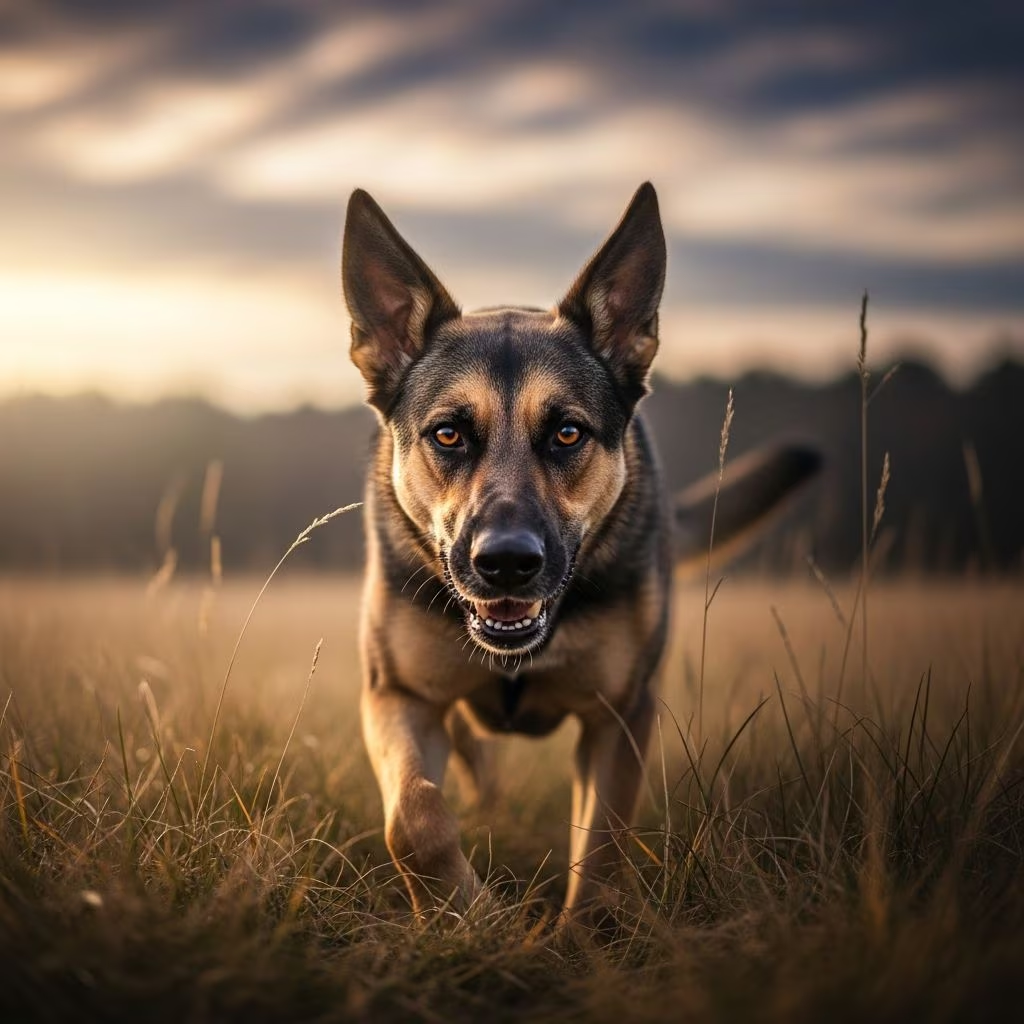
Predatory behavior represents one of the most fundamental aspects of canine nature, deeply woven into the genetic fabric of domestic dogs through millions of years of evolutionary history. This instinctive drive to locate, pursue, and capture moving objects stems directly from dogs’ wild ancestors and continues to influence modern canine behavior in significant ways. Understanding these primal instincts provides dog owners and trainers with essential insights into why their pets behave as they do and how to manage these behaviors effectively.
The Evolutionary Foundation of Canine Predation
The predatory instincts observed in today’s domestic dogs trace their origins back approximately 40 million years through the order Carnivora. Wolves, which serve as the primary ancestral species for domestic dogs, evolved from the Caninae subfamily and represent true apex predators in every sense. These wild canines developed sophisticated hunting strategies and behavioral patterns necessary for survival, relying on their ability to identify, stalk, and successfully capture prey to obtain food. The fossil record demonstrates a continuous lineage of predatory specialization that has been passed down through countless generations.
When humans first began domesticating wolves and eventually developing distinct dog breeds, they did not eliminate these predatory characteristics. Rather, selective breeding over thousands of years modified and redirected certain aspects of the predatory sequence toward specific human purposes. Breeds developed for hunting, herding, or retrieving maintained strong predatory drives, though often expressed in more specialized forms than in their wild ancestors.
Neurological Mechanisms Underlying Predatory Drive
Modern neuroscience has revealed that predatory behavior in animals, including dogs, involves distinct neural circuits that are fundamentally different from those governing aggressive behavior. Understanding these neurological pathways provides crucial context for comprehending how and why dogs express predatory instincts.
The ventral tegmental area and nucleus accumbens, components of the brain’s reward system, play central roles in predatory motivation and behavior. These regions process sensory information related to prey and generate the motivation to pursue it. The predatory sequence involves a chain of evolutionarily adapted behaviors designed specifically for capturing and killing prey. This chain includes distinct phases of activity, each controlled by specific neural mechanisms that trigger appropriate behavioral responses.
Importantly, predatory aggression and general aggression operate through different neural mechanisms. While aggression is primarily regulated by the amygdala and prefrontal cortex, which process emotional and social information, predatory behavior relies more heavily on reward-driven systems. This distinction has significant implications for understanding dog behavior, as it means that a dog exhibiting high prey drive is not necessarily demonstrating aggression in the traditional sense.
The Sequence of Predatory Behavior in Dogs
Recent behavioral research has identified distinct phases that characterize predatory behavior in domestic dogs. These phases represent a sequential chain of motor actions and sensory processing that unfolds during hunting encounters. Understanding these phases helps explain the specific behaviors dog owners observe when their pets engage with potential prey.
Search and Detection Phase
The initial stage of predatory behavior involves environmental exploration and the detection of sensory cues indicating prey presence. During this phase, dogs actively scan their surroundings for signals such as movement, scent, or sound that suggest nearby prey. Different breed types approach this phase distinctly based on their selective breeding history. Pointing breeds tend to move in quick, zig-zag patterns while visually scanning for movement, whereas scent hounds engage in intensive sniffing patterns, methodically covering terrain to detect odor trails. Sighthounds remain visually focused, tracking subtle movements within their field of vision.
Approach and Positioning Phase
Once a dog has identified potential prey, the behavior shifts to the approach phase, characterized by deliberate movement toward the target. Pointing breeds typically alternate between freezing behavior and slow, stalking movements that position them advantageously relative to prey. Scent hounds driven by olfactory information move directly toward their target, often vocalizing as excitement builds. Sighthounds maintain visual focus while closing the distance to prey. This phase involves careful positioning and heightened sensory attention to prey location and behavior.
Capture and Conclusion Phases
Following successful approach, predatory behavior culminates in capturing and subduing prey. The specific intensity and expression of this phase varies considerably among individual dogs and breeds based on genetic factors and selective breeding history.
Genetic Variation in Predatory Drive Expression
Not all dogs express predatory instincts with equal intensity. Significant variation exists both between different breeds and among individual dogs within the same breed. This variation reflects underlying genetic differences in how strongly predatory instincts motivate behavior and how resistant an individual dog is to external influences while under the influence of these drives.
Some dogs are completely driven by their genetic predatory programming and require no external stimulus from owners or environmental conditions to engage in prey-seeking behavior. For these individuals, the hormonal rewards of engaging in predatory behavior serve as self-reinforcement, making the behavior internally motivating regardless of owner interference or environmental factors. Such dogs will pursue prey with single-minded focus and minimal responsiveness to owner commands while their predatory drive is activated.
Other dogs exhibit more moderate prey drives that can be more easily controlled through training and management. Direct genetic parentage appears to influence the strength of inherited predatory tendencies, suggesting that observing a puppy’s parents when possible provides valuable insight into expected prey drive characteristics. For adult dogs where parental observation is impossible, individual assessment through careful observation becomes necessary to understand the strength of their predatory instincts.
Prey Drive Versus Other Forms of Aggression
An important distinction exists between prey drive and other manifestations of aggression in dogs. Prey drive represents a natural desire to chase and capture moving objects, whether animate or inanimate, and operates through distinct neural mechanisms compared to defensive aggression, territorial aggression, or dominance-related behaviors.
This functional distinction means that a dog with high prey drive is not necessarily predisposed toward aggression with other dogs, people, or even objects in non-hunting contexts. The predatory instinct serves a specific evolutionary function—obtaining food—and is characterized by focused, goal-directed behavior aimed at prey acquisition. Aggression, by contrast, typically serves other functions such as defense, territory protection, or social conflict resolution.
Understanding this difference allows owners and trainers to recognize that managing prey drive involves different strategies than managing other behavioral issues. A dog that chases neighborhood cats due to high prey drive presents a fundamentally different management challenge than a dog demonstrating territorial aggression toward visitors.
Breed-Specific Expressions of Predatory Instinct
Selective breeding for specific human purposes has created dramatic variations in how predatory instincts are expressed across different dog breeds. Herding breeds like Border Collies and Australian Shepherds retain the stalk and chase components of predatory behavior but typically lack the kill-bite component, having been selectively bred to control livestock without harming it. Retrievers retain the chase and capture components but have been selected for soft mouths that retrieve game without damaging it. Sighthounds like Greyhounds and Salukis retain the visual tracking and chase components with particular intensity, as these breeds were developed specifically for coursing prey.
This selective modification of predatory sequences demonstrates that while the underlying genetic predisposition remains, humans have successfully redirected and partially suppressed specific elements of the natural hunting sequence toward particular outcomes. This has significant implications for understanding breed behavior and predicting which breeds may present greater challenges regarding prey drive in certain situations.
Managing and Redirecting Predatory Impulses
While predatory instincts are natural and cannot be eliminated through training, they can be managed and redirected toward appropriate outlets. Effective management strategies recognize that suppressing the drive entirely is unrealistic, whereas providing controlled, appropriate expression of predatory behavior offers a more practical approach.
Environmental management forms the foundation of prey drive control, involving prevention of unsupervised access to small animals and elimination of triggering stimuli when possible. Training exercises that channel predatory energy toward appropriate targets, such as toys or interactive games, allow dogs to satisfy their instinctive needs in controlled contexts. Puzzle toys, fetch games, and hunting simulations provide outlets that engage the predatory sequence without endangering pets or wildlife.
Consistent training from puppyhood that establishes reliable recall and impulse control helps dogs develop the ability to override predatory impulses when commanded. Early socialization with small animals under controlled conditions can help prevent or reduce prey-directed behavior in some cases, though this approach has variable success depending on individual genetic predisposition.
Frequently Asked Questions
Can prey drive be completely eliminated through training?
No. Prey drive is a genetically determined instinct with deep evolutionary roots. While training and management can help control the expression of prey drive and teach dogs to override impulses in specific contexts, the underlying drive cannot be eliminated. Effective management involves redirecting predatory energy toward appropriate outlets rather than attempting complete suppression.
Which dog breeds have the highest prey drive?
Breeds specifically developed for hunting, herding, or retrieving typically exhibit higher prey drives than breeds developed for companionship. Terriers, sighthounds, herding breeds, and sporting breeds generally show more intense predatory instincts, though considerable individual variation exists within all breeds.
Is a dog with high prey drive aggressive?
Not necessarily. Prey drive and aggression operate through different neural pathways and serve different functions. A dog with high prey drive toward small animals may be gentle and non-aggressive toward people and other dogs. Managing prey drive requires different strategies than managing aggression.
At what age do predatory instincts appear in puppies?
Predatory behaviors can begin appearing in puppies as young as 6-8 weeks of age, though the intensity and sophistication of these behaviors increase as the puppy matures. Puppies may begin stalking siblings, toys, and other objects before more refined hunting behaviors emerge.
Can predatory drift occur in domestic dogs?
Predatory drift describes the gradual shift toward instinctive predatory behaviors during certain types of training or conditioning. This occurs when the interval between a trained behavior and reward becomes too extended, causing the animal to revert to instinctive food-seeking patterns. Understanding this phenomenon helps trainers avoid inadvertently triggering predatory responses during conditioning exercises.
The Balance Between Nature and Nurture
While genetic predisposition provides the foundation for predatory instincts, environmental factors, early experiences, and training significantly influence how these instincts are expressed and controlled throughout a dog’s life. A puppy born with strong genetic predatory potential can develop appropriate inhibition and control through early socialization and consistent training, whereas a dog with similar genetic predisposition raised without such guidance may develop problematic behaviors.
Recognizing predatory instincts as a normal, natural aspect of canine behavior—rather than a character flaw or problem to be ashamed of—enables more realistic and effective management approaches. By understanding the evolutionary roots, neurological basis, and behavioral expression of these instincts, dog owners and trainers can make informed decisions about management, training, and environmental modification that promote safety while allowing dogs to express their fundamental nature in appropriate contexts.
References
- Neurocircuitry of Predatory Hunting — National Institutes of Health, National Center for Biotechnology Information. 2023. https://pmc.ncbi.nlm.nih.gov/articles/PMC10170020/
- Understanding Predatory Drift in Dogs — Best Dog Learning and Stuff. Accessed 2026. https://bestdoglearningandstuff.co.uk/understand-predatory-drift-in-dogs
- The So-Called Predatory Aggression: A Brief Critical Analysis — Etologi. Accessed 2026. https://etologi.dk/the-so-called-predatory-aggression/
- The Canine Prey Drive Instinct — DogWays. Accessed 2026. https://www.dogways.info/the-canine-prey-drive-instinct
- What Modern Studies Reveal About Predatory Behaviour in Dogs — Predation Substitute Training. Accessed 2026. https://predation-substitute-training.com/science-prey-drive-dogs/
- Understanding Prey Drive in Dogs — Wisdom Panel. Accessed 2026. https://www.wisdompanel.com/en-us/blog/prey-drive-in-dogs



