Understanding Canine Predatory Behavior Toward Felines
Decode why your dog chases cats and practical solutions for peaceful coexistence.
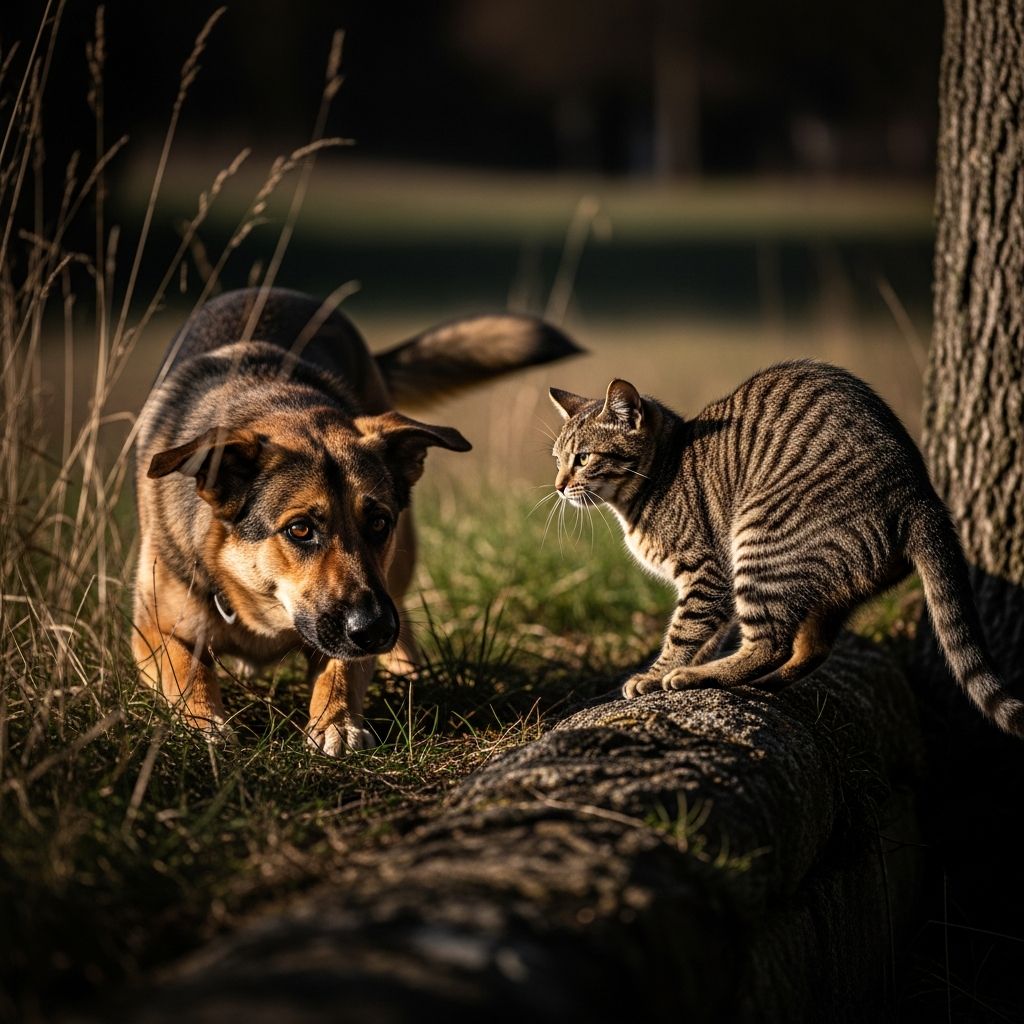
The sight of a dog pursuing a cat across the yard or through your home is one of the most recognizable domestic animal scenarios. Yet behind this seemingly timeless chase lies a complex interplay of biological drives, learned behaviors, and environmental factors. Understanding what motivates your dog’s chasing behavior is the first critical step toward creating a harmonious household where dogs and cats can coexist peacefully. This article explores the multifaceted reasons why dogs exhibit this behavior and provides practical, evidence-based strategies to address it.
The Evolutionary Foundation of Chase Behavior
To understand why modern dogs chase cats, we must look backward to their evolutionary origins. Dogs are descended from wolves, and during the domestication process, selective breeding emphasized hunting traits such as stalking, pursuit, and prey capture. These instincts were not merely tolerated—they were actively cultivated because humans valued dogs for their hunting and guarding capabilities. Even though contemporary society rarely uses dogs for hunting purposes, the genetic programming accumulated over thousands of years of selective breeding remains deeply embedded in canine psychology.
This ancestral legacy manifests as what behaviorists call prey drive, an innate motivation to pursue moving targets. The prey drive operates as a self-reinforcing behavioral loop. Each time a dog successfully chases something, the experience itself becomes rewarding, independent of whether the chase results in a catch. This means the more opportunities a dog has to practice chasing, the stronger and more habitual the behavior becomes. The chasing itself feels inherently satisfying to the dog, creating a powerful motivation to repeat the behavior whenever the opportunity arises.
It is important to distinguish prey drive from aggression or dominance. A dog chasing a cat is not necessarily displaying aggressive tendencies or trying to establish social hierarchy. Rather, the dog is responding to a hard-wired survival instinct that, in ancestral conditions, would have been essential for obtaining food. Understanding this distinction is crucial because it shifts how we address the behavior—moving away from punishment-based approaches and toward management and redirection strategies.
Breed-Specific Variations in Chase Intensity
Not all dogs chase cats with equal enthusiasm. Certain breeds display significantly higher prey drive due to their selective breeding history. German Shepherds, Beagles, and Yorkshire Terriers are among the breeds that often demonstrate particularly intense chasing behaviors. This variance among breeds reflects their original purposes: some were developed specifically for hunting, herding, or ratting, which required heightened responsiveness to moving prey.
Conversely, breeds not historically developed for hunting or predatory work may exhibit considerably lower prey drive. A dog from a breed with minimal hunting heritage may show little to no interest in chasing a cat, even if the cat moves rapidly. This breed-specific difference underscores that prey drive intensity is not uniformly distributed across all dogs and depends partially on genetic predisposition.
Understanding your dog’s breed tendency can help you set realistic expectations and determine what management strategies will be most effective. A high-prey-drive breed may require more intensive training and supervision than a breed with naturally lower chase motivation.
Territorial Claims and Boundary Defense
Beyond ancestral hunting instincts, many dogs chase cats because of territorial behavior. Dogs perceive their home and immediate surroundings as territory they own and must defend. From a dog’s perspective, a cat moving through this claimed space—whether the cat is a family member or an unfamiliar visitor—may be interpreted as an intrusion that requires a defensive response.
The dog’s reaction to a cat moving through its territory depends on several factors. A cat that moves slowly or remains stationary may not trigger the same response as a cat that darts suddenly across the room. Additionally, familiar cats with whom a dog has been socialized from an early age are far less likely to trigger territorial chasing. Dogs that have lived with cats throughout their lives tend to view them as part of the household landscape rather than as territorial intruders.
Environmental context also matters significantly. In confined indoor spaces, territorial responses may intensify because the dog has fewer escape routes and may feel that defending its territory is more critical. In outdoor environments with clearer boundary demarcation, territorial motivation may manifest differently. The behavior also varies depending on the dog’s learned history with cats in general—a dog that has never encountered a cat may react more defensively than one with previous positive experiences.
The Boredom and Under-Stimulation Factor
Not every instance of cat chasing relates to ancestral hunting instincts or territorial defense. Dogs require substantial physical and mental enrichment to maintain psychological well-being. When dogs do not receive adequate exercise or cognitive stimulation, they often redirect that accumulated energy toward whatever entertainment is available—which frequently means chasing household cats.
In these situations, the cat chase serves as an outlet for the dog’s excess energy and a source of excitement that relieves boredom. The dog may not be motivated by predatory instinct at all but rather by the simple fact that chasing provides stimulation and engagement that is otherwise absent from its daily routine. This is why many cases of problematic cat chasing improve significantly once the dog receives increased exercise and enrichment opportunities.
Recognizing boredom as the motivator is important because it directs intervention toward increasing the dog’s overall activity level rather than focusing solely on prey drive management. A dog that receives 30 minutes of vigorous daily exercise plus interactive play and puzzle toys may naturally lose interest in chasing the cat because its stimulation needs are being met through more appropriate outlets.
Play vs. Predation: Distinguishing Behavioral Intent
A complicating factor in understanding dog-cat chasing is that sometimes dogs are motivated by play rather than predatory intent. Running and chasing constitute major components of canine play behavior. A dog may chase a cat with the genuine intention of engaging in a game rather than causing harm. In these situations, the motivation differs fundamentally from prey-driven chasing, though the outward behavior may appear identical to an observer.
Determining whether chasing represents playful intent or predatory motivation requires careful observation of multiple behavioral signals. Does the dog play-bow or use other play-solicitation gestures? Do interactions include reciprocal role-switching where the cat occasionally chases the dog? Does the dog show genuine pleasure and relaxation when near the cat during non-chase moments?
Additionally, the cat’s response provides important information. Cats who are accustomed to living with dogs and view them as play partners may voluntarily initiate interactions and show less fear. Cats unfamiliar with dogs or with naturally fearful temperaments are more likely to respond with flight, which intensifies the dog’s chase response regardless of the dog’s initial intent. A cat’s fearful reaction can transform what began as friendly play-seeking into a full predatory sequence because the cat’s flight triggers the dog’s innate chase response.
Stress Consequences for Cats and Management Imperatives
Regardless of the dog’s motivations, persistent chasing creates significant psychological and physical stress for cats. Chronic stress impairs feline health, leading to anxiety disorders and various physiological symptoms including urinary tract infections, gastrointestinal disturbance, hair loss, and dermatological sores. Stressed cats often develop behavioral problems such as inappropriate elimination (spraying urine), aggressive reactions to humans, and excessive scratching or destructiveness.
Beyond feline health concerns, there are practical dangers if a dog regularly chases neighborhood cats. Outdoor cat encounters introduce disease transmission risks and potential exposure to feral cats that may carry rabies or other communicable diseases. A dog’s vaccination status becomes critically important in these scenarios. Additionally, some outdoor cats may respond to pursuit with aggressive counterattacks that injure the dog.
These considerations make managing chase behavior a priority, not merely a matter of preference. The intervention is essential for both animal welfare and household safety.
Effective Management and Training Strategies
Prevention through supervision forms the foundation of behavior modification. The primary principle is simple: prevent the dog from practicing the chasing behavior. Each successful chase reinforces the behavior neurologically, making the dog more skilled and motivated to repeat it. Preventing practice opportunities interrupts this reinforcement cycle.
Practical prevention tactics include:
- Maintaining physical separation between the dog and cat until training progresses, providing each animal with dedicated spaces where they can relax without threat
- Keeping the dog on a drag line (a lightweight rope attached to the collar) indoors so that you can quickly interrupt pursuit attempts
- Crating or confining the dog during periods when you cannot actively supervise interactions
- Creating high-value refuge areas for cats (elevated perches, separate rooms) where they can escape the dog’s presence
Recall training and impulse control represent essential behavioral tools. A dog with reliable recall—the ability to stop what it is doing and return to its handler on command—can be interrupted mid-chase before momentum escalates the interaction into something dangerous. This requires teaching the dog that responding to your call brings rewards more valuable than continuing the chase. Using high-value reinforcement items like special treats or beloved toys helps establish competing motivation.
Redirecting chase energy toward appropriate targets provides an outlet for the dog’s natural chasing drive without directing it toward cats. Some trainers recommend allowing the dog to chase objects it retrieves or using chase games where you control the prey object. This satisfies the chase motivation while maintaining safety boundaries.
Gradual habituation protocols help dogs learn to remain calm in the cat’s presence. Beginning with the cat in a carrier while rewarding the dog for calm behavior near the carrier establishes new associations between cat presence and positive outcomes. Slowly reducing the barriers and increasing proximity as the dog demonstrates consistent calm responses allows for eventual off-leash coexistence in certain contexts.
Exercise and Enrichment as Foundational Interventions
Before implementing complex training programs, assess whether your dog’s chasing behavior might respond to increased physical exercise and mental enrichment. Dogs with well-managed energy levels have less excess arousal available to redirect toward chasing activities.
Effective exercise programs include:
- Regular, vigorous aerobic activity (running, fetching, swimming) that produces genuine fatigue rather than brief play sessions
- Varied environments and activities to prevent habituation and maintain engagement
- Mental enrichment through puzzle toys, scent work, training games, and problem-solving activities
- Scheduled play sessions that predictably provide stimulation, reducing the dog’s need to create its own entertainment
For some dogs, the combination of adequate exercise and environmental enrichment alone resolves chase behavior without requiring specialized training interventions.
Professional Intervention and Behavioral Assessment
Cases involving intense prey drive, repeated failures with management attempts, or instances where the dog has physically harmed or come close to severely injuring the cat warrant consultation with professional dog trainers or animal behaviorists. These professionals can conduct detailed assessments to determine the primary motivation for chasing and recommend intervention strategies tailored to your specific situation.
Professional trainers can also help distinguish between situations with realistic potential for resolution through training versus situations where permanent separation may be the safest option for both animals.
Creating Sustainable Coexistence
Successfully managing dog-cat interactions requires consistency, patience, and realistic expectations. Improvement typically does not occur overnight but develops gradually as new behavioral patterns replace old ones. The key principles include:
- Preventing the dog from practicing chase behavior through consistent management
- Providing adequate exercise and mental stimulation to reduce boredom-motivated chasing
- Teaching reliable recall and impulse control
- Using positive reinforcement to create new associations between cat presence and good outcomes
- Maintaining separate spaces during early stages of behavior modification
- Monitoring progress and adjusting strategies based on observed changes
With commitment to these evidence-based approaches, many households successfully transition from cat-chasing conflicts to peaceful coexistence where dogs and cats share space comfortably.
References
- My Waggle – The Chase is On: 3 Reasons Why Dogs Chase Cats — My Waggle. https://mywaggle.com/blogs/pet-behaviour/the-chase-is-on-3-reasons-why-dogs-chase-cats
- Dear PetPlace: Why Does My Dog Chase My Cat? — PetPlace. https://www.petplace.com/article/general/behavior-training/dear-petplace-why-does-my-dog-chase-my-cat
- Ask Crystal: Dogs Chasing Cats — Blue Ridge Humane Society. https://www.blueridgehumane.org/dogs-chasing-cats/
- Why Do Dogs Chase Cats & How to Stop It? — PetFinder. https://www.petfinder.com/dogs-and-puppies/behavior/other-problem-behaviors/chasing-cats/
- Cat Chasing — Diamonds in the Ruff. https://www.diamondsintheruff.com/catchasing
- Dog Chasing Cat: How to Stop This Behavior — Best Friends Animal Society. https://bestfriends.org/pet-care-resources/dog-chasing-cat-how-stop-behavior
Similar Articles








Read full bio of medha deb