

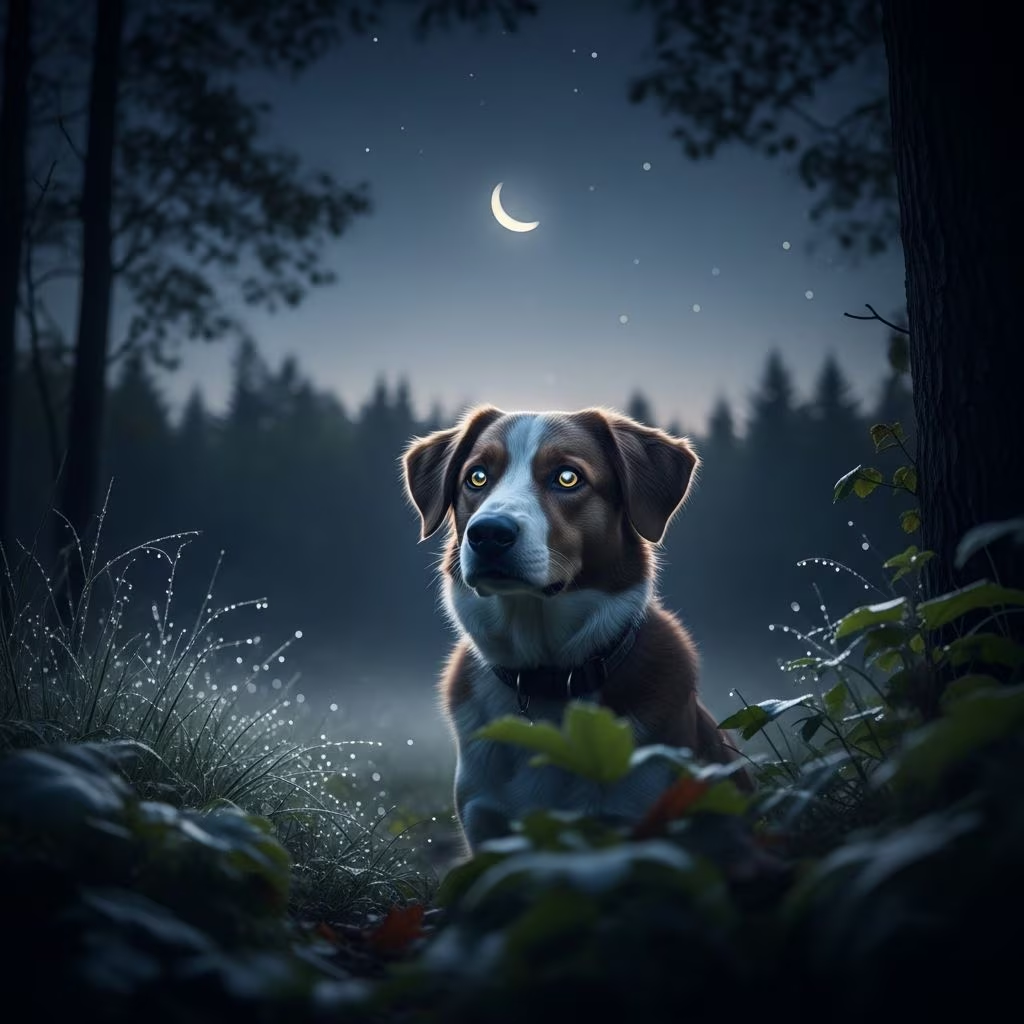
When you take your dog for an evening walk, you might notice they navigate obstacles and detect movement with remarkable ease in conditions where your own vision becomes increasingly strained. This isn’t magical ability—it’s the result of millions of years of evolutionary refinement that has equipped dogs with visual capabilities far superior to humans in low-light environments. Unlike humans, who rely heavily on daylight for clear vision, dogs possess specialized anatomical features that allow them to function effectively when darkness falls.
The Science Behind Canine Darkness Perception
Dogs can see in light levels approximately five times lower than what humans require for comfortable vision. However, it’s important to understand that this doesn’t mean dogs see in complete darkness with perfect clarity. Rather, they perceive dim light conditions with significantly greater sensitivity than we do, allowing them to distinguish shapes, movement, and objects in environments that would appear nearly black to human eyes.
The technical term for this ability is scotopic vision, which refers specifically to sight in low-light conditions. Dogs don’t possess night vision in the way we imagine it from spy movies or military technology—they cannot see in absolute darkness. Instead, they excel at utilizing minimal available light to create a functional visual picture of their surroundings. This distinction is crucial for understanding both the capabilities and limitations of canine nocturnal vision.
Anatomical Features That Enable Superior Night Vision
The Retina: A Rod-Dominated Structure
The foundation of a dog’s night vision advantage lies in the composition of their retina. The retina contains two types of light-sensitive cells: rods and cones. Cones are responsible for daytime vision and color perception, allowing for sharp detail recognition and chromatic discrimination. Rods, by contrast, are exquisitely adapted for low-light environments and motion detection.
Most domestic dogs have retinas dominated by rods rather than cones—a stark contrast to human retinas, which are cone-dominated. This anatomical difference represents a fundamental divergence in visual priorities. While humans evolved to prioritize color recognition and detailed daytime vision, dogs evolved to detect movement and navigate effectively during twilight and nighttime hours. This evolutionary trade-off means dogs sacrifice some color perception and daytime visual acuity in exchange for superior nocturnal capabilities.
The Tapetum Lucidum: Nature’s Reflective Mirror
Perhaps the most remarkable feature of canine eye anatomy is a structure called the tapetum lucidum, which literally translates to “bright tapestry” in Latin. This is a reflective layer of cells positioned directly behind the retina that functions much like a mirror inside the eye. When light enters the eye and strikes the retina, some light passes through without being immediately registered. Rather than allowing this light to be wasted, the tapetum lucidum reflects it back onto the photoreceptors, effectively giving the retina a second opportunity to capture and process the light signal.
This reflective mechanism essentially doubles the amount of light available for the dog’s visual system to work with, which is why dogs can function in dramatically darker conditions than humans. The tapetum lucidum is also the reason behind the distinctive greenish or reddish glow visible in dogs’ eyes when photographed with a flash or illuminated by car headlights at night—this eyeshine is simply reflected light bouncing back out of the eye.
It’s worth noting that most mammals possess this reflective layer, including cats, ferrets, deer, cattle, and horses. Notably, humans and other primates lack this feature, which is one reason our nocturnal vision remains relatively poor compared to many other mammals. This absence in primates likely reflects our ancestors’ evolutionary emphasis on daylight hunting and gathering.
Pupil Size and Light Capture
Dogs possess larger pupils than humans, which allows them to capture a greater volume of light under low-light conditions. The pupil acts as the aperture of the eye, controlling how much light enters the interior. A larger pupil opening means more light can reach the retina, enhancing the overall visual signal available for processing. This adaptation works in concert with the rod-dominated retina and tapetum lucidum to create a comprehensive system optimized for low-light vision.
Beyond Basic Anatomy: Additional Visual Advantages
Flicker Fusion Frequency and Motion Detection
An often-overlooked aspect of canine night vision involves how quickly dogs can perceive flickering light. This ability, called flicker fusion frequency (FFF) or critical flicker-fusion frequency (CFF), refers to the rate at which an animal’s visual system integrates individual light pulses into a continuous image. Dogs have a higher flicker fusion threshold than humans, meaning their visual processing is faster and more responsive to rapid changes.
This advantage translates into superior motion detection in low-light environments. While a television screen appears to show continuous motion to human eyes, it may appear to flicker to a dog due to their faster visual refresh rate. Conversely, this same heightened sensitivity allows dogs to detect subtle movements in darkness that would be imperceptible to human observers—an evolutionary advantage inherited from their wild ancestors who needed to spot prey and predators in twilight conditions.
Retinal Response Speed
The retina in a dog’s eye responds more rapidly to changes in their visual field compared to human retinas. This quick responsiveness, measured as flicker fusion frequency, enhances the dog’s ability to track moving objects in dim lighting conditions. The combination of rod-dominated photoreceptors and rapid retinal response creates a visual system finely tuned for detecting prey and potential threats in low-light hunting scenarios.
Lens Positioning
The anatomical position of a dog’s lens relative to the retina differs from human eye structure in a way that enhances nocturnal vision. The lens sits closer to the retina in canine eyes, resulting in a brighter image projected onto the retinal surface. This seemingly minor structural difference contributes meaningfully to the overall enhancement of low-light visual acuity.
The Trade-Offs: What Dogs Sacrifice for Night Vision
While dogs possess superior night vision, this evolutionary specialization comes with certain costs. The most significant trade-off involves visual acuity and clarity. Dogs can see objects clearly at approximately 20 feet away that humans can discern at 75 feet—a ratio that demonstrates substantially reduced daytime visual sharpness.
This reduced acuity stems from two factors. First, the tapetum lucidum, while enhancing light reflection, also scatters some light in the process, which degrades image clarity. Second, the rod-dominated retina provides motion and light sensitivity at the expense of fine detail recognition. Where humans achieve 20/20 vision or better, dogs typically achieve approximately 20/80 vision, meaning objects must be four times closer for dogs to see them with the same clarity as humans.
Additionally, dogs have limited color vision compared to humans. Their rod-dominated retinas mean they perceive the world primarily in shades of gray and blue, lacking the rich chromatic perception humans enjoy. This represents another evolutionary trade-off between color perception and nocturnal functionality.
Evolutionary Context: Why Dogs Developed Superior Night Vision
The canine visual system reflects millions of years of evolutionary pressure shaped by hunting behaviors and environmental demands. Dogs’ ancestors were predators that hunted across varying light conditions, including twilight and night hours. The ability to detect prey movement, navigate without falling, and identify potential threats in low-light environments directly contributed to survival and reproductive success.
This evolutionary heritage explains why domestic dogs retain these nocturnal advantages despite living in human homes with electric lighting. The traits remain deeply embedded in canine physiology because they provided significant survival advantages throughout evolutionary history. Even though modern pet dogs no longer hunt for survival, their eyes retain the specialized adaptations that equipped their wild ancestors for nocturnal activity.
Comparing Canine Night Vision to Other Species
| Feature | Dogs | Cats | Humans |
|---|---|---|---|
| Tapetum Lucidum | Yes | Yes | No |
| Rod-Dominated Retina | Yes | Yes | No |
| Relative Night Vision Capability | Excellent | Superior | Poor |
| Color Vision | Limited (blue-yellow) | Limited (blue-yellow) | Full spectrum |
While both dogs and cats possess the anatomical features that enable strong night vision, cats generally possess a slight edge in nocturnal capability. Cats have an even higher ratio of rods to cones and slightly larger pupils, making them marginally superior night hunters. However, dogs still maintain vision capabilities significantly superior to humans in low-light conditions.
Practical Implications for Dog Owners
Lighting Considerations
Understanding your dog’s superior night vision should influence how you approach safety during evening activities. While your dog can navigate your backyard in twilight conditions that feel uncomfortably dark to you, some lighting remains beneficial. Dim, indirect lighting helps prevent accidents while taking advantage of your dog’s natural low-light capabilities. Total darkness eliminates even the minimal light your dog’s system requires, so some ambient light remains helpful.
Nighttime Photography
The distinctive eyeshine visible in nighttime photographs of dogs—a glowing green or reddish reflection—is perfectly normal and indicates a healthy tapetum lucidum functioning as designed. This reflection is not a sign of eye problems but rather confirmation that the reflective layer is present and operational.
Exercise and Activity Timing
Dogs’ superior night vision means they can safely participate in evening walks and outdoor activities in conditions where human vision becomes significantly compromised. However, you should still use caution regarding traffic and other hazards that don’t depend on vision alone. Your dog’s ability to see in darkness doesn’t eliminate the need for reflective leashes or collars that help human drivers and other people see your pet.
Frequently Asked Questions About Canine Night Vision
Can dogs see in complete darkness?
No, dogs cannot see in complete darkness. They require minimal ambient light to function, but absolute darkness renders their vision non-functional just as it does for humans. Dogs excel in dim lighting conditions with at least trace amounts of available light, but they cannot see when light is completely absent.
Do all dog breeds have equally good night vision?
While all dogs possess the fundamental anatomical features for enhanced night vision, some variation exists between breeds. Breeds developed for hunting in low-light conditions or nocturnal work may possess slightly enhanced nocturnal capabilities, but the differences are relatively minor compared to the differences between canine and human vision.
How does a dog’s night vision compare to a wolf’s?
Wolves likely possess even superior night vision compared to domestic dogs. Wolves have retinas with an even greater ratio of rod-processing cells than domestic dogs, reflecting their evolutionary history as apex predators hunting primarily during twilight and nighttime hours.
Why do dogs’ eyes glow in the dark?
The glowing appearance of dogs’ eyes in the dark results from light reflecting off the tapetum lucidum and bouncing back out of the eye. When a light source like a camera flash or car headlight illuminates the eye, light enters, reflects off the tapetum lucidum, and exits back toward the light source, creating the distinctive greenish or reddish glow.
Does eye color affect night vision capability?
A dog’s coat color or eye color don’t significantly impact their night vision capability. The structure and composition of the retina—which is consistent across dogs regardless of external appearance—determines nocturnal vision ability far more than surface-level physical characteristics.
Conclusion: The Specialized Vision of Our Canine Companions
The canine eye represents a masterpiece of evolutionary specialization, optimized over millions of years for low-light vision and motion detection. Through a combination of rod-dominated retinas, the reflective tapetum lucidum, larger pupils, and rapid retinal response times, dogs achieve visual capabilities in darkness that far exceed human potential. While this specialization comes at the cost of daytime visual acuity and color perception, the trade-off reflects the hunting heritage of canine ancestors for whom nocturnal vision meant the difference between finding prey and going hungry.
By understanding the biological mechanisms behind canine night vision, dog owners gain insight into why their pets navigate dark spaces with such apparent ease and confidence. This knowledge also helps explain certain behavioral quirks, like a dog’s fascination with movement in low-light conditions or their ability to detect threats or prey that humans cannot perceive. The next time you notice your dog alertly detecting something in darkness that remains invisible to your eyes, you can appreciate the sophisticated visual adaptations working behind those luminous, glowing eyes.
References
- Doggy Night Vision! How your Dog Can See in the Dark — Charlotte Kennels. 2024-06-28. https://charlottekennels.com/2024/06/28/doggy-night-vision-how-your-dog-can-see-in-the-dark/
- Can Dogs See in the Dark? — PetMD. https://www.petmd.com/dog/general-health/can-dogs-see-dark
- Can Dogs See in The Dark? — Chewy. https://www.chewy.com/education/dog/health-and-wellness/can-dogs-see-in-the-dark-2
- Can Dogs See in the Dark? — Zoetis Petcare. https://www.zoetispetcare.com/blog/article/can-dogs-see-dark
- Can Dogs See in the Dark? — American Kennel Club. https://www.akc.org/expert-advice/lifestyle/can-dogs-see-in-the-dark/
- What Do Dogs See? Understanding Dog Vision and Color Perception — WellTayl. https://welltayl.com/blogs/news/what-do-dogs-see
- How Well Do Dogs See At Night? — ScienceDaily / University of Wisconsin – Madison. 2007-11-09. https://www.sciencedaily.com/releases/2007/11/071108140336.htm
- How good is your pet’s night vision? — Wisdom Panel. https://www.wisdompanel.com/en-us/blog/how-good-is-your-pets-night-vision



