
Canine Nervous System Guide: Key Insights For Dog Owners
Explore the intricate canine nervous system, from brain functions to nerve signaling, essential for understanding dog health and behavior.
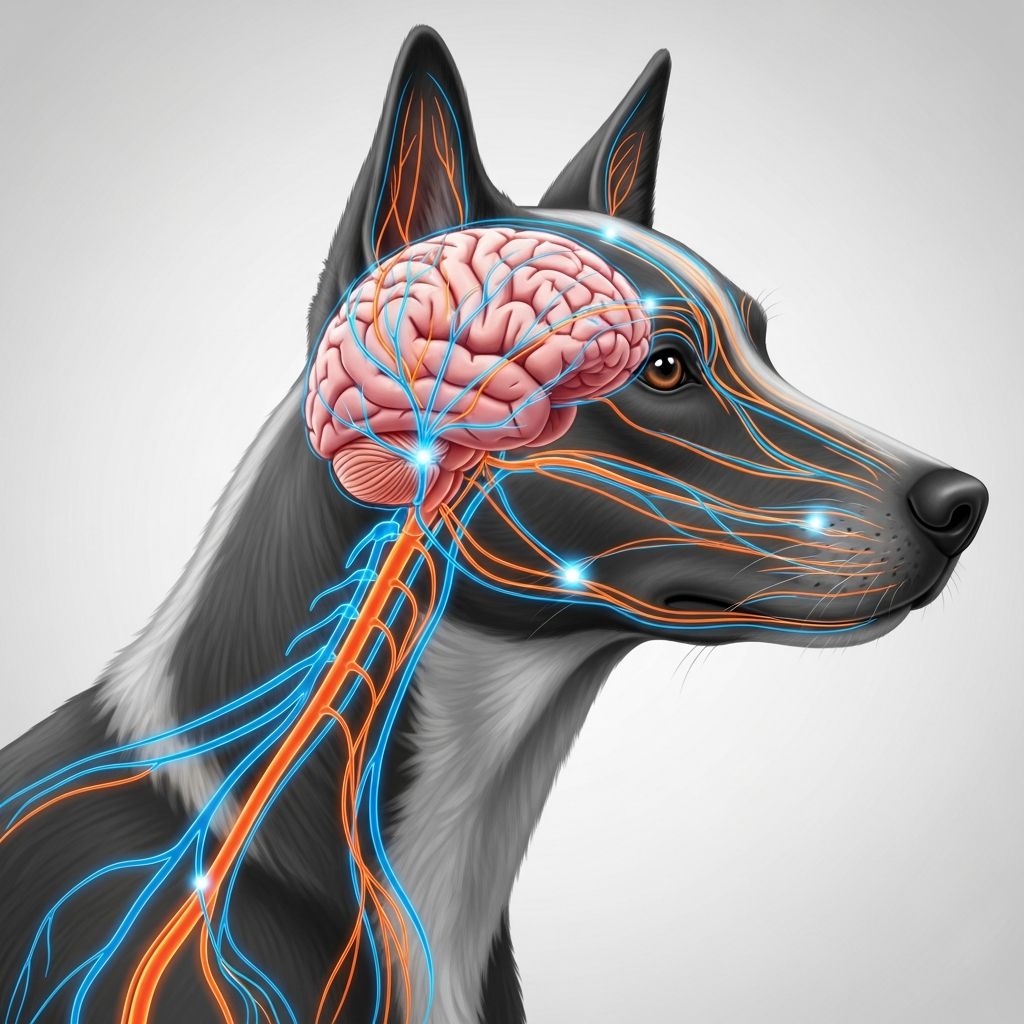
The nervous system in dogs serves as the primary control center, coordinating everything from basic survival instincts to complex behaviors. It processes sensory input, generates responses, and maintains homeostasis through a network of specialized cells and structures.
Overview of the Canine Nervous Framework
Dogs possess a highly developed nervous system divided into two primary divisions: the central nervous system (CNS) and the peripheral nervous system (PNS). The CNS, comprising the brain and spinal cord, acts as the core processing unit, while the PNS extends nerves throughout the body to relay information.
This framework enables dogs to navigate their environment, respond to stimuli, and perform voluntary actions. Understanding its components helps owners recognize signs of neurological issues early.
Central Nervous System: Brain and Spinal Cord
The CNS is the command hub. Enclosed within protective bony structures—the skull for the brain and vertebrae for the spinal cord—it safeguards delicate neural tissues.
Brain Structure and Regions
The dog’s brain, weighing about 2-3 ounces, features three main sections: the brainstem, cerebrum, and cerebellum. The brainstem regulates vital functions like breathing and heart rate. The cerebrum handles higher cognition, including decision-making and sensory interpretation, split into left and right hemispheres connected by the corpus callosum.
The cerebellum coordinates balance, posture, and fine motor skills. Specific lobes within the cerebrum manage distinct tasks: frontal for planning, parietal for spatial awareness, temporal for sound and memory, and occipital for vision.
Spinal Cord Anatomy
Extending from the brainstem, the spinal cord runs through the vertebral column, which in dogs includes 7 cervical, 13 thoracic, 7 lumbar, 3 sacral, and 20-23 caudal vertebrae. It segments correspondingly: cervical (neck), thoracic (chest), lumbar (lower back), sacral (pelvis), and caudal (tail).
The spinal cord transmits signals between the brain and body, facilitating reflexes and locomotion. Damage here can impair limb function or sensation.
Protective Layers: Meninges and Cerebrospinal Fluid
Three meningeal layers shield the CNS: the tough outer dura mater, the web-like arachnoid mater, and the vascular pia mater adhering to neural surfaces. Cerebrospinal fluid (CSF) circulates within these layers, cushioning against impacts and aiding nutrient transport.
This system provides resilience during movement, essential for active dogs prone to jumps and runs.
Peripheral Nervous System: Extending Reach
Beyond the CNS, the PNS includes cranial and spinal nerves branching to every body part. Cranial nerves (12 pairs) link the brain to head structures like eyes, ears, and face. Spinal nerves emerge in pairs from the cord, innervating limbs, organs, and skin.
These nerves subdivide into somatic (voluntary muscle control) and autonomic (involuntary functions) categories.
Neuron Fundamentals: Building Blocks of Communication
Neurons, the CNS and PNS’s functional units, number in billions. Each consists of a cell body, dendrites (signal receivers), and an axon (signal sender). Electrical impulses travel along axons, releasing neurotransmitters at synapses to propagate signals to adjacent neurons, muscles, or glands.
Glial cells, comprising 90% of CNS cells, support neurons by providing structural aid, insulation, and immune defense.
Sensory Neurons: Gathering Intelligence
Sensory (afferent) neurons detect stimuli—pain, touch, temperature, sight, sound, smell—from periphery to CNS for processing. They inform the brain about the dog’s position (proprioception) and environment.
Motor Neurons: Executing Commands
Motor (efferent) neurons carry CNS directives to muscles and glands. Somatic motor neurons control voluntary actions like walking; their axons form tracts in the spinal cord.
Autonomic Nervous System: Silent Regulator
The autonomic nervous system (ANS) oversees involuntary processes: heart rate, digestion, pupil dilation. It splits into sympathetic (fight-or-flight) and parasympathetic (rest-and-digest) branches, often with opposing effects.
Cranial nerves like the vagus (CN X) contribute parasympathetic fibers to organs. In dogs, anatomical variations affect nerve distribution, such as in the recurrent laryngeal nerve supplying trachea and esophagus.
| Function | Sympathetic | Parasympathetic |
|---|---|---|
| Heart Rate | Increases | Decreases |
| Digestion | Inhibits | Stimulates |
| Pupil Size | Dilates | Constricts |
| Airway Diameter | Widens | Narrows |
Neural Pathways and Reflexes
Information flows via circuits: sensory input ascends to brain, processed signals descend motor tracts. Reflex arcs bypass the brain for rapid responses, like paw withdrawal from heat, involving spinal interneurons.
Tracts bundle axons: ascending for sensation, descending for movement.
Common Neurological Indicators in Dogs
Disruptions manifest as seizures (cerebral issues), ataxia (cerebellar/spinal), weakness (motor neuron), or behavioral changes (frontal lobe). Early vet consultation is crucial.
- Seizures: Uncontrolled cerebrum activity.
- Paralysis: Spinal cord trauma.
- Loss of Balance: Cerebellar dysfunction.
- Sensory Deficits: Peripheral nerve damage.
Protecting Your Dog’s Nervous Health
Maintain via balanced diet, exercise, vaccinations, and parasite control. Avoid toxins; monitor for head trauma. Regular check-ups detect issues like intervertebral disc disease common in breeds like Dachshunds.
Frequently Asked Questions (FAQs)
What causes tremors in dogs?
Tremors stem from cerebellar disorders, toxins, or low blood sugar. Consult a vet for diagnosis.
How does age affect the nervous system?
Aging leads to neuron loss, reduced glial support, increasing dementia risk.
Can diet influence neurological health?
Omega-3s support myelin; antioxidants combat oxidative stress.
What breeds are prone to spinal issues?
Long-backed breeds like Dachshunds face disc herniation risks.
Is MRI necessary for diagnosis?
Advanced imaging pinpoints lesions when exams suggest CNS involvement.
References
- Parts of the Nervous System in Dogs — MSD Veterinary Manual. 2023. https://www.msdvetmanual.com/dog-owners/brain-spinal-cord-and-nerve-disorders-of-dogs/parts-of-the-nervous-system-in-dogs
- The Autonomic Nervous System — Veterian Key. 2016. https://veteriankey.com/the-autonomic-nervous-system-2/
- The Canine Central Nervous System — Whole Dog Journal. 2022. https://www.whole-dog-journal.com/health/the-canine-central-nervous-system/
- Canine Nervous System — Willamette Veterinary Hospital. 2024. https://wilvet.com/interactive-animal/canine/nervous/
- Nervous System — Linden Veterinary Clinic. 2023. https://lindenvet.co.za/nervous-system/
Similar Articles








Read full bio of medha deb




