

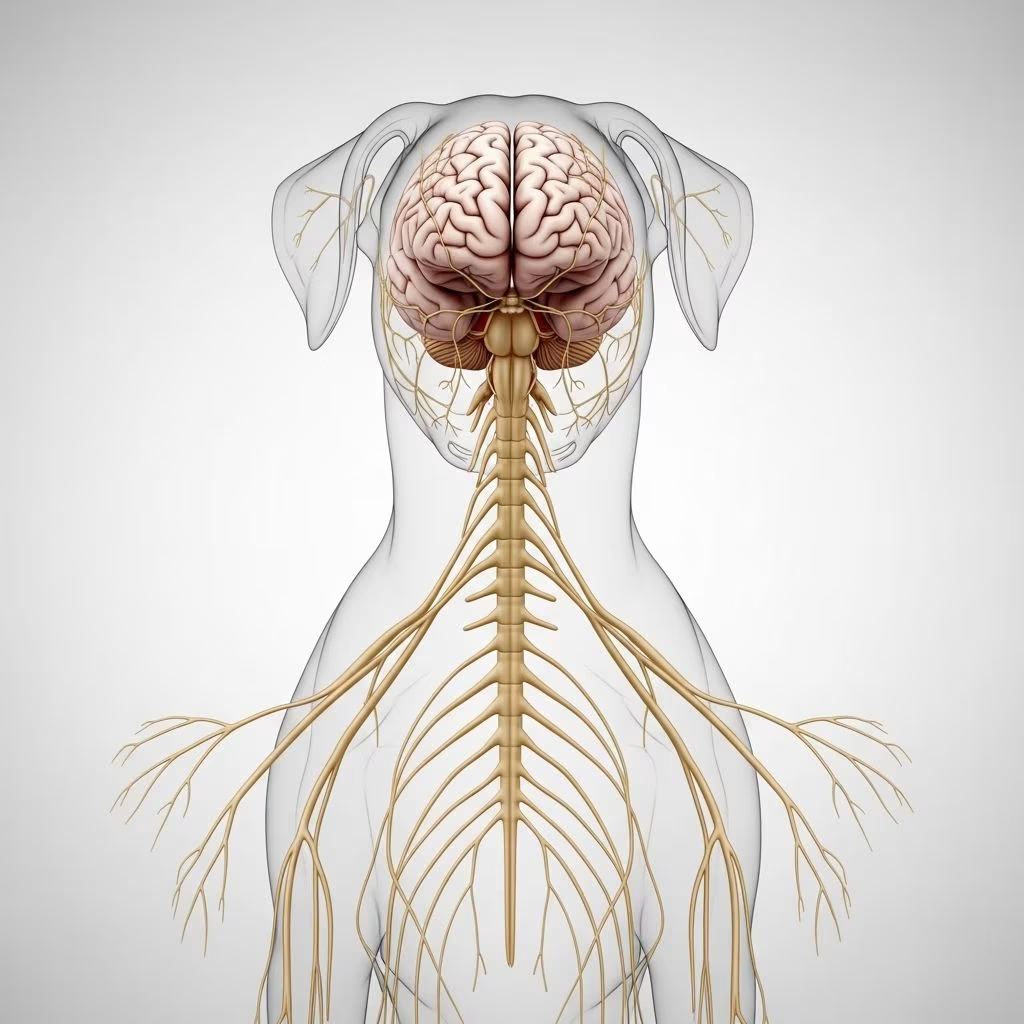
The nervous system in dogs serves as the primary communication network, coordinating everything from basic survival instincts to complex behaviors. It processes sensory inputs, generates responses, and maintains homeostasis through a sophisticated array of structures and cells. Understanding this system helps dog owners recognize signs of neurological issues early.
Overview of the Nervous System Divisions
Dogs possess a highly developed nervous system divided into two primary branches: the central nervous system (CNS) and the peripheral nervous system (PNS). The CNS acts as the command center, while the PNS extends its reach throughout the body.
- Central Nervous System (CNS): Comprises the brain and spinal cord, protected by bony structures and membranes.
- Peripheral Nervous System (PNS): Includes nerves that connect the CNS to muscles, organs, and sensory receptors.
These divisions work in tandem to enable dogs to navigate their environment, respond to stimuli, and perform voluntary and involuntary actions.
Key Components of the Central Nervous System
The CNS is the core processing unit for all neural activities in canines. It integrates information and issues commands that dictate bodily functions.
The Brain: Command and Control Hub
The canine brain, despite its modest size of about 2-3 ounces, contains hundreds of millions of neural connections. It is encased in the skull for protection and divided into distinct regions, each with specialized roles.
| Brain Region | Primary Functions | Key Features in Dogs |
|---|---|---|
| Brain Stem | Regulates vital functions like breathing, heart rate, and reflexes | Connects brain to spinal cord; handles unconscious processes |
| Cerebrum | Manages conscious thought, decision-making, and sensory processing | Divided into left and right hemispheres linked by corpus callosum |
| Cerebellum | Coordinates balance, posture, and fine motor skills | Located at the rear; essential for agile movements in dogs |
The cerebrum, the largest section, features lobes such as the frontal for behavior, parietal for sensory mapping, temporal for hearing and memory, and occipital for vision. In dogs, the frontal lobe is proportionally smaller than in humans, reflecting differences in cognitive processing.
Spinal Cord: The Information Highway
Extending from the brain through the vertebral column, the spinal cord relays signals between the brain and body. In dogs, it spans from the neck to just past the pelvis, segmented into cervical, thoracic, lumbar, sacral, and caudal regions corresponding to spinal vertebrae.
- Cervical: Neck area, controls front limbs and neck movements.
- Thoracic: Chest, innervates forequarters and respiratory muscles.
- Lumbar: Lower back, governs hind limbs.
- Sacral and Caudal: Pelvis and tail, manage bladder, bowel, and tail functions.
Dogs typically have 7 cervical, 13 thoracic, 7 lumbar, 3 sacral, and 20-23 caudal vertebrae, providing flexibility and protection.
Protective Layers of the CNS
The brain and spinal cord are safeguarded by the meninges, a three-layered membrane system, and cerebrospinal fluid (CSF). These structures cushion against mechanical stress during activity.
- Dura Mater: Tough outer layer, fibrous and resilient.
- Arachnoid Mater: Middle web-like layer, forms CSF-filled spaces.
- Pia Mater: Innermost vascular layer, clings to neural tissues.
CSF circulates within these layers, providing nutrients, removing waste, and absorbing shocks from jumps or runs common in active dogs.
Building Blocks: Neurons and Their Roles
Neurons are the functional units of the nervous system, numbering in the billions. Each consists of a cell body, dendrites for input, and axons for output.
Electrical impulses travel along axons, culminating in neurotransmitter release at synapses to propagate signals to adjacent cells, muscles, or glands. Glial cells, comprising 90% of CNS cells, support neurons by providing structural aid, insulation, and immune defense.
Types of Neurons in Dogs
Canine neurons specialize by function:
- Sensory (Afferent) Neurons: Transmit data from receptors (e.g., pain, touch, vision, smell) to the CNS.
- Motor (Efferent) Neurons: Carry commands from CNS to effectors like muscles for movement.
Within the spinal cord, motor neuron axons bundle into tracts for efficient signal transmission to limbs.
Peripheral Nervous System: Extending the Reach
The PNS links the CNS to the periphery via spinal and cranial nerves. Spinal nerves emerge in pairs from the cord, branching to limbs, organs, and skin. Cranial nerves, 12 pairs, primarily serve the head and face.
These nerves subdivide into somatic components for voluntary control and autonomic for involuntary regulation.
Autonomic Nervous System: Invisible Regulator
The autonomic nervous system (ANS) oversees unconscious processes like heart pumping, digestion, and pupil dilation. It splits into sympathetic (fight-or-flight) and parasympathetic (rest-and-digest) branches.
In dogs, parasympathetic fibers originate from cranial nerve nuclei, such as the oculomotor nerve for eye control, while sympathetic pathways influence cardiac and gastrointestinal functions.
| ANS Division | Effects | Examples in Dogs |
|---|---|---|
| Sympathetic | Increases heart rate, dilates pupils | Response to threats or exercise |
| Parasympathetic | Slows heart rate, aids digestion | Promotes recovery and relaxation |
Neural Pathways and Communication
Information flow begins with sensory neurons detecting stimuli, relaying to the spinal cord or brainstem, then to higher brain areas for processing. Responses descend via motor tracts.
This loop enables dogs to react swiftly—e.g., withdrawing from pain or pursuing prey—demonstrating the system’s efficiency.
Common Neurological Signs in Dogs
Disruptions manifest as:
- Ataxia (uncoordinated gait) from cerebellar or spinal issues.
- Seizures or behavioral changes from cerebral problems.
- Paralysis or weakness from motor neuron damage.
- Altered reflexes indicating brainstem involvement.
Early veterinary intervention is crucial for conditions like intervertebral disc disease or meningitis.
FAQs
What protects a dog’s brain and spinal cord?
The meninges (dura, arachnoid, pia) and CSF provide multilayered protection.
How many spinal nerves do dogs have?
Pairs of spinal nerves (typically 30-38 total) emerge from cord segments.
What does the cerebellum do in dogs?
It fine-tunes movement, balance, and coordination for activities like running.
Can dogs feel pain like humans?
Yes, via sensory neurons transmitting nociceptive signals to the brain.
How does the autonomic system affect a dog’s heart?
Sympathetic accelerates, parasympathetic decelerates heartbeat.
Maintaining Nervous System Health
Support your dog’s neurology through balanced nutrition rich in omega-3s for myelin, regular exercise for circulation, and prompt care for injuries. Avoid toxins like chocolate or xylitol that impair neural function. Annual vet checks aid early detection of issues like vestibular disease or epilepsy.
References
- Parts of the Nervous System in Dogs — MSD Veterinary Manual. 2023. https://www.msdvetmanual.com/dog-owners/brain-spinal-cord-and-nerve-disorders-of-dogs/parts-of-the-nervous-system-in-dogs
- The Autonomic Nervous System — Veterian Key. 2016. https://veteriankey.com/the-autonomic-nervous-system-2/
- The Canine Central Nervous System — Whole Dog Journal. 2022. https://www.whole-dog-journal.com/health/the-canine-central-nervous-system/
- Canine Nervous System — Willamette Veterinary Hospital. 2024. https://wilvet.com/interactive-animal/canine/nervous/
- Nervous System — Linden Veterinary Clinic. 2023. https://lindenvet.co.za/nervous-system/
- Anatomy: Small Animal — University of Calgary Faculty of Veterinary Medicine (.edu). 2025. https://vet.ucalgary.ca/summercamps/anatomy/monday/small-animal



