

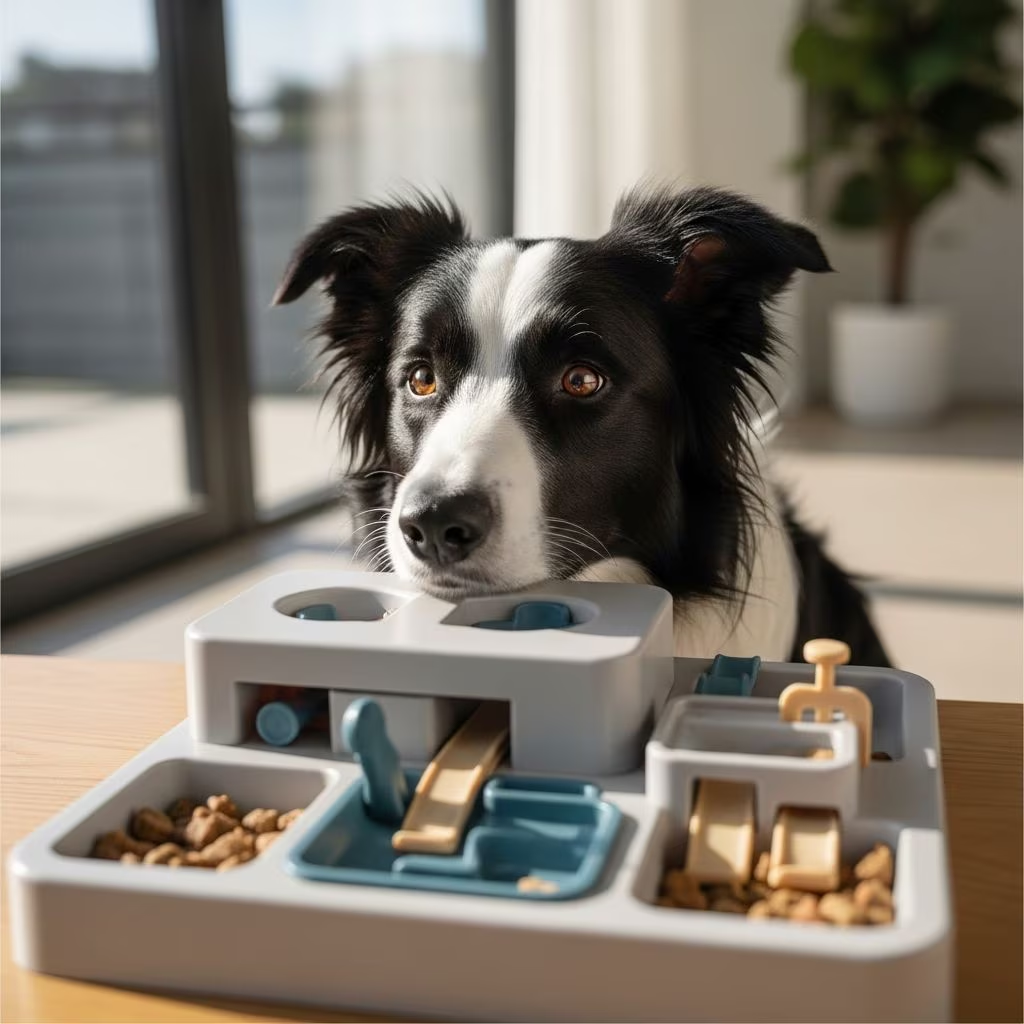
For centuries, dog owners have marveled at their companions’ apparent ability to understand commands, anticipate their needs, and navigate complex social situations. Yet the scientific study of how dogs actually think and process information is a relatively modern pursuit. In recent years, researchers have increasingly focused on understanding canine cognition—the mechanisms through which dogs acquire, store, and utilize information to interact with their environment and the humans around them. This emerging field reveals that dogs possess sophisticated mental capabilities that extend far beyond simple stimulus-response behaviors.
What Is Canine Cognition?
Canine cognition refers to the mental processes by which dogs acquire, process, and apply information. This encompasses how dogs perceive sensory input, form memories, learn from experience, solve problems, and interact socially with other dogs and humans. Rather than operating purely on instinct, dogs demonstrate the ability to think abstractly, anticipate outcomes, and modify their behavior based on previous experiences.
The scope of canine cognitive science is broad. Researchers examine sensory perception—how dogs see, hear, and smell their world—as well as higher-order thinking processes like logical reasoning, strategic problem-solving, and social awareness. Understanding these mental processes helps explain why dogs vary so dramatically in their personalities, learning speeds, and behavioral tendencies.
Core Cognitive Domains in Dogs
Modern canine cognition research identifies several distinct areas of mental functioning:
- Sensory cognition: How dogs interpret visual patterns, auditory information, and olfactory signals to make sense of their surroundings
- Memory formation: The capacity to retain information and recall it when needed, enabling learning from past events
- Social cognition: The ability to read human body language, respond to pointing gestures, and understand social hierarchies and relationships
- Problem-solving: The capacity to approach unfamiliar challenges strategically rather than through trial-and-error alone
- Impulse control: The ability to inhibit immediate responses and delay gratification
- Self-awareness: Evidence suggests dogs possess some degree of self-recognition, demonstrated through olfactory identification
How Cognitive Testing Measures Dog Intelligence
To objectively assess canine cognitive abilities, researchers have developed standardized test batteries. One notable example is the smartDOG cognitive assessment, which evaluates dogs across multiple dimensions of mental functioning. This test package includes measures of impulse control, ability to interpret human gestures, problem-solving capacity, and logical reasoning.
In a major study involving 987 dogs who completed cognitive testing, researchers discovered significant correlations between test performance and observable everyday behaviors. This finding was particularly important because it validated that laboratory measures of cognition actually translate to real-world competencies that dog owners and trainers encounter daily.
The testing approach recognizes that dog intelligence is not unidimensional. Dogs may excel in one cognitive area while showing average abilities in another. For instance, some dogs demonstrate exceptional memory for object names while others struggle with impulse control in stimulating environments.
The Connection Between Cognition and Trainability
One of the most practical discoveries in canine cognition research is the relationship between specific cognitive traits and a dog’s ability to learn. Dogs that perform well on logical reasoning tests were consistently rated by their owners as faster learners. Additionally, dogs showing superior spatial problem-solving abilities and better performance on cylinder tests—which measure the ability to work through physical obstacles—tend to acquire new commands and behaviors more rapidly.
This research has profound implications for dog training. Rather than assuming all dogs learn at similar rates, trainers can now consider that underlying cognitive differences may contribute to variation in training success. A dog that struggles with learning speed may simply process information differently, not represent a behavioral or motivational problem.
Social Cognition: Reading Human Cues
Among the most distinctive cognitive abilities dogs possess is their capacity to interpret human communication. Dogs readily learn to respond to pointing gestures, follow a human’s gaze direction, and understand verbal commands in human languages. This social-cognitive skill set appears unique within the canine family—wolves and other wild canines do not demonstrate comparable abilities to read human behavioral cues.
Research has documented individual dogs learning hundreds of object names through verbal command and retrieval tasks. One famous case involved a Border Collie named Betsy, who demonstrated knowledge of over 345 words and could associate objects with their photographic representations. Another Border Collie, Chaser, learned over 1,000 words, suggesting that dogs possess word-processing capabilities roughly equivalent to a 14-month-old human infant.
The cognitive mechanisms underlying this linguistic ability remain an area of active research. Brain imaging studies have shown that dogs’ brains distinguish between familiar and unfamiliar languages even without training, with older dogs showing enhanced discrimination ability—suggesting that linguistic exposure accumulates over time.
Problem-Solving Strategies and Independence
When faced with novel challenges, dogs demonstrate varied problem-solving approaches. Some dogs engage in what researchers term an independent problem-solving style—they work through difficulties autonomously without seeking human assistance. Other dogs adopt a human-oriented approach, quickly turning to people for help or guidance when encountering obstacles.
Recent research indicates that these cognitive styles have meaningful consequences for everyday life. Dogs displaying self-control and readily seeking human assistance in problem situations tend to experience smoother interactions with their owners and fewer behavioral conflicts. Conversely, dogs with high impulsiveness and strong independent problem-solving tendencies may face greater challenges in domestic settings, particularly when they attempt to solve problems without considering household rules or their owner’s preferences.
Self-Control and Impulse Inhibition
Impulse control—the ability to resist immediate urges in favor of more appropriate long-term outcomes—emerges as a critical cognitive trait affecting daily life. Dogs with strong impulse control are more likely to respect boundaries, wait patiently for meals or play, and respond appropriately when excited. In contrast, dogs with weak impulse control may struggle with jumping on visitors, stealing food, or reacting explosively to stimuli.
Testing impulse control typically involves scenarios where dogs must resist an immediate temptation to earn a greater reward. Performance on these tests correlates with owner-reported behaviors and training outcomes. This suggests that cognitive assessment can potentially predict not only learning capacity but also behavioral tendencies that influence a dog’s compatibility with household life.
Comparative Cognition: How Dogs Compare to Other Species
To understand whether canine cognition is truly exceptional, researchers have compared dogs against other animals including wolves, great apes, and domestic ungulates. The findings offer a nuanced picture. While dogs excel at tasks involving human social communication and gesture interpretation, they do not uniformly outperform all other species across all cognitive domains.
For example, research has documented instances where dingoes—wild canines—demonstrate superior performance in non-social problem-solving tasks compared to domestic dogs. This suggests that domestication may have enhanced dogs’ social-cognitive abilities while potentially reducing their independent problem-solving capacities. Dogs have effectively traded certain forms of individual problem-solving capability for superior ability to work collaboratively with humans.
The Impact of Age, Training, and Background
Canine cognition does not develop in isolation from life experience. Research demonstrates that multiple factors influence cognitive performance and behavioral expression. Age plays a role—older dogs sometimes show advantages in certain domains, such as language discrimination, though this may reflect accumulated exposure rather than enhanced capacity. Training history significantly affects which cognitive abilities dogs demonstrate, as formal instruction can develop capabilities that might otherwise remain latent. Background factors such as early socialization experiences also shape how dogs apply their cognitive abilities in real-world situations.
This multifactorial perspective explains why two dogs with comparable underlying cognitive capacities may behave quite differently depending on their individual life histories.
Practical Applications for Dog Owners
The expansion of canine cognition research has produced tools and insights increasingly available to everyday dog owners. Cognitive testing batteries developed by researchers are now accessible to the general public, allowing owners to gain objective information about their dogs’ cognitive profiles. Understanding whether a dog has particular strengths in logical reasoning, social attentiveness, or problem-solving can inform training approaches and activity selection.
Additionally, recognizing the connections between cognitive traits and everyday behavior helps owners develop realistic expectations and tailor their management strategies. A dog prone to independent problem-solving may thrive with enrichment activities that channel this tendency constructively, while a socially-oriented dog might benefit from training that leverages their natural inclination to seek human guidance.
The Evolution of Dog Cognition Studies
The scientific study of dog cognition has experienced exponential growth since the 1990s. This acceleration reflects both technological advances enabling brain imaging and behavioral analysis, as well as growing recognition that understanding how dogs think has practical value for training, breeding, and welfare. As research methodologies have become more sophisticated, findings have grown increasingly nuanced, moving beyond simplistic notions of intelligence toward comprehensive mapping of cognitive abilities and their real-world manifestations.
Future Directions in Canine Cognition Research
Ongoing research continues to expand understanding of canine mental processes. Emerging areas include investigation of how individual cognitive profiles predict success in service dog and working dog roles, exploration of breed-specific cognitive patterns, and examination of how cognitive abilities develop across a dog’s lifespan. As research tools improve and sample sizes increase, the field promises increasingly detailed understanding of the canine mind.
Frequently Asked Questions
Are some dog breeds more intelligent than others?
While breed tendencies exist, cognition is multidimensional rather than unidimensional. Breeds may show different patterns of cognitive strength rather than universal intelligence differences. A breed might excel at one form of cognition while showing average abilities in another.
Can cognitive abilities be measured objectively?
Yes. Standardized test batteries like smartDOG measure specific cognitive domains through controlled tasks. These tests demonstrate validity by correlating with real-world behavioral measures reported by owners.
How does cognitive testing help with training?
Understanding a dog’s cognitive profile helps trainers select appropriate methods, set realistic goals, and identify potential behavioral challenges. Dogs with strong logical reasoning show faster learning rates, while dogs with different cognitive strengths may benefit from adapted approaches.
Can human-oriented problem-solving be taught?
While cognitive styles show some stability, training can strengthen dogs’ tendency to seek human guidance in problem situations through positive reinforcement and environmental management.
References
- Canine cognitive traits linked to everyday behaviour — University of Helsinki. 2024. https://www.helsinki.fi/en/news/dogs/canine-cognitive-traits-linked-everyday-behaviour
- In what sense are dogs special? Canine cognition in comparative perspective — National Center for Biotechnology Information (NCBI/NIH). https://pmc.ncbi.nlm.nih.gov/articles/PMC6276074/
- Dog intelligence — Wikimedia Foundation. https://en.wikipedia.org/wiki/Dog_intelligence
- How dogs think — American Psychological Association. 2025. https://www.apa.org/monitor/2025/10/how-dogs-think
- Why the number of dog cognition studies is rapidly rising — Psychology Today. 2021. https://www.psychologytoday.com/us/blog/canine-corner/202109/why-the-number-dog-cognition-studies-is-rapidly-rising



