
Canine IVDD: Spinal Disc Issues in Dogs
Discover the essentials of Intervertebral Disc Disease in dogs, from early warning signs to advanced treatments and prevention strategies for a healthier life.
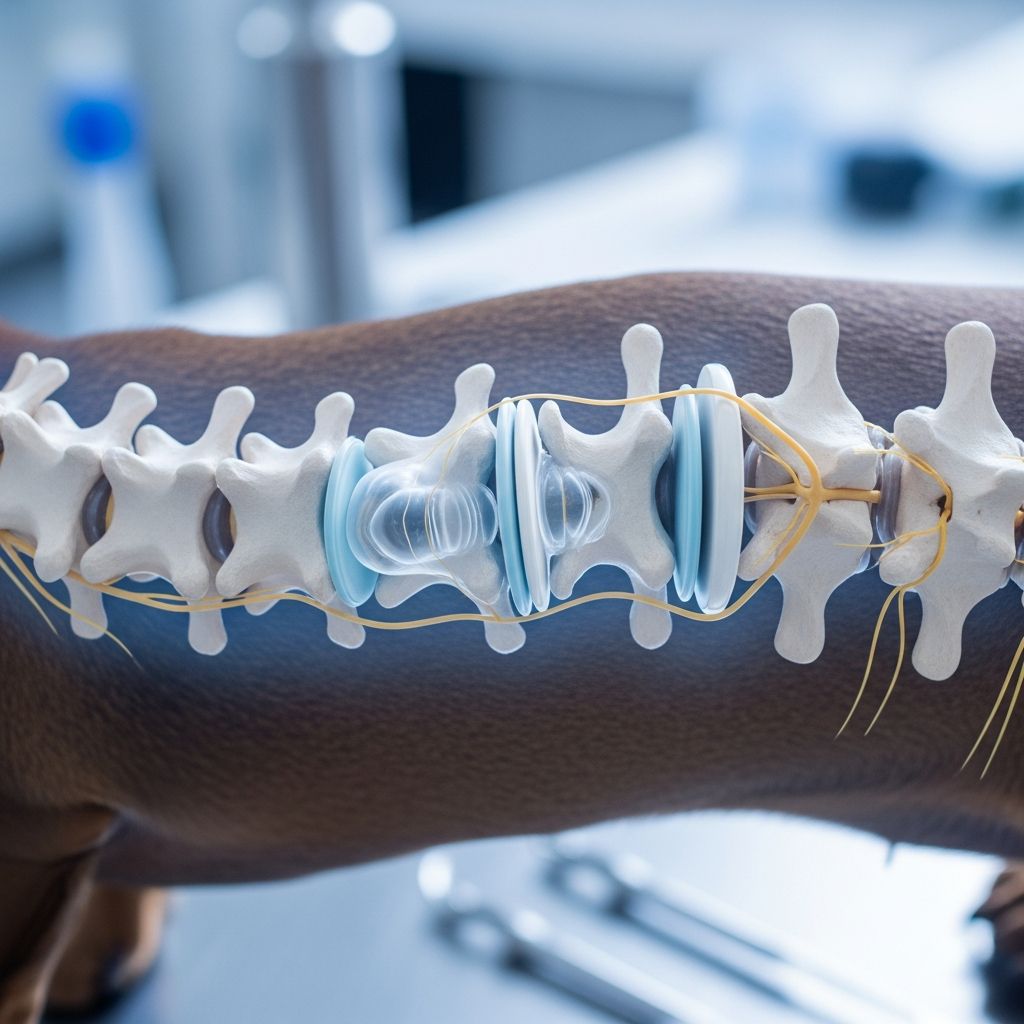
Intervertebral Disc Disease (IVDD) represents a prevalent spinal condition in dogs, where the cushions between vertebrae degenerate and potentially herniate, compressing the spinal cord and nerves. This leads to a spectrum of issues from mild discomfort to complete paralysis, particularly affecting certain breeds.
The Anatomy of a Dog’s Spine and Disc Function
Dogs possess a spine composed of vertebrae separated by intervertebral discs, which act as shock absorbers during movement. These discs consist of a tough outer layer (annulus fibrosus) encasing a gel-like core (nucleus pulposus). In healthy dogs, they provide flexibility and protect the spinal cord running through the vertebral canal.
Over time or due to genetic predispositions, these discs can calcify or weaken. When compromised, the inner material may extrude or the disc may bulge, impinging on neural structures. This disruption interrupts nerve signals, causing pain, weakness, or loss of function in limbs and organs.
Primary Causes and Risk Factors for IVDD
IVDD arises mainly from degenerative changes in the discs, accelerated by age, genetics, and physical stress. Trauma from jumps or falls can trigger herniation in predisposed dogs.
- Genetic Predisposition: Breeds with elongated bodies and short legs, such as Dachshunds, Beagles, and Shih Tzus, face higher risks due to chondrodystrophic traits that promote early disc mineralization.
- Age-Related Degeneration: Discs naturally harden with age, more acutely in chondrodystrophic breeds by 2-4 years and gradually in others after 5-7 years.
- Obesity and Activity: Excess weight strains the spine, while high-impact activities like jumping exacerbate weakened discs.
Two main types dominate: Hansen Type I (acute extrusion in young chondrodystrophic dogs) and Type II (chronic bulging in older, non-chondrodystrophic breeds).
Recognizing Symptoms: From Subtle Signs to Emergencies
Symptoms depend on the herniation’s location (cervical, thoracolumbar, or lumbosacral) and severity. Early detection is crucial to prevent permanent damage.
Cervical IVDD Signs (Neck Region)
- Intense neck pain, reluctance to turn head
- Held-low head posture
- Weakness or wobbling in front legs
- Limping or dragging front paws
- In severe cases, all four-limb ataxia or paralysis
Thoracolumbar IVDD Signs (Mid-Back)
- Hunched back, muscle spasms
- Hind leg weakness, crossing or dragging feet
- Knuckling toes, unsteady gait
- Tense abdomen, reluctance to rise or jump
- Progressing to hind limb paralysis
Lumbosacral IVDD Signs (Lower Back)
- Tail limpness, difficulty jumping
- Urinary or fecal incontinence
- Dilated anus, pain on defecation
- Hindquarter weakness without full paralysis
General indicators include shivering, panting, appetite loss, and anxious behavior. Severe cases show loss of deep pain sensation, a poor prognostic sign.
Diagnosis: Confirming IVDD in Your Dog
Veterinarians start with a neurologic exam assessing gait, reflexes, and pain response. Imaging confirms the diagnosis:
| Method | Description | Advantages |
|---|---|---|
| Plain Radiographs | X-rays detect disc mineralization or narrowing | Non-invasive, rules out fractures |
| Myelogram | Dye injected to visualize cord compression | Gold standard for surgical planning |
| CT/MRI | Advanced cross-sections of discs and cord | Precise, no dye needed; MRI best for soft tissue |
Neurologic grading (1-5) guides treatment: Grade 1 (pain only) to Grade 5 (paralysis without sensation).
Treatment Pathways: Conservative vs. Surgical Options
Treatment hinges on severity, duration, and location. Prompt intervention improves outcomes.
Conservative Management
Suitable for Grade 1-3 with deep pain intact and symptoms under 24-48 hours:
- Strict crate rest (4-6 weeks)
- Pain meds (NSAIDs, opioids, muscle relaxants)
- Physiotherapy (laser therapy, underwater treadmill)
- Monitoring for deterioration
Surgical Intervention
Recommended for Grade 3-5, especially without deep pain beyond 24 hours (success drops):
- Hemilaminectomy removes extruded material
- Ventral slot for cervical cases
- Post-op rehab essential
Success rates: 80-95% for ambulatory recovery in acute cases with pain sensation.
Prognosis Factors and Recovery Expectations
Key predictors include:
- Deep Pain Presence: Absent beyond 48 hours signals <50% recovery chance.
- Time to Surgery: Optimal within 24 hours.
- Post-Op Care: Compliance with rest/rehab boosts outcomes.
Recovery timeline: Weeks to months. Incontinence may persist but often resolves.
Prevention Strategies for At-Risk Dogs
Minimize IVDD incidence through:
- Weight Control: Maintain ideal body condition.
- Low-Impact Exercise: Avoid stairs/jumps; use ramps.
- Breeding Choices: Select non-chondrodystrophic lines.
- Early Screening: Annual neuro exams for breeds over 3 years.
Frequently Asked Questions (FAQs)
Can IVDD be cured completely?
Many dogs regain function with treatment, but degenerative nature means recurrence risk persists. Prevention is key.
Is surgery always necessary for IVDD?
No, mild cases respond to rest and meds. Surgery for severe compression or paralysis.
Which breeds are most prone to IVDD?
Dachshunds (45-75% lifetime risk), French Bulldogs, Corgis, Bassets.
How long does recovery take?
4-12 weeks with rehab; full function may take 3-6 months.
Can obese dogs develop IVDD?
Yes, extra weight accelerates disc strain in any breed.
Long-Term Management and Quality of Life
Post-recovery, harnesses replace collars, supportive slings aid mobility, and ongoing physio maintains strength. Wheelchairs enable active lives for paraplegic dogs. Regular vet check-ups monitor for re-herniation.
Owners report high satisfaction with early intervention, emphasizing vigilance in high-risk breeds.
References
- Intervertebral Disk Disease in Dogs (IVDD) in Dogs — PetMD. 2023. https://www.petmd.com/dog/conditions/neurological/c_dg_intervertebral_disc_disease
- IVDD (Intervertebral Disc Disease) in Dogs — Matthews Carolina Vet. 2020-08-14. https://www.matthews.carolinavet.com/site/pet-health-blog/2020/08/14/ivdd-intervertebral-disc-disease-in-dogs
- Intervertebral Disk Disease in Dogs Treatment, Symptoms, Causes — AKC. 2023. https://www.akc.org/expert-advice/health/intervertebral-disk-disease-dogs/
- What Is Intervertebral Disc Disease (IVDD) in Dogs? — WebMD. 2023. https://www.webmd.com/pets/dogs/what-is-intervertebral-disc-disease-dogs
- Intervertebral Disc Disease in Dogs: Symptoms, Causes & Surgery — Providence Vets Waxhaw. 2020-07-23. https://www.waxhaw.providencevets.com/site/blog/2020/07/23/intervertebral-disc-disease-dogs
- Signs & Treatment for Intervertebral Disc Disease (IVDD) in Dogs — VMSG. 2021-05-07. https://www.vmsg.com/site/blog/2021/05/07/intervertebral-disc-disease-dogs
- Intervertebral disc disease — Cornell University College of Veterinary Medicine. 2023. https://www.vet.cornell.edu/departments-centers-and-institutes/riney-canine-health-center/canine-health-topics/intervertebral-disc-disease
Similar Articles








Read full bio of Sneha Tete




