

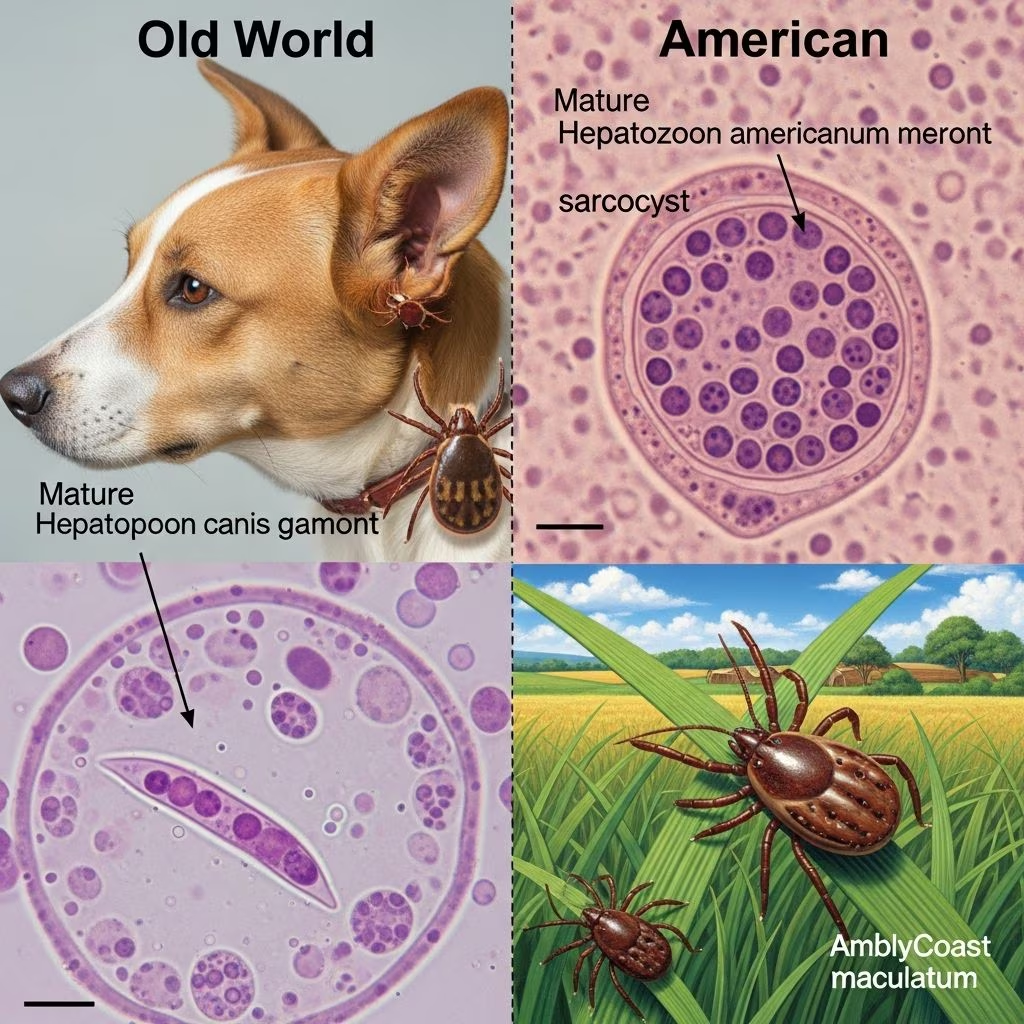
Canine hepatozoonosis represents a group of protozoal infections affecting dogs, primarily transmitted through the ingestion of infected ticks rather than bites. Two key variants dominate: the Old World form caused by Hepatozoon canis, common in tropical regions globally, and the more severe American canine hepatozoonosis (ACH) due to Hepatozoon americanum, prevalent in the southern United States. These parasites invade white blood cells and tissues, leading to a spectrum of health issues from subclinical infections to debilitating disease.
Understanding the Parasites and Their Life Cycles
The life cycle of Hepatozoon species is unique among tick-borne pathogens because dogs become infected by eating infected ticks or intermediate hosts containing the parasite’s dormant stages, not through saliva during feeding. In ticks, the parasite undergoes sexual reproduction, producing oocysts filled with sporocysts, each containing 12-24 sporozoites—the infective form for dogs.
For H. americanum, the Gulf Coast tick (Amblyomma maculatum) serves as the vector. Sporulated oocysts remain in the tick’s hemocoelom without migrating to salivary glands. Dogs ingest these ticks while grooming, hunting, or scavenging. Sporozoites are released in the dog’s intestine, penetrate the gut wall, enter leukocytes, and spread to muscles, bones, and organs where merogony (asexual reproduction) occurs, forming inflammatory cysts.
In contrast, H. canis uses the brown dog tick (Rhipicephalus sanguineus). Its sporozoites primarily reside in white blood cells without forming large muscle cysts, resulting in less tissue destruction. Ticks acquire gametocytes by feeding on infected dogs, passing the infection transovarially to offspring, perpetuating endemic cycles.
Geographic Distribution and Risk Factors
H. americanum is concentrated in the southeastern and southern US, correlating with A. maculatum habitats in coastal grasslands and wooded areas. Cases occasionally appear elsewhere due to tick relocation. H. canis, the Old World form, thrives in Africa, Asia, the Middle East, and southern Europe, with sporadic US reports, often imported via travel.
Risk escalates in warm, humid climates favoring tick proliferation. Dogs that hunt, scavenge wildlife like rodents or birds (paratenic hosts harboring cystozoites), or live in tick-infested yards face higher exposure. Breeds like Greyhounds and hunting dogs show increased susceptibility, possibly due to lifestyle. Vertical transmission from dam to pups remains unproven but suspected via placental merozoites.
Clinical Manifestations: Symptoms and Progression
Symptoms emerge 4-10 weeks post-infection for ACH, starting with fever, neutrophilic leukocytosis, and lethargy. Dogs develop severe myalgia (muscle pain), lameness, reluctance to move, mucopurulent eye discharge, and weight loss. Advanced cases involve muscle atrophy, recumbency, and secondary infections, often proving fatal without intervention. Large cysts in skeletal muscles incite granulomatous inflammation, explaining the pain.
H. canis infections are often milder or asymptomatic, especially in endemic areas where dogs develop immunity. When clinical, signs include fever, anorexia, and mild anemia, without prominent muscle involvement. Parasites appear in buffy coat smears of blood.
| Feature | American (H. americanum) | Old World (H. canis) |
|---|---|---|
| Severity | Severe, often fatal | Mild to subclinical |
| Key Symptoms | Muscle pain, lameness, fever, eye discharge | Fever, anemia, lethargy |
| Tissue Impact | Muscle cysts, bone lesions | Leukocytes, organs |
| Vector Tick | Amblyomma maculatum | Rhipicephalus sanguineus |
Diagnostic Approaches for Accurate Identification
Diagnosis hinges on history of tick exposure in endemic areas plus clinical signs like neutrophilia and myalgia. For ACH, muscle biopsies reveal meronts or cysts; PCR on blood or tissue confirms H. americanum. Blood smears may show gametocytes in leukocytes for H. canis, though sensitivity is low.
Serology detects antibodies but cannot distinguish active from past infection. Imaging like radiographs shows bone lesions in ACH. Differential diagnoses include immune-mediated diseases, bacterial infections, or other protozoa like Babesia. Early PCR is recommended for high-risk dogs with unexplained fever or pain.
Treatment Protocols: Acute and Long-Term Management
ACH requires aggressive therapy: trimethoprim-sulfadiazine (15 mg/kg PO q12h), chloramphenicol (50 mg/kg PO q8h), and pyrimethamine (0.25 mg/kg PO q24h) for 14 days to target meronts, followed by decoquinate (25-50 mg/kg PO daily) for 2+ years to prevent recrudescence. Ponazuril (50 mg/kg PO q24h for 28 days) offers an alternative acute phase.
H. canis responds to imidocarb dipropionate (5-7.5 mg/kg IM q14d x2) or doxycycline. Supportive care includes NSAIDs for pain, fluids, and nutrition. Prognosis for ACH improves with prompt treatment but relapses occur without maintenance.
- Acute ACH Phase: Triple therapy for 2 weeks
- Maintenance: Decoquinate indefinitely
- Monitoring: Monthly PCR and clinical exams
Prevention Strategies: Breaking the Transmission Cycle
Year-round tick preventives (e.g., isoxazolines) reduce but do not eliminate risk since ingestion is key. Discourage scavenging, hunting rodents/birds, and grooming ticks off fur. Prompt tick removal before ingestion helps. Avoid endemic areas during peak tick season (spring-fall in US South).
Vaccines are unavailable; reservoir control via treating carrier dogs limits spread. Environmental management includes acaricide yard treatments.
Pathophysiology: How the Parasite Evades Defenses
Sporozoites encyst in paratenic hosts as cystozoites, dormant until ingested by dogs. In canines, they hijack leukocytes for dissemination, completing merogony shielded from immunity. Rupturing meronts trigger inflammation via merozoite release, forming granulomas with parasites in macrophages. H. americanum‘s muscle tropism amplifies damage.
Chronic carriers shed gametocytes, infecting feeding ticks, sustaining cycles. Dogs mount antibodies, but cell-mediated responses falter against intracellular stages.
Epidemiology and Emerging Concerns
ACH cases rise with A. maculatum expansion northward due to climate change. Co-infections with Ehrlichia or Anaplasma complicate outcomes. Global travel spreads H. canis. Surveillance via PCR in at-risk populations is crucial.
Frequently Asked Questions (FAQs)
Can hepatozoonosis spread dog-to-dog directly?
No, transmission requires ticks or paratenic hosts; no direct contact or saliva spread.
Is hepatozoonosis fatal in all cases?
ACH can be without treatment, but H. canis is rarely so. Early intervention improves survival.
How long does treatment last for ACH?
Acute phase: 2 weeks; maintenance: 2 years or lifelong.
Are there vaccines for canine hepatozoonosis?
None currently available; focus on prevention.
Can cats get hepatozoonosis?
Rare; primarily a canine disease.
References
- American Canine Hepatozoonosis — Companion Animal Parasite Council. 2023. https://capcvet.org/guidelines/american-canine-hepatozoonosis/
- Hepatozoonosis in Dogs — VCA Animal Hospitals. 2023. https://vcahospitals.com/know-your-pet/hepatozoonosis-in-dogs
- American Canine Hepatozoonosis — PubMed Central (PMC). 2002-10-01. https://pmc.ncbi.nlm.nih.gov/articles/PMC207105/
- American Canine Hepatozoonosis — Clinical Microbiology Reviews (ASM). 2003-10-01. https://journals.asm.org/doi/abs/10.1128/cmr.16.4.688-697.2003
- Old World Hepatozoonosis and American Canine Hepatozoonosis — Merck Veterinary Manual. 2023. https://www.merckvetmanual.com/circulatory-system/blood-parasites/old-world-hepatozoonosis-and-american-canine-hepatozoonosis



