

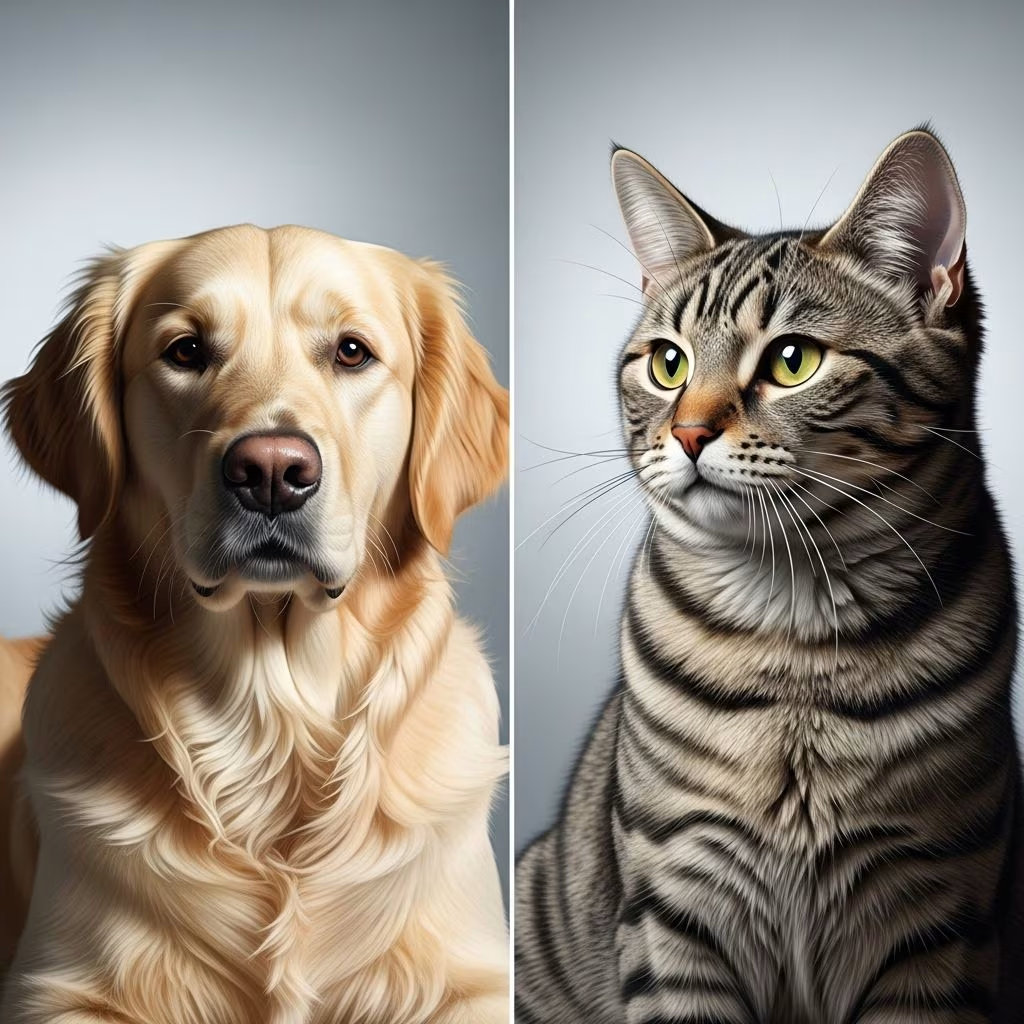
Dogs and cats, beloved companions in countless households, share homes but not the ability to produce hybrid offspring. Biologically, crossbreeding between these two species is impossible due to profound genetic and reproductive differences.
The Genetic Divide Between Dogs and Cats
At the core of this impossibility lies the fundamental mismatch in their genetic makeup. Dogs possess 78 chromosomes arranged in 39 pairs, while cats have 38 chromosomes in 19 pairs. This disparity prevents successful fertilization, as chromosomes from each parent must align properly during cell division for an embryo to develop.
Beyond chromosome count, the DNA sequences, gene structures, and expression patterns of canines (family Canidae) and felines (family Felidae) diverged evolutionarily over 50 million years ago. Even if sperm from a dog were to contact a cat’s egg, the cellular mechanisms would reject it, halting development at the zygote stage.
These barriers ensure species integrity, a natural mechanism observed across mammals. Domestication has led to remarkable diversity within each species—think of the vast array of dog breeds versus cat varieties—but it cannot bridge inter-family gaps.
Real-World Examples of Successful Animal Hybrids
While dog-cat unions fail, nature and human intervention have produced hybrids between closely related species. These cases highlight the strict limits of interbreeding, requiring shared recent ancestry and compatible genetics.
| Hybrid Name | Parent Species | Key Traits | Fertility |
|---|---|---|---|
| Liger | Lion (male) + Tiger (female) | Massive size, faint stripes | Usually infertile |
| Zorse | Zebra + Horse | Striped coat, horse-like build | Sterile |
| Mule | Donkey (male) + Horse (female) | Strong, enduring | Sterile |
| Beefalo | Bison + Cattle | Hardy, meaty | Fertile females possible |
These hybrids succeed because parent species belong to the same genus or family, sharing enough genetic overlap. Dogs and cats, separated by family lines, fall far outside this range.
Historical Claims and Modern Hoaxes
Stories of dog-cat hybrids have persisted for centuries, fueled by folklore, media sensationalism, and digital trickery. In the 1930s, the Journal of Heredity published accounts with photos of supposed hybrids from a fox terrier and cat mating, but these lacked specimen verification and are widely dismissed as hoaxes or misidentifications.
YouTube videos showing dogs mounting cats spark curiosity, yet such behaviors stem from dominance or hormonal drives, not viable reproduction. Imprinting—where animals raised by another species prefer similar mates—can lead to attempts, but no offspring result.
Recent internet myths, like “kuppies” or cat-dog mixes, rely on Photoshopped images or kittens with unusual markings. No peer-reviewed study or veterinary record confirms a live dog-cat hybrid birth.
- Hoax indicators: Lack of DNA evidence, anonymous sources, extraordinary claims without lab analysis.
- Common misidentifications: Calico cats mistaken for dog-like due to fur patterns or rare mutations.
- Ethical note: Promoting fakes harms public understanding of real animal welfare issues.
Why Observed Mating Behaviors Don’t Lead to Babies
Pet owners often witness dogs and cats engaging in mounting or courtship-like actions, especially if raised together from youth. This reflects social bonding or play rather than reproductive intent. Hormones and instincts drive these displays, but physiological incompatibilities—different gestation periods (dogs: 63 days; cats: 65 days), genitalia structures, and gamete recognition—prevent conception.
Cats and dogs can form deep interspecies friendships, nursing each other’s young or sleeping curled together. However, reproduction demands precise biological synchronization absent here.
Scientific Advances: Could Technology Change This?
Modern tools like CRISPR gene editing modify DNA within species but cannot merge canine and feline genomes. In vitro fertilization (IVF) and cloning succeed intraspecifically, not across families. Artificial wombs and synthetic biology focus on conservation or agriculture, not fantasy pets.
Even convergent evolution—where cats and dogs developed similar skull shapes under domestication pressures—shows parallel adaptation, not hybridization potential. Future breakthroughs might create chimeras (cells from multiple species), but viable, fertile dog-cat hybrids remain speculative and ethically fraught.
Common Myths About Pet Breeding Debunked
Misinformation proliferates online, confusing pet owners. Here’s a breakdown:
| Myth | Fact |
|---|---|
| Close bonding enables breeding | Bonds are social; genetics rule reproduction |
| Hybrids gain ‘hybrid vigor’ | Inapplicable to distant species; most fail to develop |
| All hybrids are sterile | Some, like beefalo, are partially fertile if closely related |
| Spaying after a litter helps cats | No benefit; early spaying reduces cancer risks |
Responsible ownership involves spaying/neutering to curb overpopulation, regardless of myths.
Promoting Healthy Multispecies Households
Without hybrid worries, focus on harmony. Introduce pets gradually, provide separate resources, and monitor interactions. Both species thrive on tailored care: high-protein diets for cats, exercise for dogs.
- Training tips: Positive reinforcement builds tolerance.
- Health monitoring: Vaccinations, flea control prevent cross-species issues.
- Vet advice: Annual checkups catch behavioral flags early.
Cats and dogs enrich lives without needing offspring to prove compatibility.
Frequently Asked Questions
Is there any recorded dog-cat hybrid?
No credible scientific record exists. All claims trace to unverified anecdotes or fabrications.
Why do dogs try to mate with cats?
Instinctual behaviors like mounting express dominance or arousal, not crossbreeding success.
Can science create a dog-cat hybrid in the future?
Current tech cannot overcome genetic chasms; ethical barriers would likely halt pursuits.
Are hybrid pets healthier?
Hybrid vigor applies within species or close relatives, not distant ones like dogs and cats.
What if a cat raises puppies or vice versa?
Fostering cross-species bonds occurs but doesn’t enable reproduction.
References
- Can a Dog and a Cat Have a Baby? The Biological Truth — Alibaba Cat Lovers. 2023. https://catlovers.alibaba.com/question/can-a-dog-and-a-cat-have-a-baby
- Cat-dog Hybrids — Macroevolution.net. Accessed 2026. http://www.macroevolution.net/cat-dog-hybrids.html
- Copy-cat evolution: Divergence and convergence within and … — PNAS (Proceedings of the National Academy of Sciences). 2025-01-15. https://www.pnas.org/doi/10.1073/pnas.2413780122
- The Myth of Cat-Dog Hybrids: Understanding Interbreeding Limits — Ore ate AI Blog. 2024. https://www.oreateai.com/blog/the-myth-of-catdog-hybrids-understanding-interbreeding-limits/524e21287f2f44f7e1edc8d34779786d
- Cat and Dog Origins & Breeds — CTS Animals. 2020. https://www.ctsanimals.ca/courses/agr-2020-cat-and-dog-husbandry-welfare/lessons/module-2-responsible-choices-monitoring-your-cat-or-dogs-health/topic/cat-and-dog-origins-breeds/
- Kuppies, Cat-Dogs, And Other Pet Hybrids That Are Too Good to Be … — Atlas Obscura. 2018-06-12. https://www.atlasobscura.com/articles/kuppies-catdogs-pet-hybrids-hoax



