

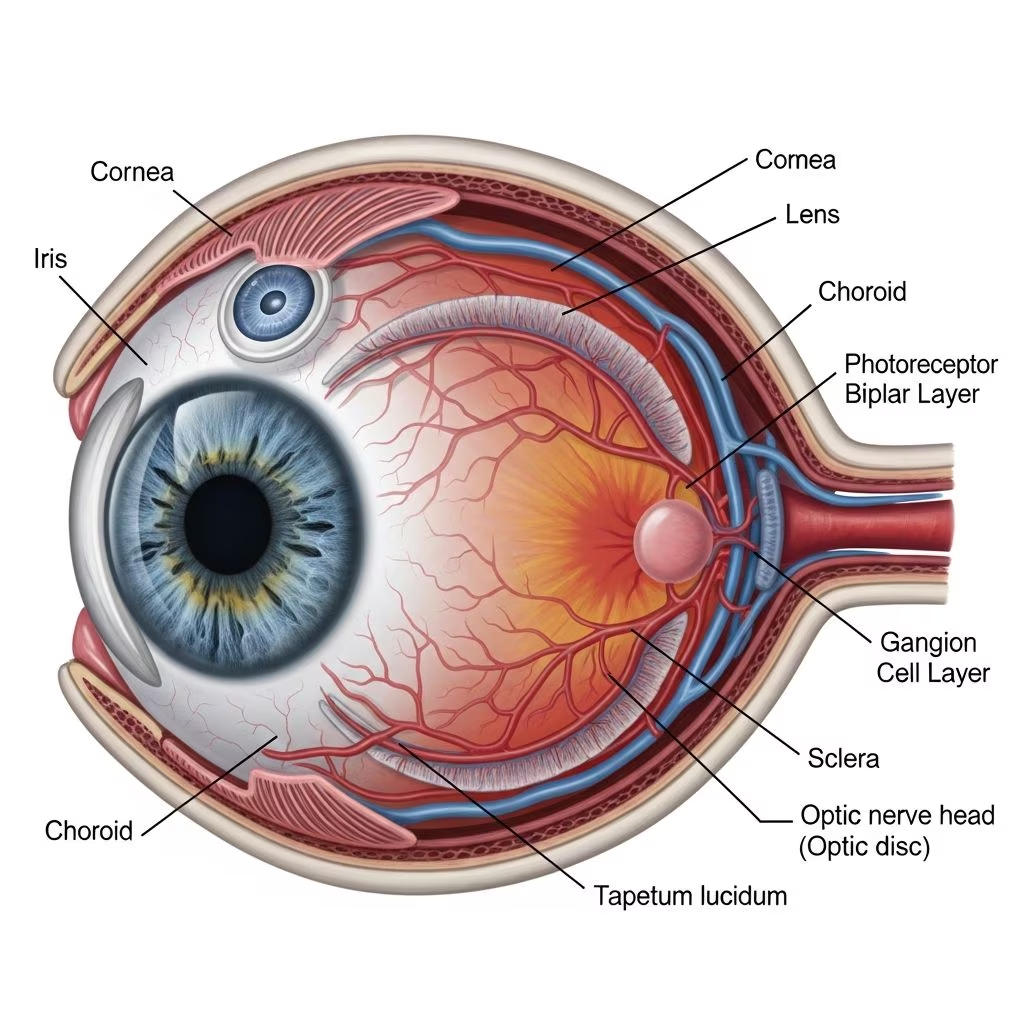
The eyes of dogs represent a remarkable feat of evolutionary design, enabling them to navigate their world with acute awareness of motion and low-light conditions. Unlike human eyes, canine vision prioritizes detecting movement over color detail, thanks to specialized structures within the eyeball. This guide delves into the layered composition of the dog’s eye, its supporting orbital framework, and unique adaptations that set it apart from other species.
The Orbital Foundation: Protecting the Eyeball
The orbit forms a bony socket that cradles the eyeball, extraocular muscles, nerves, blood vessels, and lacrimal glands. This protective cavity, constructed from multiple skull bones, shields the delicate eye from trauma while allowing precise movement. Within the orbit, fat pads cushion the eye, and the retractor bulbi muscle pulls it back into safety during threats.
- Bony walls: Provide rigid enclosure, denser in breeds prone to eye injuries.
- Muscles: Seven key muscles (four recti, two obliques, one retractor) control gaze direction and retraction.
- Glands and ducts: Lacrimal gland produces tears; nasolacrimal ducts drain excess fluid to the nose.
Understanding this setup explains why orbital fractures can lead to vision loss, as they disrupt muscle function and nerve pathways.
Outer Layer: The Protective Shell
The eye’s exterior consists of the sclera and cornea, forming a tough, fibrous barrier. The sclera, or ‘white of the eye,’ comprises three layers: episclera, scleral stroma (dense collagen for opacity and strength), and lamina fusca. Opaque to block excess light, it merges seamlessly with the transparent cornea at the limbus.
The cornea, a dome-shaped structure, accounts for most refractive power, bending incoming light. Its layers include:
| Layer | Composition | Function |
|---|---|---|
| Anterior Epithelium | Multi-layered cells with basement membrane | Protects against pathogens and debris |
| Stroma | 90% thickness; parallel collagen lamellae | Maintains clarity and shape |
| Descemet’s Membrane | Endothelial basement | Supports single-cell endothelium for fluid balance |
Corneal injuries heal rapidly due to regenerative epithelium, but deep ulcers expose Descemet’s, appearing as dark spots under fluorescein staining.
Middle Layer: Vascular and Pigmented Uvea
The uveal tract nourishes the eye: iris anteriorly, ciliary body centrally, choroid posteriorly. The iris, with its pigmented stroma and smooth muscles, adjusts pupil size—dilating in dim light, constricting in brightness—to regulate entry.
Ciliary body produces aqueous humor via processes and controls lens shape through zonules. The choroid supplies blood to the retina, featuring the reflective tapetum lucidum in many dogs, enhancing night vision by bouncing light back to photoreceptors.
- Tapetum lucidum: Iridescent layer absent in humans; causes eye shine in photos.
- Blood supply: Dense vessels prevent retinal oxygen deprivation.
Inner Neurosensory Layer: The Retina
At the back, the retina converts light to neural signals. Packed with rods (motion/low-light sensitivity) and fewer cones (color), dogs excel at dusk hunting but see fewer hues—primarily blues/yellows. The area centralis provides sharpest vision, akin to a human fovea but less specialized.
Photoreceptors synapse with bipolar and ganglion cells; axons form the optic nerve at the optic disk (blind spot). Ora serrata marks the retina’s edge, transitioning to ciliary epithelium.
Optical Components: Lens and Chambers
Behind the iris, the biconvex lens focuses light, flatter anteriorly. Zonules adjust its curvature for near/far vision, though canine accommodation is limited compared to humans. Avascular, it relies on aqueous humor for nutrients.
The eye’s interior divides into aqueous (anterior/posterior chambers) and vitreous compartments. Aqueous, produced by ciliary processes, nourishes avascular tissues and maintains intraocular pressure (10-25 mmHg). It drains via trabecular meshwork; blockages cause glaucoma. Vitreous, a gel filling 80% volume, stabilizes the retina.
Protective Eyelids and Conjunctiva
Upper/lower eyelids, lined by conjunctiva, spread tears and blink 10-20 times per minute. Meibomian glands secrete oily tear film layer, preventing evaporation. Conjunctiva covers sclera (bulbar) and lids (palpebral), inflamed in ‘pink eye.’
Unique Canine Feature: The Third Eyelid
Medial nictitating membrane, with T-shaped cartilage and tear-producing gland (up to 50% of tears), sweeps across the cornea passively via retractor muscle. Lymphoid follicles aid immunity. Prolapse signals illness like dehydration.
How Dogs Perceive the World
Dog vision: 20/75 acuity (blurry at distance), panoramic 240° field, dichromatic color (no red/green). Superior motion detection via rod dominance suits predation.
| Aspect | Dogs | Humans |
|---|---|---|
| Acuity | 20/75 | 20/20 |
| Color Vision | 2 cones (blue/yellow) | 3 cones (RGB) |
| Night Vision | Excellent (tapetum) | Moderate |
| Field of View | 240° | 180° |
Common Eye Conditions and Prevention
Breeds like Bulldogs face entropion; Pugs, dry eye. Monitor for cloudiness (cataracts), redness (uveitis), discharge.
- Regular checks: Vet exams biannually.
- Protection: Goggles for outdoorsy dogs.
- Nutrition: Antioxidants support retinal health.
FAQs
Why do dogs have a third eyelid?
It protects the cornea and produces tears, activating during sleep or stress.
Can dogs see colors?
Yes, but limited to blue/yellow; reds appear grayish.
What causes cherry eye in dogs?
Third eyelid gland prolapse, common in young breeds; surgery often needed.
How to spot eye problems early?
Look for squinting, pawing, cloudiness, or unequal pupils.
Do all dogs have a tapetum lucidum?
Most do, but color varies by breed; enhances low-light vision.
References
- Understanding the anatomy of the eye (cats and dogs) — Dechra UK. Accessed 2026. https://www.dechra.co.uk/companion-animal/ophthalmology/anatomy-of-the-eye
- Dog Vision and Eye Anatomy: How Dogs See — PetMD. Accessed 2026. https://www.petmd.com/dog/general-health/how-do-dogs-see-world
- Dogs Eye Anatomy: Everything You Need To Know About Them — Zigzag.dog. Accessed 2026. https://zigzag.dog/en-us/blog/puppy-health/new-puppy-health/dog-eye-anatomy/
- Eye Structure and Function in Dogs — Merck Veterinary Manual. Accessed 2026. https://www.merckvetmanual.com/dog-owners/eye-disorders-of-dogs/eye-structure-and-function-in-dogs
- Carnivore Anatomy Lab 24 Introduction — University of Minnesota (vanat.ahc.umn.edu). Accessed 2026. https://vanat.ahc.umn.edu/carnLabs/Lab24/Lab24.html



