

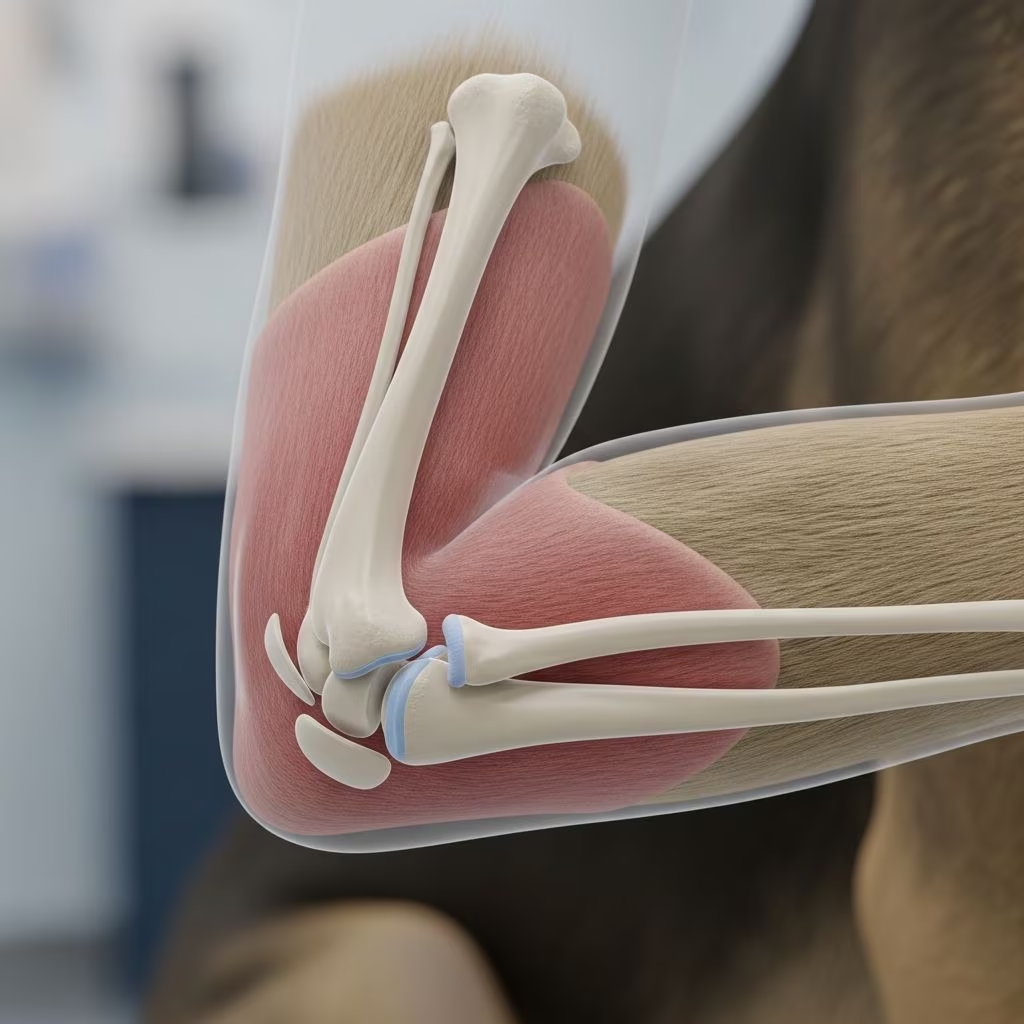
Elbow dysplasia represents a prevalent developmental orthopedic disorder in dogs, particularly impacting large and giant breeds during their growth phase. This condition arises from irregularities in the elbow joint’s formation, leading to discomfort, instability, and eventual joint degeneration.
Understanding the Developmental Roots
The elbow joint in dogs comprises the humerus, radius, and ulna bones, which must align precisely for smooth function. Disruptions in this alignment stem from genetic predispositions, rapid growth rates, or nutritional excesses, resulting in multiple pathological forms.
Key developmental anomalies include fragmented medial coronoid process (FCP), where a portion of the ulna’s coronoid detaches due to stress fractures; osteochondritis dissecans (OCD), involving cartilage flap separation from the humerus; ununited anconeal process (UAP), a failure of bone fusion; and joint incongruity, a mismatch in bone lengths causing uneven load distribution.
Breeds at Heightened Risk
Certain breeds exhibit hereditary vulnerabilities due to selective breeding emphasizing size and speed. Commonly affected varieties encompass Labrador Retrievers, Golden Retrievers, German Shepherds, Rottweilers, Newfoundlands, Bernese Mountain Dogs, and Great Danes.
- Labrador Retriever: Highest incidence, often bilateral.
- German Shepherd: Prone to FCP variants.
- Great Dane: Susceptible to OCD and UAP.
Breeders should prioritize screening via orthopedic evaluations to mitigate propagation.
Recognizing Early Warning Signs
Symptoms typically emerge between 4 and 12 months, though mature dogs may present later with chronic changes. Owners often note subtle shifts progressing to overt lameness.
| Symptom | Description | Frequency |
|---|---|---|
| Lameness | Intermittent or persistent forelimb limp, worsening post-exercise | Most common |
| Joint Effusion | Visible swelling around elbow | High |
| Reduced Motion | Stiffness, pain on flexion/extension | Common |
| Atrophy | Muscle wasting in limb | Progressive |
| Creaking | Audible joint noise during movement | Occasional |
Young dogs may display playful reluctance, while adults show hesitancy in rising or jumping.[10]
Diagnostic Approaches for Confirmation
Veterinarians employ a multi-modal strategy for precise lesion identification, as radiographic findings alone may miss subtle issues.
- Physical Exam: Assess gait, palpate for pain/effusion, measure range of motion.
- Radiography: Standard views detect UAP, OCD fragments, or arthritis.
- Advanced Imaging: CT excels at FCP detection; MRI for soft tissue.
- Arthroscopy: Gold standard for direct visualization and biopsy.
Early diagnosis via CT/arthroscopy optimizes outcomes by addressing lesions before osteoarthritis advances.
Conservative Management Strategies
For mild cases or non-surgical candidates, multimodal therapy controls symptoms and delays progression.
- Weight Optimization: Reduces joint stress; even 10% loss alleviates pain dramatically.
- Pharmacotherapy: NSAIDs (e.g., carprofen), injectable Adequan for cartilage protection, Librela for osteoarthritis pain.
- Supplements: Glucosamine/chondroitin formulations support synovial health.
- Exercise Modification: Leash walks on soft surfaces, avoid stairs/jumping.
Physical rehabilitation incorporates hydrotherapy, laser therapy, and massage to enhance circulation and strength.
Surgical Interventions Explained
Surgery targets specific lesions, recommended for moderate-severe dysplasia in young dogs to preserve joint longevity.
| Procedure | Target Lesion | Outcomes |
|---|---|---|
| Arthroscopic Fragment Removal | FCP, OCD | Pain relief, slowed OA; 80-90% improvement in juveniles |
| UAP Excision | Ununited Anconeal Process | Restores stability; good for early cases |
| Proximal Ulna Osteotomy | Incongruity | Realigns bones; variable success |
| Total Elbow Replacement | End-stage OA | Restores function in adults; emerging technique |
Post-operative care involves 4-8 weeks crate rest, gradual rehab; complications like infection are rare (<5%).
Long-Term Care and Prognosis
Despite interventions, osteoarthritis invariably develops, necessitating lifelong management. Many dogs achieve functional mobility into senior years with diligent care.
Prognosis factors: lesion severity, intervention timing, adherence to therapy. Juveniles post-arthroscopy often regain near-normal activity; chronic cases focus on comfort.
- Monitor weight quarterly.
- Annual orthopedic rechecks.
- Adapt environment: ramps, orthopedic beds.
Prevention Through Responsible Practices
Genetic selection via OFA/ PennHIP elbow scoring prevents propagation. Growth management includes balanced large-breed diets avoiding excess calcium, controlled exercise sans forced rapid growth.
Breed clubs advocate screening; spay/neuter post-maturity in at-risk lines may influence hormones.
Frequently Asked Questions
Can elbow dysplasia affect small breeds?
Rarely; predominantly large/giant breeds due to growth dynamics.
Is surgery always required?
No; conservative measures suffice for mild cases, surgery for advanced lesions.
How much does treatment cost?
Conservative: $500-2000/year; surgery: $3000-8000, varying by complexity.
Will my dog fully recover?
Not cured, but managed effectively; most live comfortably.
What home remedies help?
Weight control, soft bedding, controlled low-impact exercise; consult vet before supplements.
References
- Elbow Dysplasia in Dogs: Symptoms, Causes, and Treatment — PetMD. 2023. https://www.petmd.com/dog/conditions/musculoskeletal/elbow-dysplasia-in-dogs
- Elbow Dysplasia in Dogs: Signs, Symptoms, Treatment — American Kennel Club. 2023. https://www.akc.org/expert-advice/health/elbow-dysplasia-in-dogs/
- Canine Unicompartment Elbow — Bridger Veterinary Specialists. 2024. https://www.bridgervetspecialists.com/services/canine-unicompartment-elbow.html
- Elbow Dysplasia in Dogs — PDSA. 2024. https://www.pdsa.org.uk/pet-help-and-advice/pet-health-hub/conditions/elbow-dysplasia-in-dogs
- Elbow Dysplasia in Dogs — Merck Veterinary Manual. 2023. https://www.merckvetmanual.com/musculoskeletal-system/arthropathies-and-related-disorders-in-small-animals/elbow-dysplasia-in-dogs
- Canine Elbow Dysplasia — Fitzpatrick Referrals Orthopaedics. 2024. https://www.fitzpatrickreferrals.co.uk/orthopaedics/canine-elbow-dysplasia/



