

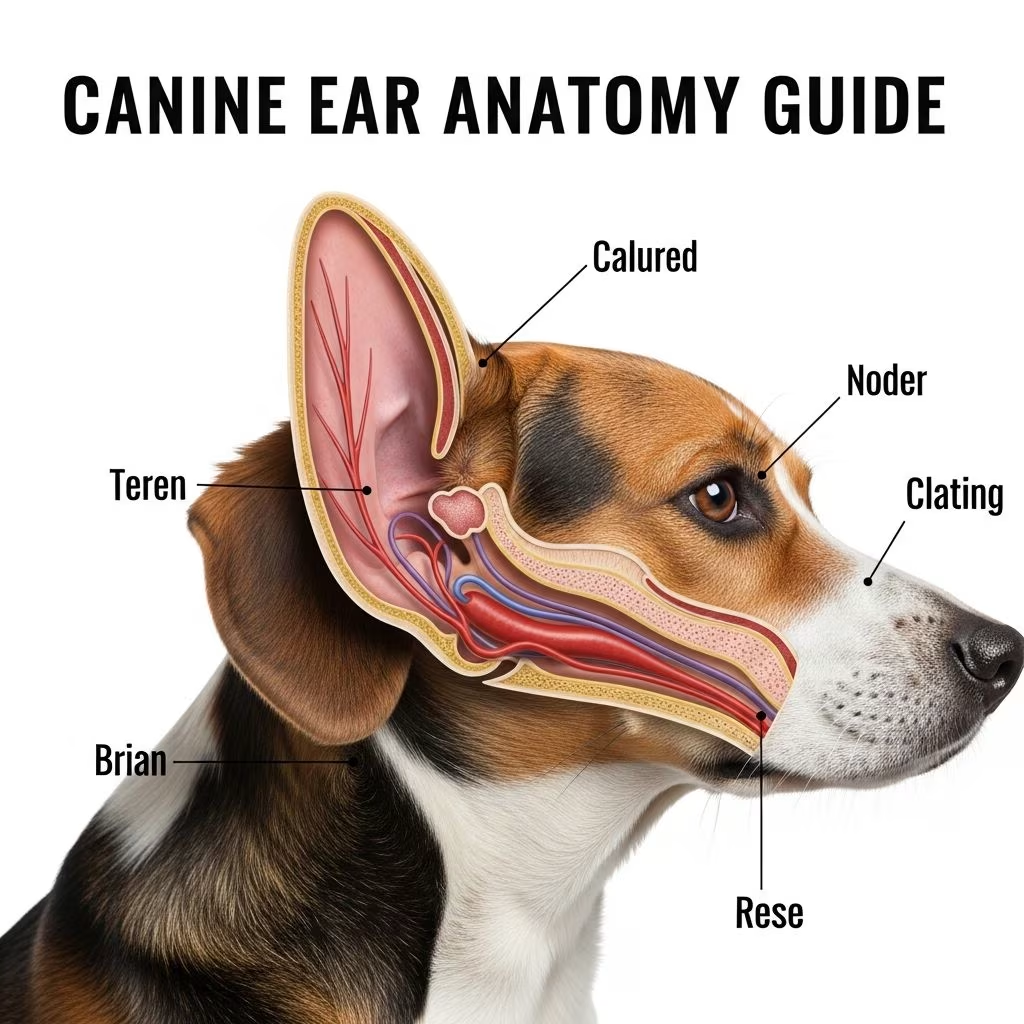
The ears of dogs serve vital roles in hearing, balance, and communication, featuring a complex structure divided into outer, middle, and inner sections. Understanding this anatomy helps owners recognize issues early and provide proper care.
The Outer Ear: Gateway to Sound
The outer ear, or external ear, captures and directs sound waves into deeper structures. It consists of the visible **pinna** and the ear canal, both supported by flexible cartilage covered in skin, fur, or hair.
The **pinna**, also called the ear flap, varies widely by breed—from erect in German Shepherds to floppy in Basset Hounds. This mobile structure swivels independently to locate sounds, funneling them toward the canal. Its cartilage, primarily auricular, forms a funnel-like shape with inner concave and outer convex surfaces.
Adjacent features include the tragus at the canal entrance and the antitragus, separated by the intertragic incisure. The pinna’s apex and helix margins enhance sound collection.
Vertical and Horizontal Ear Canals
The ear canal forms an L-shaped path: the **vertical canal** descends about 1 inch (2.5 cm), then bends into the **horizontal canal**. This design, made of auricular and annular cartilage, traps debris and moisture, promoting infections if uncleaned.
- Auricular cartilage fans out distally to the pinna and proximally forms the conchal tube.
- Annular cartilage encircles the horizontal portion near the skull.
- Scutiform cartilage adds support in some areas.
Lining the canals are sebaceous and ceruminous glands producing wax, plus hair follicles that filter particles. The canal’s flexibility from overlapping cartilage flaps allows movement but risks abscesses if damaged.
Middle Ear Mechanics: Amplifying Vibrations
Separated from the outer ear by the **tympanic membrane** (eardrum), the middle ear is an air-filled chamber transmitting sound vibrations.
The tympanic membrane is semitransparent, with **pars tensa** (taut lower section) and **pars flaccida** (floppy dorsal part). Vibrations here move three tiny **ossicles**: malleus (hammer), incus (anvil), and stapes (stirrup), amplifying sound 20-fold before reaching the inner ear.
Key Middle Ear Components
| Component | Description | Function |
|---|---|---|
| Tympanic Cavity | Air-filled space with epitympanic recess and ventral bulla | Houses ossicles and equalizes pressure |
| Promontory | Medial wall bulge containing cochlea | Supports inner ear interfaces |
| Cochlear Window | Caudolateral membrane on promontory | Transmits fluid waves to cochlea |
| Vestibular Window | Dorsolateral diaphragm with stapes footplate | Links ossicles to balance organ |
| Auditory Tube | Canal from nasopharynx to cavity | Ventilates and drains middle ear |
Two muscles tense the membrane and dampen loud sounds, protecting the system. The bulla, a bony expansion, stores air and is prone to infection buildup.
Inner Ear: Hearing and Equilibrium Center
Embedded in the temporal bone’s petrous portion, the inner ear features a **bony labyrinth** enclosing a **membranous labyrinth** filled with fluid.
The **cochlea** spirals like a snail shell, converting vibrations into nerve signals via hair cells in the organ of Corti. The **vestibular system**, including semicircular canals, utricle, and saccule, detects head position and motion for balance.
- Semicircular canals sense rotation.
- Maculae in utricle/saccule detect linear acceleration.
- Endolymph and perilymph fluids transmit movements.
Breed Variations in Ear Design
Ear shape influences health risks. Prick-eared breeds like Huskies have straighter canals, reducing moisture trap. Drop-eared breeds like Spaniels accumulate debris, heightening otitis externa risk.
Canal length varies (5-10 cm), with deeper horizontal sections harder to examine without an otoscope.
Common Ear Disorders and Prevention
Knowledge of anatomy aids in spotting problems. **Otitis externa** inflames the canal from allergies, yeast, or bacteria. Symptoms: odor, head shaking, discharge.
**Otitis media** affects the middle ear via ruptured eardrum, causing pain and hearing loss. Inner ear issues lead to vestibular disease: circling, nystagmus.
Prevention Strategies
- Regular cleaning with vet-approved solutions; avoid cotton swabs.
- Dry ears after swimming, especially in floppy-eared dogs.
- Manage allergies with diet or meds.
- Monthly otoscope checks for early debris.
Examine by gently lifting the pinna, using light to view the vertical canal. Horizontal requires professional tools.
Diagnostic Tools for Ear Health
Vets use **otoscopy** to visualize the eardrum, **cytology** for infection typing, and **imaging** (CT/MRI) for middle/inner issues.
FAQs
Why do dogs tilt their heads when listening?
This adjusts the pinna to better capture directional sounds, enhancing localization.
Can I clean my dog’s ears at home?
Yes, with gentle cleaners, but stop if painful and consult a vet.
What causes head shaking in dogs?
Often ear infections, foreign bodies, or mites irritating the canal.
How does ear shape affect hearing?
Larger pinnae amplify faint sounds; L-shaped canals protect but trap moisture.
Is ear cropping beneficial?
It alters pinna shape but doesn’t improve hearing and raises welfare concerns.
References
- Anatomy and physiology of the canine ear — Cole. 2009-01-01. https://onlinelibrary.wiley.com/doi/abs/10.1111/j.1365-3164.2009.00849.x
- Ear Structure and Function in Dogs — Merck Veterinary Manual. 2023-01-01. https://www.merckvetmanual.com/dog-owners/ear-disorders-of-dogs/ear-structure-and-function-in-dogs
- Ear Structure and Function in Dogs — MSD Veterinary Manual. 2023-01-01. https://www.msdvetmanual.com/dog-owners/ear-disorders-of-dogs/ear-structure-and-function-in-dogs
- Dog ear anatomy and examination — YouTube (Dr. Chris Gleeson). 2020-01-01. https://www.youtube.com/watch?v=TCoLZCTcBOo
- 1 ANATOMY OF THE EAR — Veterian Key. 2016-01-01. https://veteriankey.com/1-anatomy-of-the-ear/



