

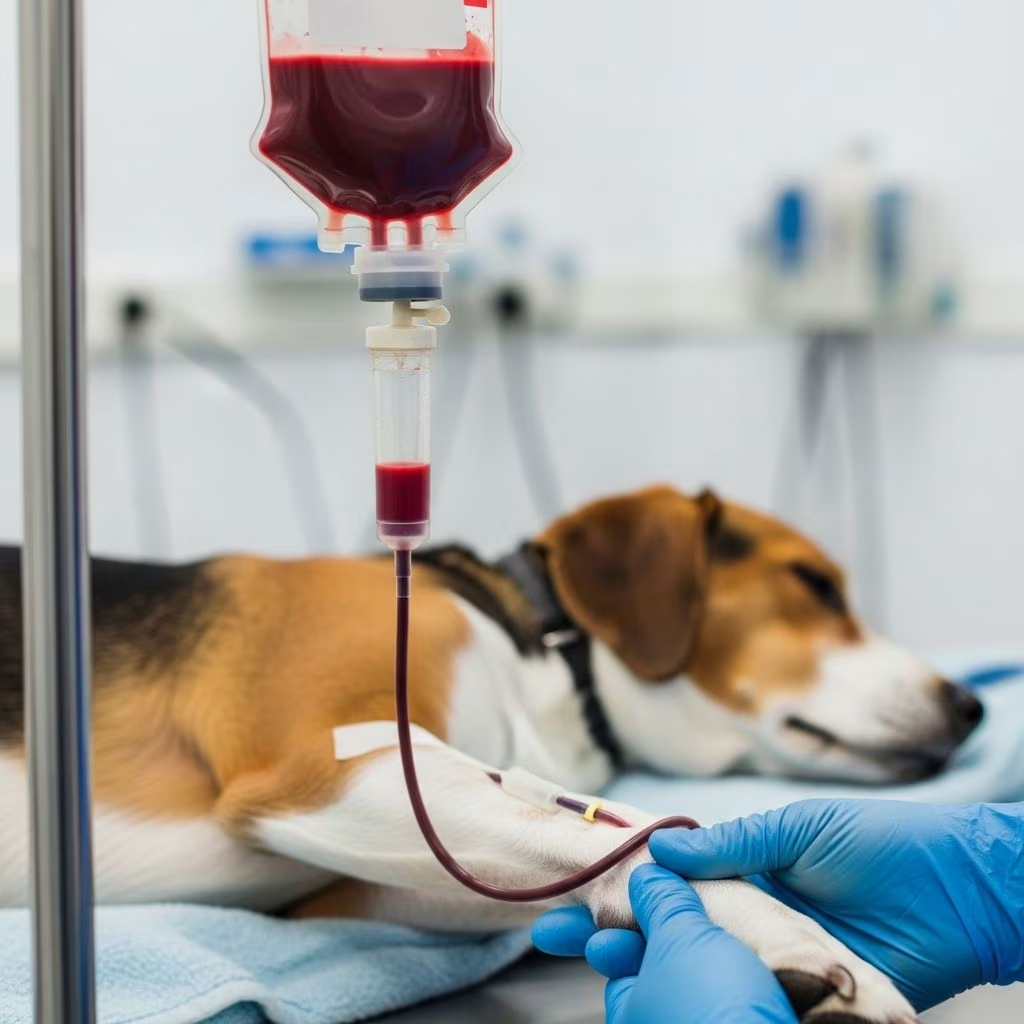
Blood transfusions represent a critical intervention in emergency veterinary medicine, providing immediate support to dogs experiencing severe anemia or significant blood loss. Understanding the mechanics, procedures, and protocols surrounding transfusions enables veterinary professionals to make informed decisions that can mean the difference between life and death for their canine patients.
Recognizing When Dogs Need Blood Support
Veterinarians determine the necessity for blood transfusion based on specific clinical indicators and patient conditions. A dog experiencing a significant decrease in packed cell volume (PCV) to below 25% requires immediate assessment for transfusion eligibility. Additional critical situations warranting transfusion consideration include:
- Severe hemorrhage following trauma or surgical complications
- Immune-mediated hemolytic anemia conditions
- Toxin exposure resulting in red blood cell destruction
- Chronic diseases affecting bone marrow function
- Surgical procedures in severely anemic patients where PCV falls below 20%
- Laboratory findings indicating inadequate oxygen delivery to tissues, including elevated lactate levels and negative base deficit measurements
The decision to transfuse must also account for the individual patient’s clinical presentation. A dog exhibiting poor pulse quality, marked blood loss during anesthesia, or signs of shock requires rapid assessment regardless of PCV values alone.
Understanding Canine Blood Types and Classification Systems
Dogs possess approximately 13 distinct blood types, each characterized by unique protein markers on red blood cell surfaces. The most significant protein in veterinary transfusion medicine is the dog erythrocyte antigen (DEA) 1.1, which nearly half of all canine populations express.
The DEA 1.1 antigen carries particular importance because dogs lacking this protein can experience dangerous transfusion reactions when receiving blood containing it, particularly during subsequent transfusions. Most dogs tolerate their initial transfusion well regardless of blood type compatibility, allowing veterinarians flexibility in emergency situations when immediate typing isn’t possible.
For dogs exhibiting auto-agglutination—a condition making blood typing card interpretation difficult—veterinarians should administer DEA 1.1 negative blood to ensure safety. Bitches that have previously whelped and any dog receiving their second transfusion should undergo crossmatching procedures before transfusion administration.
Blood Collection Procedures and Donor Preparation
Successful blood collection begins with careful donor assessment and preparation. Veterinarians should obtain baseline vital signs including temperature, pulse, and respiratory rate before placing the donor dog in lateral recumbency with extended neck positioning.
The jugular vein serves as the standard collection site. Before needle insertion, veterinarians must evaluate the vein quality and location, then shave and sterilize the surrounding skin area appropriately. Blood collection utilizes specialized collection bags containing anticoagulant preservation solutions. Most modern commercial systems employ citrate-phosphate-dextrose-adenine (CPDA-1) or citrate-phosphate-dextrose/adsol preservation solutions as anticoagulants.
During collection, the needle insertion occurs in a cranial direction with the bevel facing upward into the jugular vein. An assistant should maintain compression of the thoracic inlet to enhance jugular vein distension and improve collection efficiency. Once blood enters the collection system, the hemostat clamp is removed to allow proper flow into the tubing and collection bag.
Careful mixing during collection is essential. An assistant should gently agitate the collection bag back and forth throughout the procedure to ensure blood mixes thoroughly with the anticoagulant. Collection typically yields 405 to 480 grams of blood per donation. Once sufficient volume is obtained, pressure to the thoracic inlet is released, the needle is removed, and compression is applied over the puncture site for one minute. The jugular site should be wrapped with cohesive bandage wrap for at least 30 minutes to prevent bruising and hematoma formation.
Post-collection care for donors involves administering replacement intravenous crystalloids at three times the volume of blood withdrawn over 20 to 30 minutes. Dogs may be sedated with opioids or opioid/benzodiazepine combinations during the collection procedure if needed.
Blood Product Types and Storage Considerations
Different blood products serve specific clinical purposes and have distinct shelf lives. Fresh whole blood, transfused within 4 to 6 hours of collection, contains all blood components including clotting factors and platelets. This product is indicated for anemia, platelet replacement, and clotting factor deficiencies.
Fresh plasma, separated through centrifugation and administered within 4 to 6 hours, addresses coagulation factor deficiencies and von Willebrand disease. Packed red cells concentrate red blood cells for efficient anemia treatment, while platelet-rich plasma addresses platelet dysfunction and thrombocytopenia conditions.
The time-sensitive nature of blood products stems from bacterial contamination risks. Because fresh blood products contain no preservatives, transfusions should be completed within 4 hours of the bag being opened to minimize bacterial growth. Strict aseptic technique throughout collection, storage, and administration is vital to prevent contamination.
Crossmatching and Compatibility Testing
Manual crossmatching procedures provide additional safety for dogs requiring subsequent transfusions. The process involves collecting 3 milliliters of blood from both donor and recipient animals. For each sample, 2 milliliters are placed into an EDTA tube to obtain red blood cells, while 1 milliliter is collected in a nonadditive tube for serum extraction.
Samples are then centrifuged at 1000x or 3400 rpm to separate plasma and serum from red blood cells. The serum is saved while plasma from the EDTA tube is discarded. This compatibility testing ensures optimal transfusion outcomes and reduces the risk of adverse reactions during transfusion administration.
Transfusion Administration Techniques
Blood products must be administered intravenously, or by intraosseous catheter if intravenous access is unavailable. Critical safety protocols require that blood products containing red blood cells be delivered only through syringes or volumetric pumps that have been specifically validated for blood component administration. Use of non-validated equipment increases the risk of early red blood cell loss in transfused dogs.
Maintaining strict asepsis throughout all procedures involving blood product administration is essential. The recipient dog’s leg is shaved and cleaned, and an intravenous catheter is placed in an appropriate vein. Blood is administered slowly through the IV line, with close vital sign monitoring throughout the process.
Transfusion rates vary based on patient category and clinical urgency. Initial infusion rates should begin at 1 to 2 milliliters per minute for all transfusions. For stable patients, rates of 0.5 to 1.0 milliliters per kilogram per hour during the initial 15 to 30 minutes allow monitoring for adverse reactions. Adult dogs can tolerate maximum rates of 3 to 6 milliliters per minute once initial tolerance is established.
In emergency situations requiring rapid blood replacement, bolus administration over 10 to 15 minutes may be necessary, though this increases transfusion reaction risk. Typical transfusion administration takes 1 to 4 hours depending on clinical urgency and patient stabilization needs.
Calculating Transfusion Volumes
Determining appropriate transfusion volumes requires understanding normal blood volume in dogs. The normal blood volume approximates 85 to 90 milliliters per kilogram for dogs. Veterinarians calculate the specific volume needed to increase the packed cell volume to desired target levels, ensuring efficient and appropriate transfusion dosing.
Fresh whole blood transfusions typically range from 12 to 20 milliliters per kilogram and can be repeated every 24 hours as needed. Packed red cell transfusions require 6 to 10 milliliters per kilogram and may be repeated every 12 to 24 hours depending on clinical response.
Monitoring During Transfusion Administration
Continuous patient monitoring ensures early detection of transfusion reactions and confirms clinical improvement. During the first hour of transfusion, vital parameters including temperature, pulse or heart rate, mucous membrane color, capillary refill time, respiratory rate and effort, blood pressure, and mentation status should be assessed every 15 minutes. After the first hour, monitoring intervals can extend to every 30 to 60 minutes until transfusion is complete.
The patient’s vital signs should demonstrate improvement and stabilization as new blood is administered. These parameters guide decisions regarding transfusion rate adjustments and detection of adverse reactions. Blood counts should be rechecked following transfusion completion to confirm the patient has achieved stable hemoglobin and hematocrit levels.
Addressing Transfusion Reactions
Despite careful preparation and monitoring, transfusion reactions can occur. Recognition of early warning signs enables rapid intervention. Common reaction indicators include fever, facial swelling, difficulty breathing, trembling, vomiting, dark-colored urine, or collapse. Immediate transfusion cessation and veterinary intervention are necessary if any reaction signs develop.
Recovery and Post-Transfusion Care
Following successful transfusion, dogs typically begin showing clinical improvement relatively quickly. Enhanced oxygen delivery to tissues allows stabilization of vital functions and supports recovery from the underlying condition necessitating transfusion. Dogs should be monitored closely in the immediate post-transfusion period and observed for any delayed reaction development.
References
- The AEA Guide to Canine and Feline Transfusion Medicine — Animal Emergency Australia. 2024. https://animalemergencyaustralia.com.au/blog/transfusion-medicine-guide/
- Dog Blood Transfusions: How Do They Work and Why — PetMD. 2024. https://www.petmd.com/dog/procedure/dog-blood-transfusions
- Practical Transfusion Medicine (Proceedings) — DVM360. 2023. https://www.dvm360.com/view/practical-transfusion-medicine-proceedings
- Blood Transfusion in Dogs — Clinician’s Brief. 2024. https://www.cliniciansbrief.com/article/blood-transfusion-dogs
- Transfusion Guidelines — Cornell University College of Veterinary Medicine. 2023. https://www.vet.cornell.edu/animal-health-diagnostic-center/laboratories/comparative-coagulation/clinical-topics/transfusion-guidelines
- Administration of Canine Red Cell Products — Pet Blood Bank UK. 2024. https://www.petbloodbankuk.org/vet-professionals/i-need-advice/administration/canine-blood-administration/administration-of-canine-red-cell-products/
- How to Transfuse: The Ultimate Guide to Giving Blood to Cats and Dogs — Veterinary Internal Medicine Nursing. 2023. https://www.veterinaryinternalmedicinenursing.com/blog/blood-transfusions



