

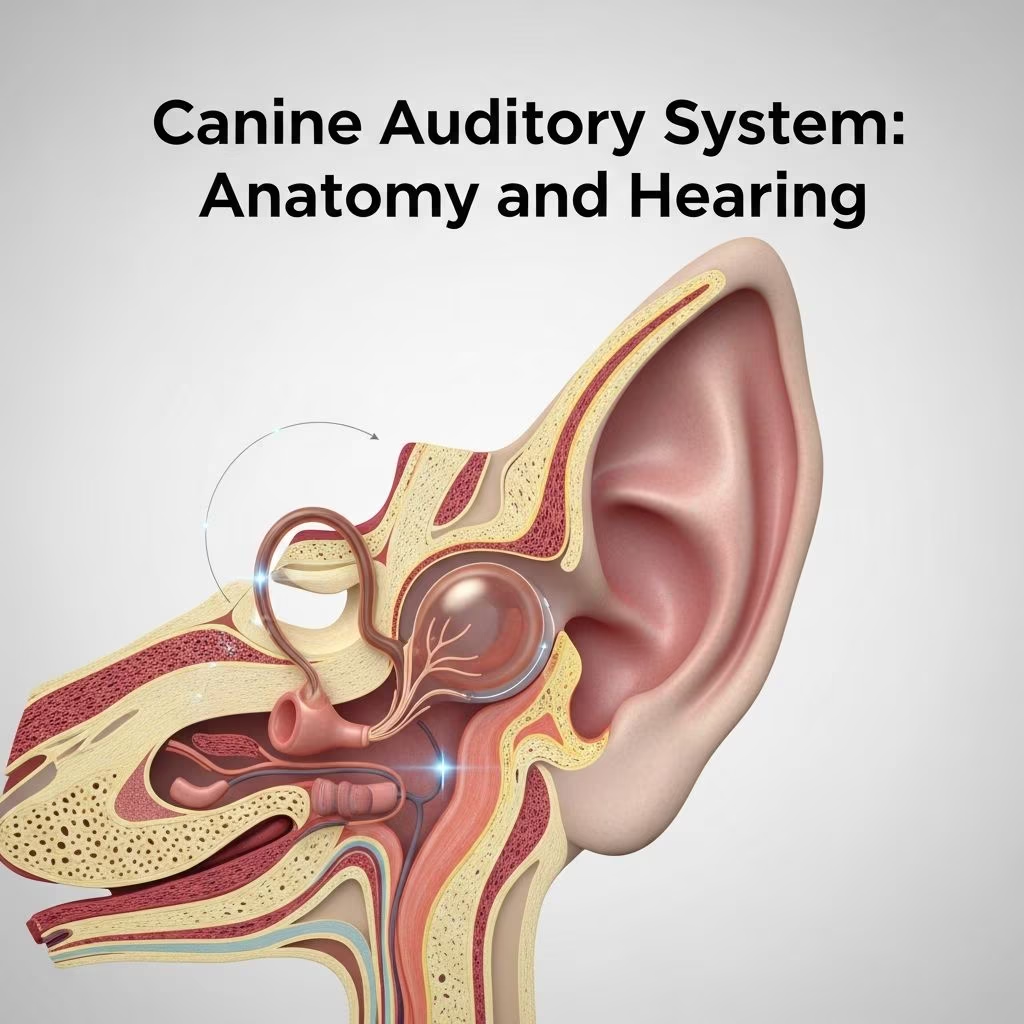
Dogs possess one of nature’s most sophisticated auditory systems, with hearing abilities that far surpass those of their human companions. The canine ear is a marvel of biological engineering, composed of multiple interconnected structures working in harmony to capture, process, and interpret sound waves from the environment. Understanding the anatomy of your dog’s ear not only satisfies curiosity about how they perceive the world but also helps pet owners recognize potential hearing problems and appreciate the sensory advantages dogs enjoy.
The Three-Part Architecture of Canine Ears
The canine auditory system is traditionally divided into three primary regions, each serving distinct functions in the hearing process. These divisions represent thousands of years of evolutionary refinement, creating an organ system that allows dogs to detect frequencies and distances that remain imperceptible to human ears. The progression from the outer ear through the middle ear to the inner ear demonstrates how nature converts physical sound waves into neural signals that the brain interprets as meaningful information.
The Outer Ear: Nature’s Sound Collector
The outer ear comprises two essential components that work together to gather and direct sound into the deeper ear structures. The first component, the pinna (also called the auricle), is the visible, cartilage-based structure covered with skin and fur that you can see and feel on your dog’s head. This remarkable structure varies dramatically among dog breeds, ranging from the erect pointed ears of German Shepherds to the drooping ears of Basset Hounds and Cocker Spaniels.
What makes the canine pinna particularly impressive is its mobility and control. Dogs possess more than a dozen separate muscles that govern pinna movement, allowing each ear to rotate and adjust independently of the other. This independent mobility gives dogs a significant advantage in sound localization—they can pinpoint the direction of a sound source with remarkable precision without moving their head. The pinna’s funnel shape naturally captures airborne sound waves and channels them into the next structure of the auditory pathway.
The ear canal serves as the passageway connecting the pinna to the eardrum, and its unique anatomical features distinguish it significantly from human ear canals. The dog’s ear canal follows an L-shaped path, consisting of a vertical segment approximately one inch in length, which then transitions into a horizontal segment. This distinctive configuration creates a deeper, more effective funnel for sound transmission compared to the relatively straight human ear canal. The L-shaped design also provides protective benefits, creating natural barriers against debris and foreign objects attempting to reach the eardrum.
The ear canal walls contain specialized glands that produce cerumen, commonly known as earwax, which serves protective and lubricating functions. In healthy dogs, these glands maintain appropriate cerumen production, but in dogs with chronic ear infections, the composition and quantity of secretions can change dramatically.
The Middle Ear: Vibration Amplification Chamber
The middle ear represents a fascinating evolutionary development in mammalian auditory systems. This air-filled chamber, known as the tympanic cavity, sits directly behind the eardrum and contains some of the tiniest bones in the entire mammalian skeleton. The eardrum, or tympanic membrane, serves as the critical interface between the outer and middle ear spaces, vibrating in response to sound waves that have traveled through the ear canal.
The three auditory ossicles—the malleus (hammer), incus (anvil), and stapes (stirrup)—form an intricate chain of bones that transmits vibrations from the eardrum to the inner ear. These diminutive bones work in concert to amplify sound vibrations, with each bone contributing to the overall amplification process. The malleus attaches directly to the eardrum, the incus serves as an intermediary connection, and the stapes connects to the inner ear structures. Together, they increase the force of vibrations by approximately thirty times, a crucial function given the energy loss that would otherwise occur when vibrations transition from the air-filled middle ear to the fluid-filled inner ear.
The middle ear also includes two muscles—the tensor tympani and the stapedius—that help regulate the transmission of vibrations and protect against excessively loud sounds. Additionally, the eustachian tube connects the middle ear to the nasopharynx (the back of the nose and throat), allowing air pressure equalization and drainage of fluids from the middle ear cavity. This connection is essential for maintaining proper middle ear function and preventing the accumulation of fluid that could impair hearing.
The Inner Ear: Processing Sound and Balance
The inner ear represents the most complex component of the canine auditory system, housing the specialized sensory organs responsible for both hearing and balance. Encased within the petrous portion of the temporal bone, this fluid-filled labyrinth contains structures of remarkable sophistication that convert mechanical vibrations into the electrical signals the brain interprets as sound and spatial orientation.
The Cochlea and Hearing Function
The cochlea is the specialized organ dedicated to hearing, forming a spiral structure that resembles a tiny snail shell—indeed, the word “cochlea” derives from the Latin word for snail. In dogs, the cochlea completes approximately three and one-quarter turns around a central hollow core of bone. Within this spiral chamber lies the cochlear duct, containing specialized sensory hair cells that detect vibrations and convert them into neural impulses.
The stapes bone connects to the oval window, a membrane-covered opening that transmits vibrations from the middle ear into the cochlear fluid. As vibrations travel through the cochlear fluid, they stimulate the hair cells in a process called mechanotransduction. These hair cells synapse directly with the auditory nerve, which carries neural signals to the auditory processing centers of the brain. This direct neural connection allows for rapid, efficient transmission of sound information with minimal delay.
The Vestibular System: Maintaining Balance and Spatial Awareness
Equally important to hearing, the vestibular system maintains the dog’s balance and spatial orientation, allowing them to move with confidence and coordination regardless of body position. This system comprises the vestibule and three semicircular canals, which work in conjunction with the brain and other sensory systems to keep dogs upright and aware of their position in space.
The three semicircular canals—anterior, posterior, and lateral—are oriented in three different planes, allowing them to detect rotational movements in all directions. The anterior canal measures approximately 6mm across at its widest point, while the lateral canal spans about 4.5mm, and the posterior canal is the smallest at roughly 3.5mm in medium-sized dogs. These measurements scale with the overall size of the dog, allowing the vestibular system to remain proportionally effective across different breeds.
Within the vestibule lie specialized structures called the utricle and saccule, both containing sensory hair cells surrounded by gelatinous material embedded with calcium carbonate particles called otoconia or otoliths. These particles shift with gravity and acceleration, stimulating the hair cells and providing the brain with constant information about the dog’s head position and movement relative to gravity. This information integrates with signals from the semicircular canals to create a comprehensive picture of the dog’s spatial orientation.
Comparative Hearing Abilities: Why Dogs Outperform Humans
The sophisticated architecture of the canine ear translates into auditory capabilities that substantially exceed human hearing. Dogs can hear sounds at frequencies approximately four times higher than those detectable by humans, with sensitivity extending to frequencies around 65,000 Hz, compared to the human upper limit of approximately 20,000 Hz. This expanded frequency range allows dogs to detect ultrasonic sounds that are completely inaudible to people, explaining their reactions to sounds that seem to come from nowhere to their owners.
The superior hearing sensitivity in dogs stems from multiple anatomical advantages: the deeper L-shaped ear canal creates a more efficient sound funnel, the mobile pinnae can orient toward sound sources with precision, and the amplification provided by the ossicle chain is optimized for the frequency ranges most important to canine survival and social communication. Additionally, dogs possess approximately 15,000 auditory nerve fibers compared to humans’ 3,500, providing greater neural capacity for processing auditory information.
Breed-Specific Variations in Ear Structure
The visible diversity in dog ear shapes and sizes reflects underlying anatomical variations that influence how different breeds perceive sound. Dogs with erect ears like German Shepherds benefit from enhanced sound-gathering capabilities due to the large surface area and directional orientation of their pinnae. Conversely, breeds with drooping ears like Bloodhounds and Cocker Spaniels sacrifice some sound-gathering efficiency, though this may be partially offset by their enormous ear canal volume and the acoustic properties of their longer ear canals.
Research indicates that middle ear structural dimensions in different dog breeds correlate more closely with skull length than skull width, suggesting that the overall size and proportions of the dog’s head influence auditory system development and function. Larger dogs generally develop proportionally larger ear structures, maintaining relative hearing capabilities across the species.
Frequently Asked Questions About Canine Ear Anatomy
Can dogs really hear frequencies humans cannot?
Yes, dogs can detect ultrasonic frequencies ranging from approximately 40,000 to 65,000 Hz, well above the human hearing range that tops out around 20,000 Hz. This explains why dogs respond to certain sounds that seem inaudible to their owners.
Why do some dogs have floppy ears while others have erect ears?
Ear shape in dogs results from selective breeding and genetic variation in cartilage development. Erect ears provide directional sound-gathering advantages, while floppy ears may offer other benefits such as protection in certain environments or thermal regulation.
How many muscles control dog ear movement?
More than a dozen separate muscles govern the movement of each canine pinna, allowing independent rotation and positioning that helps with sound localization and communication with other dogs.
What is the purpose of earwax in dog ears?
Earwax (cerumen) provides protective lubrication for the ear canal and contains antimicrobial properties that help prevent infections. However, excessive accumulation can lead to impacted cerumen and bacterial or fungal overgrowth.
Do all dogs have the same hearing ability?
While all dogs possess superior hearing compared to humans, individual variation exists based on breed, age, genetics, and overall health. Older dogs and those with certain health conditions may experience age-related hearing loss.
The Integration of Form and Function
The canine auditory system exemplifies how anatomical structure perfectly serves functional requirements. Every component, from the multimuscular pinna to the ossicle chain to the fluid-filled cochlea, evolved to maximize the dog’s ability to detect, locate, and interpret sound in their environment. Understanding this remarkable system enhances appreciation for your dog’s sensory world and can help you recognize when problems develop that require veterinary attention.
References
- Ear Structure and Function in Dogs — MSD Veterinary Manual. Accessed February 2026. https://www.msdvetmanual.com/dog-owners/ear-disorders-of-dogs/ear-structure-and-function-in-dogs
- Structure of the Canine Ear — Whole Dog Journal. https://www.whole-dog-journal.com/care/structure-of-the-canine-ear/
- Anatomy of the Ear—Cats and Dogs — Oakleigh Central Veterinary Clinic. https://www.oakleighcentralvet.com.au/single-post/anatomy-of-the-ear-cats-and-dogs
- Anatomy and Physiology of the Canine Ear — PubMed Central, National Institutes of Health. https://pubmed.ncbi.nlm.nih.gov/20230592/
- The Ear — Veterinary Key. https://veteriankey.com/the-ear/
- Anatomy of the Ear — Pinoy Vet. YouTube. https://www.youtube.com/watch?v=oc5ErOUw72I
- Structure and Scaling of the Middle Ear in Domestic Dog — Journal of Anatomy, Wiley Online Library. 2023. https://onlinelibrary.wiley.com/doi/10.1111/joa.14049



