

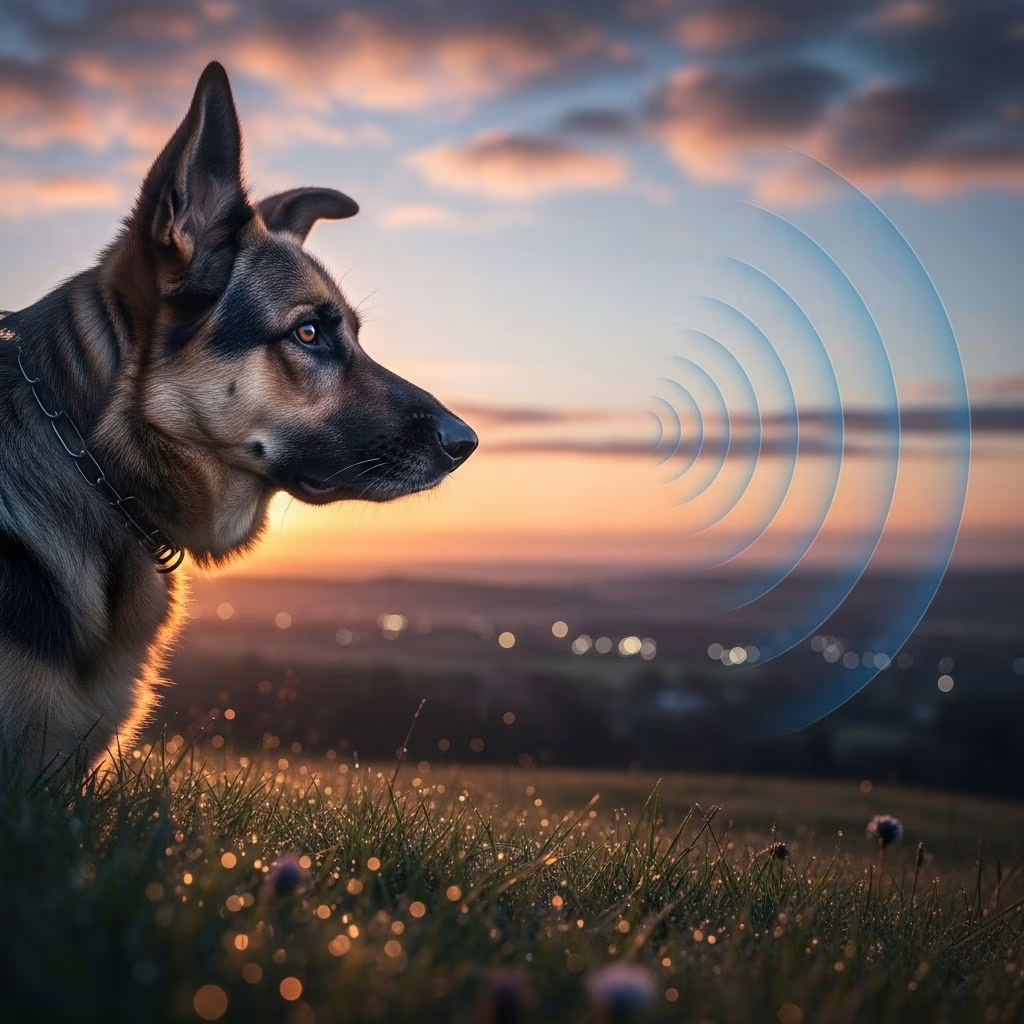
Dogs possess an extraordinary auditory system that allows them to detect sounds at much greater distances and higher frequencies than humans. While human hearing typically spans 20 Hz to 20 kHz, dogs can perceive frequencies from approximately 40 Hz to 60 kHz, enabling them to hear distant or faint noises that escape our ears.
The Science of Dog Hearing Capabilities
The canine ear is a marvel of evolutionary design, optimized for survival in the wild and modern environments. Dogs’ movable outer ears, or pinnae, can swivel independently to pinpoint sound sources with precision. This mobility, combined with a larger cochlea relative to body size, amplifies their ability to capture and process subtle acoustic signals.
Research using behavioral methods like the staircase procedure has measured precise hearing thresholds in dogs. At low frequencies like 0.5 kHz, thresholds average 19.5 dB SPL; at 4 kHz, they drop to 14.5 dB SPL; and remarkably, at high frequencies of 20 kHz, sensitivity reaches 8.5 dB SPL, outperforming expectations from older studies.
Frequency Spectrum: What Dogs Hear That Humans Miss
Dogs excel in high-frequency detection, with their optimal range between 3,000 and 12,000 Hz, where sensitivity surpasses humans by 10-20 dB. Peak sensitivity occurs around 8,000 Hz, ideal for detecting small prey movements or ultrasonic whistles.
| Species | Low Frequency (Hz) | High Frequency (Hz) | Peak Sensitivity (Hz) |
|---|---|---|---|
| Humans | 20 | 20,000 | 2,000 |
| Dogs | 40-67 | 45,000-60,000 | 8,000 |
This table illustrates the stark contrast: dogs’ upper limit can extend to 60 kHz, varying by breed and age.
Distance Detection: Factors Influencing How Far Dogs Hear
Sound propagation diminishes with distance due to factors like atmospheric absorption, ground reflection, and obstacles. High-frequency sounds attenuate faster, but dogs’ superior sensitivity compensates. For instance, a dog might detect a 10 kHz whistle several hundred meters away under ideal conditions, while humans hear nothing beyond 50 meters.
- Frequency Impact: Low pitches travel farther; high pitches fade quickly but remain audible to dogs at greater distances.
- Environmental Noise: Urban settings reduce range by 20-50% compared to open fields.
- Sound Intensity: Louder sources extend detection up to 1 km for barks or howls.
Breed Variations in Auditory Performance
Not all dogs hear equally. Breeds with erect ears, like German Shepherds, benefit from enhanced sound funneling. Hounds with long, droopy ears may have slightly reduced high-frequency sensitivity but excel in low-end tracking. Studies note breed-specific ranges: some reach 65 kHz, others top at 45 kHz.
Age-Related Changes in Hearing Distance
Puppies start with near-perfect hearing, but age brings presbycusis, or age-related hearing loss. By middle age (7+ years), high-frequency detection drops first, reducing effective range by 30-50%. Older dogs struggle with sounds above 15 kHz, mistaking silence for absence.
Owners notice this as ignored whistles or slower responses to calls. Regular vet checks can identify early decline through brainstem auditory evoked response (BAER) tests.
Comparing Canine and Human Sound Localization
While dogs detect fainter, higher sounds, humans excel in localization precision. Dogs require an 8-degree angular separation to pinpoint sources; humans manage 1 degree. Dogs compensate with ear mobility and frequency discrimination, discerning notes differing by 1/8th of a semitone.
Practical Applications for Dog Owners
Understanding hearing range enhances training and safety. Use frequencies around 8-12 kHz for commands via apps or whistles. Avoid fireworks or loud music above 20 kHz, which stress dogs invisibly.
- Train with variable pitches to maintain acuity.
- Protect ears during hunts or noisy events with earmuffs.
- Monitor for selective deafness, signaling health issues.
Health Implications of Superior Hearing
Heightened sensitivity risks noise-induced damage. Chronic exposure to sounds over 85 dB SPL can cause permanent threshold shifts. Vets recommend limiting time near traffic or concerts.
In clinical settings, audiograms guide diagnosis. Recent staircase-method studies confirm dogs retain sensitivity at 20 kHz better than predicted, challenging prior models.
Evolutionary Reasons for Enhanced Hearing
Dogs evolved from wolves, prioritizing high-frequency hearing for rodent footsteps (40-60 kHz). Smaller heads relative to humans allow finer spectral cues, boosting upper limits. This adaptation persists in domesticated breeds, aiding companionship by detecting baby cries or door knocks early.
Testing Your Dog’s Hearing at Home
Simple tests gauge range:
- Silent whistle apps at 15-25 kHz; note reactions.
- Squeaky toys mimicking prey sounds.
- Observe ear flicks to distant rustles.
Professional BAER tests provide audiograms, plotting thresholds across frequencies.
FAQs
What’s the maximum distance a dog can hear a sound?
Up to several kilometers for low-frequency howls in quiet conditions, but typically 100-500 meters for high pitches.
Do all dog breeds hear the same?
No, erect-eared breeds often outperform floppy-eared ones in high frequencies.
Can dogs hear TV or phone sounds?
Yes, ultrasonic elements in electronics register for dogs but not humans.
How does age affect dog hearing range?
Senior dogs lose high-frequency sensitivity first, shrinking range by half.
Are dog whistles really inaudible to humans?
Most are 23-54 kHz, beyond human limits.
Advanced Research Insights
Recent peer-reviewed work using forced-choice paradigms shows low variability in thresholds (SD 2.8-12.8 dB), affirming behavioral tests’ superiority over electrophysiology. Future studies may extend to 47 kHz, per historical data.
Dogs’ 25 dB inter-subject variability underscores individual testing needs.
References
- Determining Hearing Thresholds in Dogs Using the Staircase Method — PMC/NCBI. 2024. https://pmc.ncbi.nlm.nih.gov/articles/PMC10892234/
- Frequency Range of Dog Hearing — The Physics Factbook. 2003 (authoritative compilation). https://hypertextbook.com/facts/2003/TimCondon.shtml
- Sounds Only Dogs Can Hear: Higher Pitches Is Where They Shine — American Kennel Club (AKC). Recent. https://www.akc.org/expert-advice/lifestyle/sounds-only-dogs-can-hear/
- How Good Is a Dog’s Hearing Compared to Humans? — Psychology Today. 2024-07. https://www.psychologytoday.com/us/blog/canine-corner/202407/how-good-is-a-dogs-hearing-compared-to-humans
- Why have dogs evolved to hear higher pitches than us? — BBC Science Focus. Recent. https://www.sciencefocus.com/nature/why-have-dogs-evolved-to-hear-higher-pitches-than-us



