

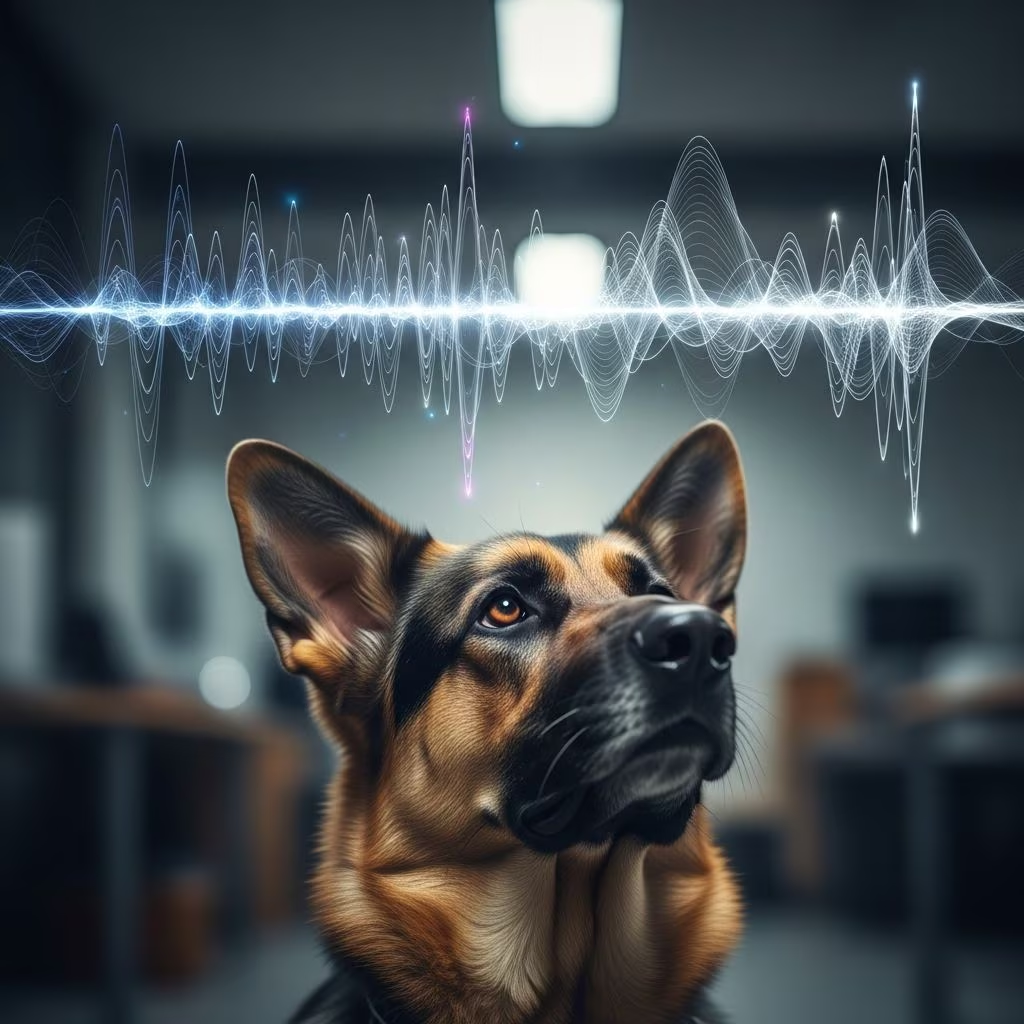
Dogs possess a remarkable auditory capability that extends well beyond human limits, allowing them to detect high-frequency sounds up to 65,000 Hz compared to our maximum of around 20,000 Hz. This superior hearing equips them to sense subtle environmental cues, from distant footsteps to ultrasonic whistles, profoundly influencing their behavior and interaction with the world.
The Science of Sound Detection in Dogs
Sound is characterized by frequency, measured in hertz (Hz), which determines pitch, and intensity, measured in decibels (dB), which indicates loudness. Humans typically perceive frequencies from 20 Hz to 20,000 Hz, with peak sensitivity around 2,000-5,000 Hz, aligning with human speech patterns. Dogs, however, excel in a broader spectrum, generally from 40-67 Hz on the low end to 45,000-65,000 Hz on the high end, varying by breed, age, and individual health.
This expanded range stems from evolutionary adaptations. Canines developed heightened sensitivity to high pitches to locate small, quick-moving prey like rodents, which emit ultrasonic squeaks inaudible to us. Their ear structure, including mobile pinnae (outer ears) that swivel to capture sound waves, amplifies this advantage. For instance, breeds with erect ears, such as German Shepherds, funnel sounds efficiently toward the eardrum.
| Species | Low Frequency (Hz) | High Frequency (Hz) | Peak Sensitivity (Hz) |
|---|---|---|---|
| Human | 20 | 20,000 | 2,000-5,000 |
| Dog (Average) | 40-67 | 45,000-65,000 | 8,000 |
The table above summarizes key differences, highlighting dogs’ dominance in ultrasonic detection.
Superior Sensitivity to Subtle Noises
Beyond range, dogs detect quieter sounds. In the 3,000-12,000 Hz band, they perceive noises at -5 to -15 dB, levels too faint for human ears, where 0 dB marks the threshold of human audibility. Above 12,000 Hz, the gap widens dramatically, enabling dogs to hear whispers of sound we miss entirely.
Dogs also discriminate minute pitch variations, distinguishing tones separated by just one-eighth the interval between musical notes C and C-sharp—a feat beyond most humans. However, humans outperform in sound localization, pinpointing sources separated by 1 degree, while dogs require 8 degrees.
Everyday Sounds That Startle Dogs
Household appliances often produce high-frequency harmonics that distress dogs. Vacuum cleaners and power tools emit pitches above 20,000 Hz, sounding piercingly loud and shrill to canine ears, explaining their aversion. Television remotes and smoke detectors beep at ultrasonic levels, prompting sudden reactions without visible cause to owners.
Even natural events like earthquakes may be presaged by infrasonic rumbles or high-pitched precursors dogs sense first, leading to anxious behavior. Car engines approaching from afar trigger alert postures, as dogs detect tire hums or exhaust notes blocks away.
- Vacuum cleaners: High-pitched whines exceed 20 kHz, amplifying perceived volume.
- Power tools: Emit ultrasounds up to 40 kHz, causing discomfort.
- Remote controls: 30-40 kHz signals grab attention instantly.
- Smoke alarms: Ultrasonic components trigger frantic responses.
Tools and Devices Tailored for Canine Ears
Dog whistles, operating at 23,000-54,000 Hz, exemplify human ingenuity in harnessing this trait for training. These pea-less or galton whistles produce pure tones inaudible to people, allowing silent commands for recall or behavior correction.
Modern applications include anti-bark collars emitting ultrasonic bursts to deter excessive vocalization without audible noise to owners. Pest repellents use similar frequencies to ward off rodents, leveraging dogs’ prey-detection instincts indirectly.
Testing Your Dog’s Auditory Abilities
Simple at-home tests reveal hearing prowess. Play tones starting at 8,000 Hz, gradually increasing to 25,000 Hz or higher, observing ear twitches or head turns. Apps and online tools generate sweeps from 20 Hz to 45,000 Hz; dogs typically respond up to their limit, while humans fade out early.
- Select a quiet room to minimize distractions.
- Use a device with reliable frequency output.
- Start at moderate volume (around 50-60 dB).
- Note reactions: perked ears, alert gaze, or approach indicate detection.
- Compare personal limits—most adults hear to 15,000-18,000 Hz max.
Professional evaluation via Brainstem Auditory Evoked Response (BAER) testing measures neural responses to clicks, diagnosing congenital or acquired deafness accurately.
Factors Influencing Hearing Over Time
Puppies boast optimal range, but age-related decline mirrors human presbycusis, starting with high frequencies. Older dogs may ignore whistles yet respond to low barks. Breeds like Dalmatians face higher congenital deafness risks.
Otitis (ear infections), trauma, or ototoxic drugs erode sensitivity. Chronic exposure to loud noises, such as gunfire for hunting dogs, accelerates loss. Preventive care includes regular vet checks, ear cleanings, and avoiding prolonged high-decibel environments.
Practical Tips for Supporting Canine Hearing
Enhance your dog’s auditory world thoughtfully:
- Avoid sudden loud blasts; use gradual exposure for desensitization.
- Incorporate hand signals and visual cues alongside verbal commands for aging pets.
- Choose toys with varied pitches to stimulate natural responses.
- Monitor for signs of loss: ignoring calls, startling easily, or head tilting.
- Consult vets for supplements like omega-3s supporting ear health.
High-frequency toys or treat-dispensing devices emitting subtle tones encourage engagement without overwhelming.
Comparing Dog Hearing to Other Animals
Dogs surpass humans but trail bats (up to 100,000-120,000 Hz for echolocation) and cats (45,000-64,000 Hz). Horses hear to 33,500 Hz, elephants to infrasonics below 20 Hz. This spectrum shapes ecological roles: canines hunt by sound-tracking, bats navigate via sonar.
| Animal | Frequency Range (Hz) | Key Adaptation |
|---|---|---|
| Dog | 40-65,000 | Prey detection |
| Cat | 45-64,000 | Hunting small rodents |
| Bat | Up to 120,000 | Echolocation |
| Human | 20-20,000 | Speech communication |
Implications for Training and Daily Life
Understanding canine audio perception transforms training. Pair whistles with rewards for reliable recall in noisy areas. In homes, reduce distress by muting high-pitch appliances or using ear defenders for sensitive dogs during chores.
For working dogs—search-and-rescue or detection—precise frequency training hones skills, detecting survivor cries or explosives via unique signatures.
Frequently Asked Questions
Can all dogs hear the same frequencies?
No, variations occur by breed, age, and health. Smaller breeds often have wider ranges; seniors lose high-end sensitivity first.
Why do dogs hate vacuums?
They produce ultrasounds over 20 kHz plus intense low rumbles, overwhelming sensitive ears.
How to test if my dog is deaf?
Use escalating high pitches or BAER testing; lack of response across frequencies signals impairment.
Do dog whistles hurt dogs’ ears?
At proper volumes (under 100 dB), no; they’re designed for clear signaling without pain.
Can deaf dogs live happily?
Yes, with visual signals, vibrations, and scents; many adapt seamlessly.
References
- Frequency Range of Dog Hearing — Tim Condon, The Physics Factbook. 2003. https://hypertextbook.com/facts/2003/TimCondon.shtml
- Sounds Only Dogs Can Hear: Higher Pitches Is Where… — American Kennel Club (AKC). Accessed 2026. https://www.akc.org/expert-advice/lifestyle/sounds-only-dogs-can-hear/
- Test Your Hearing (and Your Dog’s) — MasterBowie. Accessed 2026. https://www.masterbowie.com/test-your-hearing-and-your-dogs
- Dog Hearing Test | Test Your Dogs Ears — n Beats (YouTube). 2021-08-06. https://www.youtube.com/watch?v=PR0kQjBkJxY
- What’s Your Pet’s Favorite Sound? — Oregon Museum of Science and Industry (OMSI). Accessed 2026. https://omsi.edu/explore/whats-your-pets-favorite-sound/



