

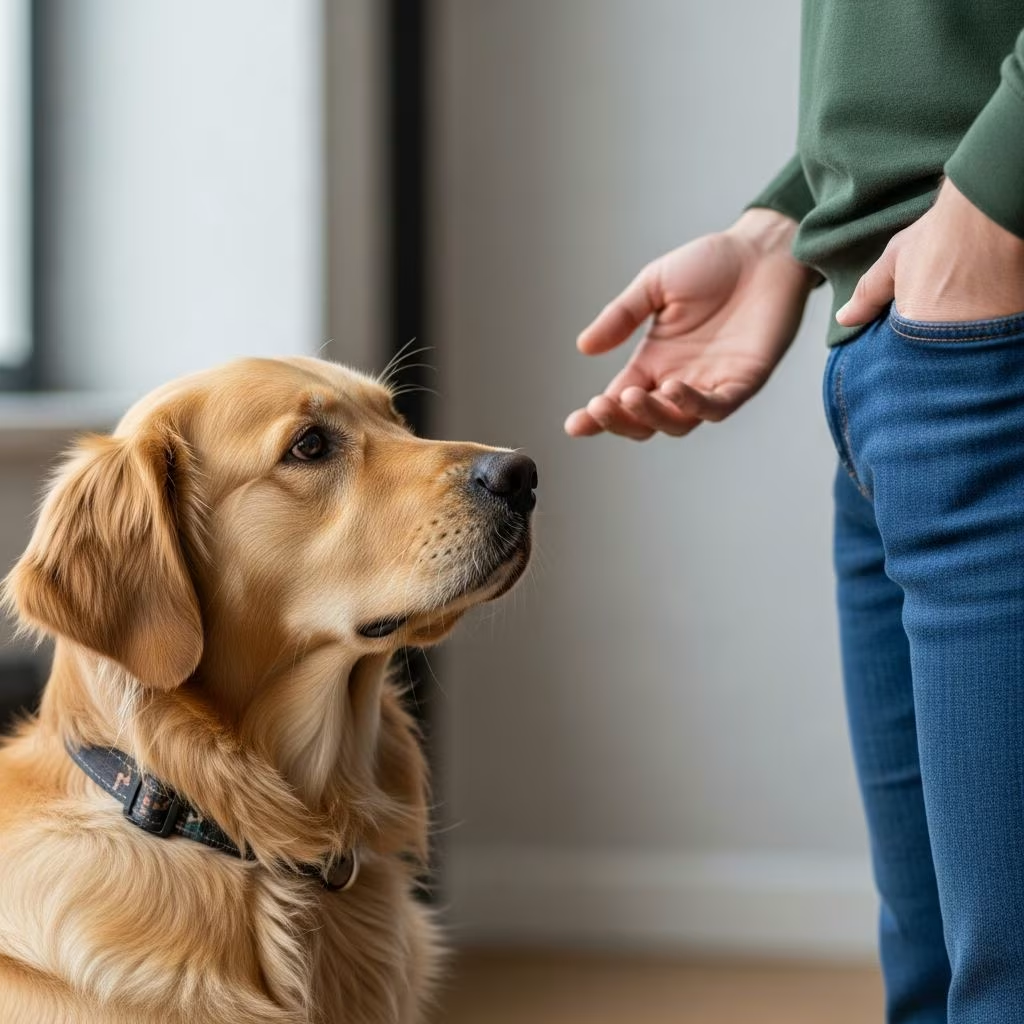
Dogs possess remarkable abilities to assess human character, distinguishing trustworthy individuals from those who may pose a threat through observation of actions, scent detection, and social cues. Scientific studies confirm that dogs refuse treats from unhelpful people, ignore pointers who lie, and pick up on stress pheromones, showcasing their evolved social intelligence honed over thousands of years alongside humans.
Key Studies Proving Dogs Judge Character
Multiple experiments demonstrate dogs’ capacity to evaluate people based on their behaviour toward the dog’s owner or consistency in communication.
- In a study published in Neuroscience and Biobehavioral Reviews, researchers tested 18 dogs across three scenarios where strangers either helped, refused to help, or remained neutral while the owner struggled to open a box. Dogs consistently rejected treats from the unhelpful stranger but accepted them from helpful or neutral ones, indicating they form judgments based on observed actions.
- A Kyoto University experiment led by Akiko Takaoka involved 34 dogs in pointing tasks. Dogs initially followed pointers to food containers but, after being deceived by directions to empty ones, refused to follow even when pointed to real food in subsequent trials. New reliable pointers were followed, proving dogs devalue unreliable humans and remember their actions.
These findings highlight dogs’ sophisticated social intelligence, allowing them to prioritise predictability and reliability in human interactions.
How Dogs Detect ‘Bad’ People: The Science
Dogs rely on a combination of sensory and cognitive skills to sense potentially harmful individuals, far surpassing human capabilities.
Superior Sense of Smell and Pheromones
Dogs’ olfactory system, including the vomeronasal organ, is up to 1,000 times more sensitive than humans’, enabling detection of pheromones linked to human emotions like stress or guilt. Chemicals such as adrenaline and cortisol released by a ‘guilty conscience’ can be smelled by dogs, alerting them to true intentions.
Peer-reviewed research on canine olfaction confirms dogs excel at detecting subtle odour changes associated with human states, supporting their use in medical detection.
Reading Body Language and Facial Expressions
Dogs accurately distinguish human emotions like joy from anger by observing facial expressions, even with unfamiliar faces. Studies show dogs receive treats for correctly identifying emotional cues, demonstrating keen visual observation.
Understanding Vocal Cues and Sounds
Brain imaging reveals dogs have specific areas that activate for emotionally charged sounds, including human laughter, crying, or aggressive tones, similar to human responses but balanced across species.
Memory and Long-Term Association
Dogs form lasting memories of individuals and link scents to emotions, hesitating to follow cues from previously deceptive humans across trials.
Table: Dog Sensory Abilities for Character Judgment
| Ability | Description | Evidence |
|---|---|---|
| Olfaction | Detects stress pheromones (e.g., cortisol) | 1000x human sensitivity; vomeronasal organ |
| Visual Cues | Reads faces for joy/anger | Accuracy in emotion recognition tasks |
| Auditory | Processes emotional sounds | Brain activation for human/dog vocals |
| Memory | Remembers liars/unhelpful people | Refusal in repeated trials |
Signs Your Dog Senses a Good vs. Bad Person
Observe your dog’s body language to interpret their judgments accurately.
Signs of a ‘Good’ Person
- Tail wagging: Relaxed, broad wag indicates trust and positivity.
- Sniffing: Curious exploration shows interest without fear.
- Staring: Attentive gaze without tension.
- Ears dropped/relaxed: Non-erect ears signal comfort.
Signs of a ‘Bad’ Person
- Barking or growling: Vocal warnings of threat.
- Tail tucked/stiff: Fear or aggression posture.
- Avoidance: Refusing treats, hiding, or pulling away.
- Hair standing up (piloerection): Alertness to danger.
These instincts stem from evolutionary domestication, making dogs attuned pack members who protect their human families.
Real-Life Examples and Implications
Dog owners often report pets reacting negatively to dates or strangers later proven untrustworthy, aligning with research. For instance, if your dog shuns someone, it may signal mismatched pheromones or subtle cues you miss.
While not infallible—your own stress can influence them—dogs’ judgments are remarkably reliable. This ability extends to practical uses, like Medical Detection Dogs in the UK training canines to smell diseases, underscoring their sensory prowess.
What to Do If Your Dog Dislikes Someone
Trust but verify your dog’s instincts without overriding them.
- Do not punish: Yelling suppresses future alerts and erodes trust.
- Keep on leash: Maintain control in uncertain situations.
- Observe and leave if needed: If distress persists, remove your dog to avoid stress.
- Reward good judgments: Give treats or praise when they correctly identify safe people to reinforce instincts.
Progress from non-verbal rewards (pats) to verbal cues once comfortable, encouraging harder work for approval.
Limitations: Do Dogs Always Get It Right?
Dogs may ignore ‘bad advice’ if it doesn’t serve them, showing free-thinking. Past trauma or poor socialisation can skew reactions, so combine their input with your judgment. Wolves, dogs’ ancestors, are being tested to compare domestication effects.
Frequently Asked Questions (FAQs)
Q: Can dogs really smell a bad person?
A: Yes, via pheromones like cortisol from stress; their nose detects what humans can’t.
Q: What if my dog likes everyone?
A: Well-socialised dogs may default to friendliness but still show subtle wariness to threats.
Q: How long do dogs remember a bad person?
A: Studies show memory persists across sessions, linking scents to emotions long-term.
Q: Should I trust my dog’s judgment over my own?
A: Use as a valuable cue alongside your observations; dogs enhance but don’t replace human discernment.
Q: Can training improve a dog’s judgment?
A: Positive reinforcement hones instincts without overriding natural senses.
Conclusion: Trust Your Dog’s Instincts
Dogs’ ability to tell good from bad people blends sensory superpowers with emotional intelligence, making them invaluable companions. Next time your pup growls at a stranger, pay attention—science suggests they might be onto something.
References
- Research Confirms That Dogs Can Detect If You’re Dating a Bad Person — Plush Paws Products. 2024. https://plushpawsproducts.com/blogs/news/research-confirms-that-dogs-can-detect-if-youre-dating-a-bad-person
- Dogs can recognize a bad person and now there’s science to prove it — Good.is. N/A. https://www.good.is/dogs-can-recognize-a-bad-person-and-now-there-s-science-to-prove-it-ex1
- How Dogs Can Recognize a Bad Person — YouTube (Smelly Belly). 2024-02-12. https://www.youtube.com/watch?v=NoihT7xfGI0
- Do Dogs Follow Bad Advice — Or Ignore It? — Kinship. N/A. https://www.kinship.com/dog-behavior/do-dogs-ignore-bad-advice
- Canine Olfaction: Physiology, Behavior, and Possibilities for Practical Applications — PMC (NCBI). 2021-08-18. https://pmc.ncbi.nlm.nih.gov/articles/PMC8388720/
- Can Dogs Sense a Bad Person? And Other Tales of Dog Instincts — Northrop Grumman. N/A. https://now.northropgrumman.com/can-dogs-sense-a-bad-person-and-other-tales-of-dog-instincts



