

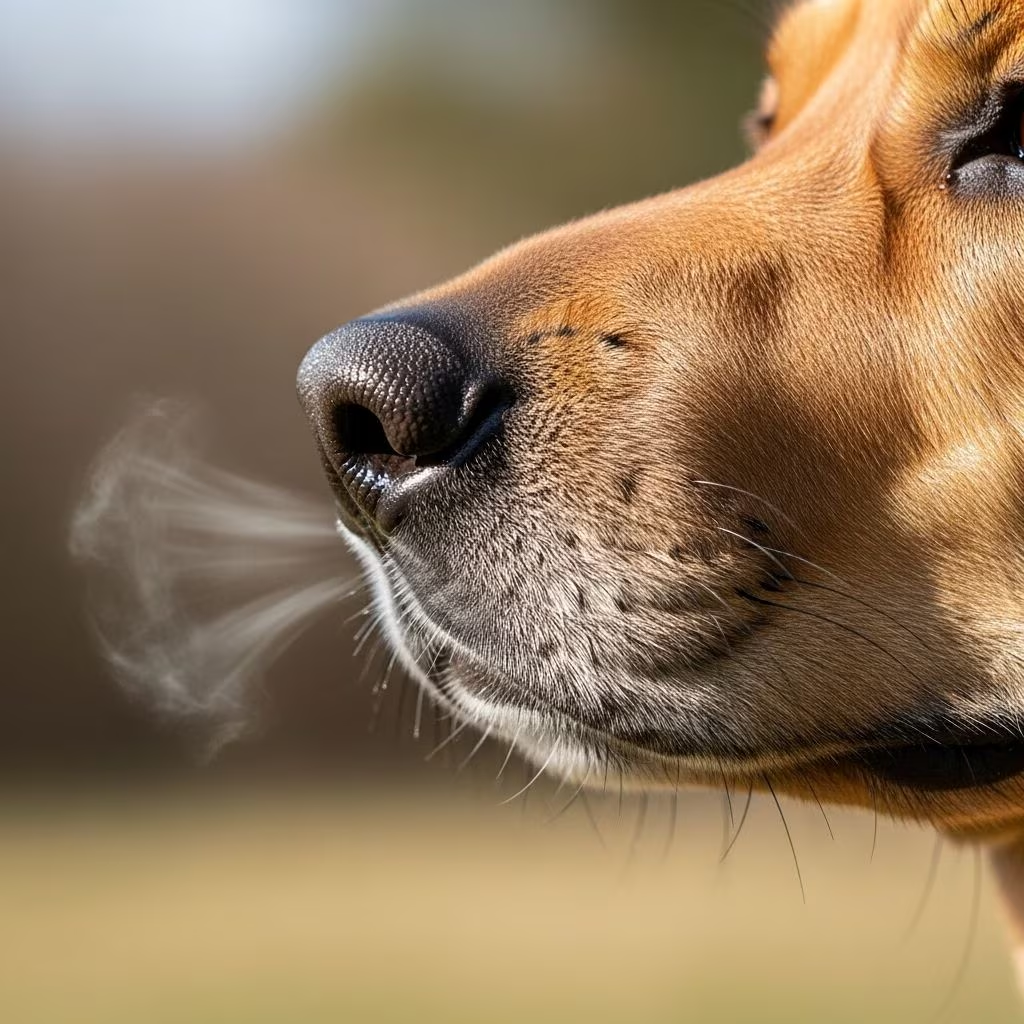
Dogs possess a extraordinary nasal design that enables them to inhale scents for analysis while simultaneously breathing air into their lungs without interruption. This dual functionality sets their olfactory system apart from humans, allowing continuous scent processing during normal respiration.
The Anatomy of a Dog’s Remarkable Nose
A dog’s nose serves dual roles: respiration and olfaction. Inside the nasal cavity, inhaled air divides into distinct streams. About 12-13% of each breath travels upward to the olfactory epithelium, where scent molecules bind to receptors, while the remaining air proceeds to the lungs via the lower pathway. This separation ensures odors accumulate without being expelled during exhalation, maintaining prolonged exposure for detection.
Canine noses contain up to 300 million olfactory receptors, compared to humans’ mere 6 million, with a brain region 40 times larger dedicated to scent interpretation. Nasal turbinates—scroll-like bones covered in sensory tissue—further amplify this capability by increasing surface area and creating turbulent airflow that traps odorants effectively.
How Dogs Achieve Simultaneous Sniffing and Breathing
Unlike humans, who alternate between inhaling and exhaling, dogs’ nostrils facilitate concurrent airflow. During sniffing, air enters and cycles continuously, with expiration passing through the olfactory zone to refresh scent samples without dilution. This mechanism supports rhythmic sniffing cycles that encode odor identity and concentration through neural timing.
- Airflow Partitioning: Upper path (12-13%) for olfaction; lower for respiration.
- Exhalation Recycling: Outbound air re-exposes receptors, preventing odor loss.
- Nasal Cycles: Alternating congestion in turbinates optimizes low-airflow detection.
This adaptation explains why dogs can track trails or analyze environments indefinitely, nose to the ground, without pausing for breath.
Beyond Basic Smell: The Vomeronasal Organ
Dogs have a secondary scent detection system called the vomeronasal organ (VNO), or Jacobson’s organ, located in the nasal roof. It specializes in pheromones—chemical signals influencing behavior and reproduction. The VNO enhances social communication, mating, and territorial awareness, providing a ‘sixth sense’ layered atop standard olfaction.
Spatial Awareness: Dogs Smell in Three Dimensions
Each nostril functions independently, capturing distinct odor profiles. The brain compares these inputs, much like binocular vision creates depth perception, pinpointing scent origins with precision. This stereoscopic smelling aids in locating hidden objects or following faint trails.
Temporal Detection: Smelling the Passage of Time
Dogs discern odor gradients over time, detecting dilution as scents age or disperse. Tracking dogs exploit this to determine direction by ground scents weakening progressively. Sniff frequency, airflow rate, and uptake differ markedly from passive breathing, enabling fine-tuned environmental scanning.
Practical Applications of Canine Olfaction
| Application | Description | Key Capability |
|---|---|---|
| Detection Work | Explosives, drugs, disaster survivors | High receptor polymorphism for breed-specific prowess |
| Medical Detection | Cancer, COVID-19, seizures, hypoglycemia | Discerns human biomarkers in breath/sweat |
| Tracking | Ground/air scent trails | 3D localization and temporal analysis |
| Therapy/Service | Stress, narcolepsy alerts | Pheromone/stress odor sensitivity |
Trained dogs outperform machines in volatile organic compound detection, such as SARS-CoV-2 in breath samples. Untrained pets instinctively react to owners’ hypoglycemic episodes or stress pheromones in sweat and breath.
Differences Between Sniffing and Passive Smelling
Passive smelling occurs unconsciously with breathing, alerting dogs to nearby stimuli. Active sniffing, however, is deliberate and rhythmic, scanning for specifics. A single sniff can differentiate similar odors, combining with localization for efficiency.
- Ground sniffing: Nose low, follows surface trails.
- Air sniffing: Head raised, detects airborne plumes.
Behavioral cues like sniff duration gauge detection confidence, vital for high-stakes operations.
Factors Influencing Canine Scent Detection
Genetic polymorphisms in olfactory receptors correlate with sniffing aptitude across breeds. Age, health, training, and environment modulate performance. Nasal airflow turbulence, driven by turbinates, ensures optimal humidification and odor routing.
Health Implications for Dog Owners
Excessive sniffing is normal but monitor for nasal discharge, bleeding, or labored breathing signaling issues like infections or tumors. Encourage sniffing during walks for mental stimulation, mimicking natural foraging.
Training Dogs to Harness Their Nose
Start with basic scent games: hide treats, progress to specific odors. Positive reinforcement builds association. Professional programs leverage airflow separation for tasks like cadaver or accelerant detection.
Consistency and short sessions prevent fatigue, capitalizing on dogs’ continuous sniffing ability.
FAQs
Why do dogs sniff everything on walks?
Dogs gather environmental data via scents, equivalent to reading a newspaper. Their dual airflow allows exhaustive exploration without respiratory pause.
Can all dogs sniff and breathe simultaneously?
Yes, this is a universal canine trait due to shared nasal anatomy, varying slightly by breed.
How much better is a dog’s sense of smell than a human’s?
Up to 50 times more sensitive, with vastly more receptors and brain processing power.
Do puppies have the same sniffing ability?
Puppies develop full olfaction around 8 weeks, with sniffing behaviors emerging early.
Can illness affect a dog’s sniffing?
Yes, respiratory infections or nasal obstructions impair airflow partitioning and detection.
Conclusion
The fusion of sniffing and breathing exemplifies evolutionary brilliance in canines, powering everything from companionship to life-saving work. Understanding this empowers owners to enrich their dogs’ lives through scent-based activities.
References
- Dogs can sniff and breathe at the same time! — Rescue Ranch Inc. Accessed 2026. https://rrdog.org/fact/dogs-can-sniff-and-breathe-at-the-same-time/
- 8 Dog Nose Facts You Probably Didn’t Know — PetMD. Accessed 2026. https://www.petmd.com/dog/behavior/5-dog-nose-facts-you-probably-didnt-know
- Canine Olfaction: Physiology, Behavior, and Possibilities — PMC (NCBI). 2021-08-25. https://pmc.ncbi.nlm.nih.gov/articles/PMC8388720/
- Dogs really can tell when we are stressed by smelling it — BBC Science Focus. Accessed 2026. https://www.sciencefocus.com/news/dogs-really-can-tell-when-we-are-stressed-by-smelling-it-in-our-sweat-and-breath



