

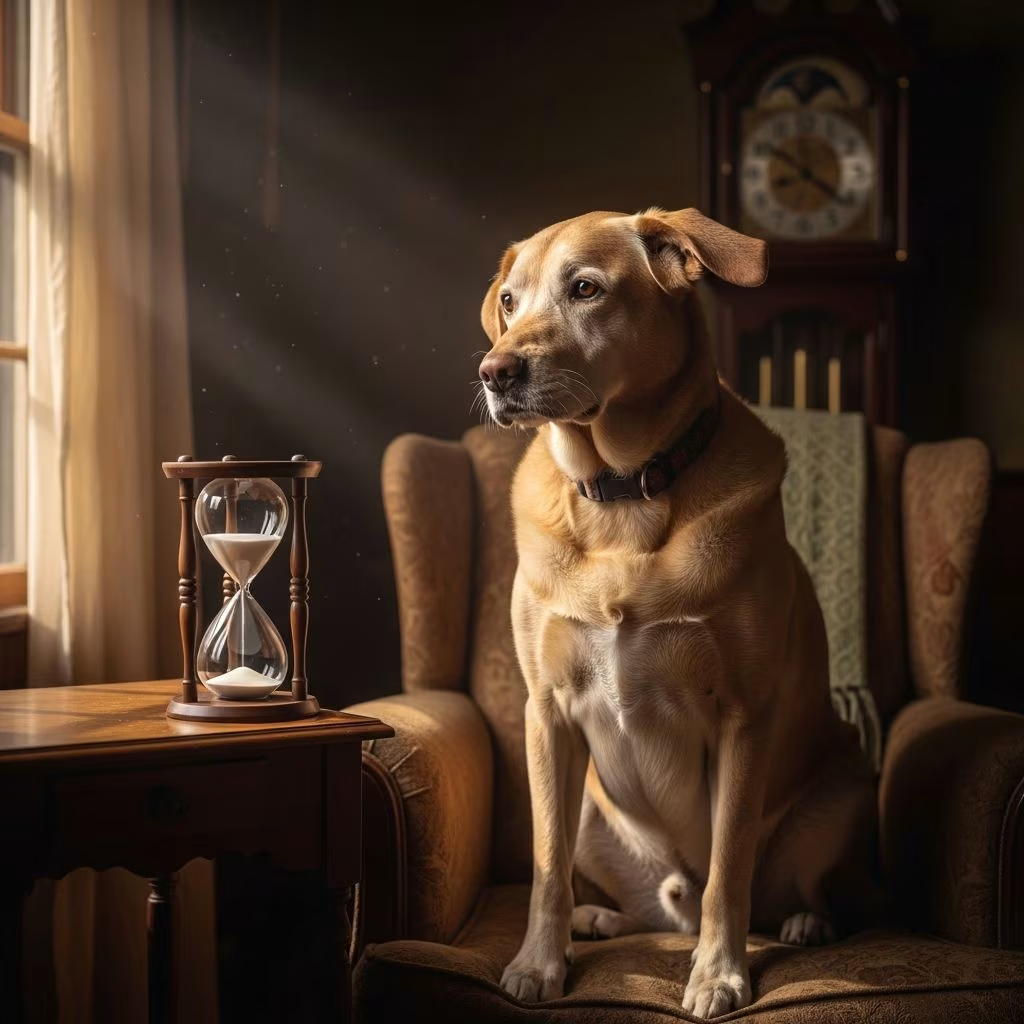
Many dog parents swear their pups know exactly when it is time for dinner, a walk, or when a favorite person is due home. While dogs cannot read clocks, their powerful sense of smell and memory may give them another way to experience the flow of time: they may literally smell change in their world as minutes and hours pass.
This article explores how dogs’ noses work, how scent changes over time, and why your dog may seem to anticipate future events based on smells, routines, and emotional cues.
Understanding a Dog’s Incredible Sense of Smell
To understand how dogs might detect the passage of time, it helps to appreciate just how extraordinary their noses are compared with ours.
- Dogs have up to tens of times more olfactory receptor cells than humans, giving them dramatically greater sensitivity to odor molecules.
- They possess a large, specialized olfactory epithelium and a relatively bigger olfactory bulb in the brain, dedicated to processing smells.
- Airflow in a dog’s nose splits into separate paths: one pathway leads to the lungs, and another directs odor-rich air to the olfactory region for analysis.
- Dogs can sniff in rapid bursts, taking multiple small inhalations per second, which helps them continuously sample the air and refine scent information.
This sophisticated system allows dogs to detect extremely low concentrations of odor and distinguish between very similar smells with remarkable accuracy.
How a Dog’s Nose Draws in and Sorts Scents
When a dog sniffs, the airflow is cleverly engineered by their nasal anatomy.
- Independent nostrils: Dogs can sample air separately through each nostril, helping them locate the direction a scent is coming from.
- Upper vs. lower airways: A smaller portion of incoming air is channeled to olfactory tissue, where odor molecules accumulate, while the rest goes to the lungs for breathing.
- Exhalation pattern: Air exits through lateral slits in the nostrils, creating vortices that draw new odor-laden air in, allowing continuous smell sampling without interrupting respiration.
Because odor molecules stick to the moist surfaces of the nose and olfactory epithelium, a dog’s brain can process a continuous stream of scent-based information about the environment.
Can Dogs Have a Sense of Time?
Dogs do not understand time as humans do; they do not count hours or read calendars. However, research suggests that they do experience changes that correspond to the passage of time.
- Behavioral studies show dogs can distinguish between shorter and longer absences of their owners, often reacting more intensely after long separations than short ones.
- Dogs form expectations around consistent routines, such as meal times or daily walks, and may appear to anticipate these events.
- Instead of knowing “3 p.m.,” dogs likely rely on changes in their own body states, environmental cues, and scent patterns that shift throughout the day.
One compelling idea is that dogs use the intensity and distribution of scent in their environment as a kind of clock.
The Concept of Dogs “Smelling Time”
The hypothesis that dogs might smell the passage of time is based largely on how odors naturally change.
- When a person is present, their scent is strongest and constantly reinforced in the environment.
- As soon as they leave, their odor begins to dissipate and spread out, becoming weaker and more diffuse over time.
- A dog with a highly sensitive nose could, in theory, learn that a certain degree of fading corresponds to a familiar interval—such as the workday length before someone returns home.
This idea, sometimes described as a form of olfactory memory, suggests dogs may track how smells change over time and use that information to anticipate events.
How Dogs Might Use Smell to Track the Day
In daily life, dogs are surrounded by constantly shifting patterns of scent indoors and outdoors. These changes may serve as markers of time.
1. Fading Human Scent and Anticipating Your Return
Consider what happens to your scent in the home after you leave:
- Your body odor is embedded in furniture, flooring, and air currents while you are present.
- Once you leave, no new odor molecules are added; the existing scent gradually weakens and spreads.
- A dog could learn that when your scent has faded to a particular level, you typically come home soon.
This would not be a conscious calculation of hours, but a learned association: a familiar degree of scent fading corresponds to the event “my person is about to return.”
2. Daily Odor Patterns in the Home
Beyond a single person’s scent, the entire household generates repeating odor patterns:
- Morning: Smells of breakfast, coffee, showers, and grooming products.
- Midday: Quieter, cooler odor profile if most people are away.
- Evening: Cooking aromas, more human scent, possibly outdoor smells tracked in after walks.
These recurring scent “landscapes” may help dogs orient themselves in their daily rhythm. As one set of smells fades and another emerges, dogs might sense that one period of the day is ending and another is beginning.
3. Outdoor Scent Clues and Environmental Changes
Outdoor odors change across hours due to temperature, humidity, wind, and human activity.
- In cooler morning air, scents tend to linger closer to the ground, often making trails stronger for dogs.
- Midday warmth and air currents can disperse and lift odors, altering how smells reach a dog’s nose.
- Evening can bring new scents: more people outside, food smells, and different animal activity.
By recognizing how familiar outdoor smells shift predictably over the day, dogs may add another layer of environmental timing to their internal sense of routine.
Inside the Nose: Olfactory Memory and Learning
Dogs not only sense smells; they remember and interpret them. Their brain’s olfactory regions are highly developed and strongly connected to emotion and memory centers.
How Dogs Store and Use Scent Memories
- Olfactory receptor cells in the nose send signals along nerves to the olfactory bulb and other brain regions.
- Each receptor cell responds to certain molecules; different combinations create unique scent “signatures.”
- Through repetition, dogs learn that specific scent signatures predict events—such as a family member coming home smelling like a particular workplace or location.
- These memories can last a long time, allowing dogs to recognize familiar individuals and contexts even after long gaps.
When combined with the natural fading and spreading of odor over time, this learning could allow dogs to link the strength or pattern of a smell to how long ago something happened.
Smell and Emotional Experience
Smell is closely tied to emotion in mammals. Dogs often react emotionally to meaningful smells, which may reinforce their time-related patterns.
- Positive odors (such as a beloved person’s scent) can trigger excitement, tail wagging, and searching behaviors.
- Dogs may feel calmer or more alert at certain times of day if those periods usually bring particular smells and events.
- Emotional responses can strengthen associations, helping dogs learn that “when it smells like this, something important happens.”
Routines, Predictability, and the Human–Dog Bond
Even if a dog can smell changes in time-linked scents, the way humans structure daily life plays a crucial role in how dogs anticipate events.
How Daily Routines Help Dogs “Tell Time”
Dogs thrive on predictable routines. Consistent schedules create patterns that a dog can use along with smell and other cues.
- Feeding times: If meals happen at roughly the same time every day, dogs can rely on a mixture of hunger, environmental cues, and household scents to anticipate them.
- Walks and play: Regular movement patterns, such as a walk after breakfast or play in the evening, create recognizable sequences of events.
- Departure and return: Repeated scent changes—perfume, shoes, keys, door sounds—mark departures and arrivals in ways dogs can learn.
The more consistent the routine, the easier it is for a dog to connect what they smell, feel, and see with what usually happens next.
Why Dogs Seem to Know When You’re Coming Home
There are several plausible explanations for why some dogs wait by the door just before their person returns:
- They have learned that at a certain smell intensity—when your residual scent has faded to a familiar level—you typically arrive soon.
- They may detect subtle outside cues, such as the sounds or smells of your car or footsteps before humans do.
- They rely on regular timing; if you come home at similar times, their anticipation becomes a habit reinforced by daily repetition.
These mechanisms can work together, making your dog seem almost psychic, when in reality they are exquisitely tuned to patterns you may not notice.
What Science Can and Cannot Say (Yet)
Researchers agree that dog noses are powerful and that dogs can form complex scent-based memories. However, the idea that dogs literally “smell time” remains a hypothesis, not a proven fact.
| What Is Supported | What Is Still Hypothetical |
|---|---|
| Dogs have far more olfactory receptors than humans. | Dogs use scent fading as a precise internal clock. |
| They can detect tiny changes in odor concentration. | They understand durations in the human sense (hours, minutes). |
| Dogs remember people and places by smell. | All dogs use scent-based time tracking in the same way. |
| Dogs behave differently after short vs. long separations. | We know exactly which brain processes encode time via smell. |
Current evidence supports the idea that dogs experience patterns that correlate with time but does not fully explain how they internally represent those intervals.
Supporting Your Dog’s Natural Sense of Routine
Regardless of the exact mechanisms, you can help your dog feel secure and confident in their daily life by respecting both their sense of smell and their need for predictability.
Practical Tips for Guardians
- Keep a reasonably consistent schedule for feeding, walking, and play to help your dog anticipate what comes next.
- Allow sniffing time on walks; this is how dogs gather information and understand their world.
- Provide scent-rich enrichment, like safe scent trails, snuffle mats, or hidden treats, to engage their olfactory system.
- Use scent to ease transitions, such as leaving a worn T-shirt with your scent when you are away to help your dog feel comforted.
By appreciating how deeply your dog depends on smell, you can design a home environment that supports their well-being and sense of stability.
Frequently Asked Questions (FAQs)
Q: Do dogs really know what time it is?
A: Dogs do not understand clock time, but research indicates they can distinguish between shorter and longer intervals and anticipate regularly scheduled events using internal states, environmental cues, and scent patterns.
Q: Can my dog smell how long I’ve been gone?
A: It is plausible that dogs can estimate how long you have been away by the fading strength and spread of your scent in the home. As that scent weakens in a reliable way over the day, your dog may associate a particular level of fading with your usual return time.
Q: Is there proof that dogs can smell the passage of time?
A: There is no definitive proof yet. The idea that dogs “smell time” is a well-known hypothesis based on their strong sense of smell and behavioral observations, but it has not been directly tested and confirmed in controlled experiments.
Q: How much better is a dog’s sense of smell than a human’s?
A: Dogs have far more olfactory receptor cells and a much larger olfactory processing area in the brain than humans, allowing them to detect much lower concentrations of odorants and discriminate between subtle scent differences.
Q: How can I use scent to comfort my dog when I’m away?
A: Leaving items that carry your scent, such as unwashed clothing or bedding, can provide familiar odor cues that may help your dog feel more secure during your absence. Pairing this with a consistent routine and enrichment can further reduce stress.
References
- Dog sense of smell — Wikipedia (summary of scientific consensus; used as a general overview, not a primary source). Accessed 2024-10-01. https://en.wikipedia.org/wiki/Dog_sense_of_smell
- Canine Olfaction: Physiology, Behavior, and Possibilities for Practical Applications — Angle C, Waggoner P, Ferrando A, et al. Animals (Basel). 2021-08-16. https://www.ncbi.nlm.nih.gov/pmc/articles/PMC8388720/
- Do Dogs Have a Sense of Time? — PetMD Editorial. Last updated 2023-03-10. https://www.petmd.com/dog/behavior/do-dogs-have-sense-time
- Can Dogs Smell Time? — Coren S. Psychology Today. 2019-11-18. https://www.psychologytoday.com/us/blog/canine-corner/201911/can-dogs-smell-time



