

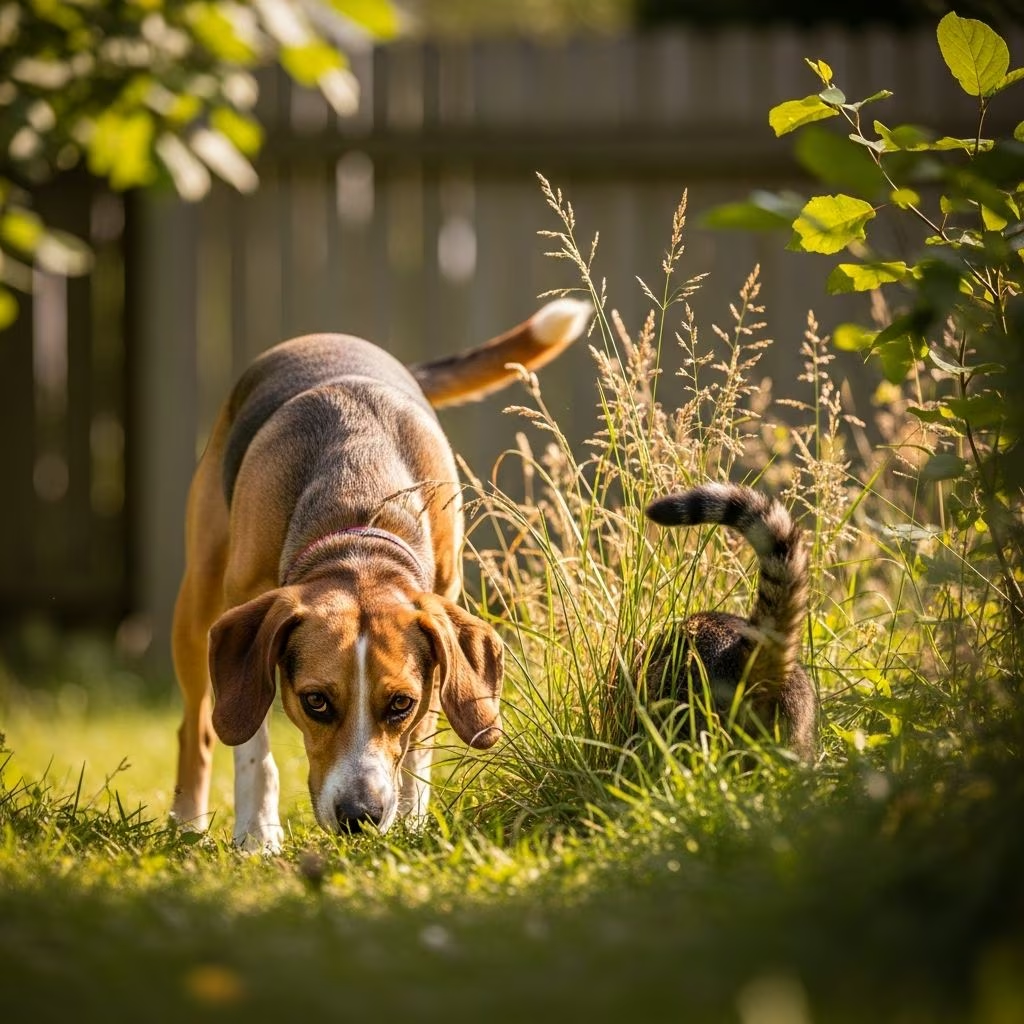
Dogs possess an extraordinary sense of smell that allows them to detect cats from a distance through pheromones, body odors, and environmental scents left behind by felines. This olfactory ability, far superior to humans, plays a key role in how dogs react to cats in multi-pet homes.
How Powerful Is a Dog’s Sense of Smell?
Dogs have between 100 million to 300 million olfactory receptors, compared to humans’ mere 5 million, enabling them to detect scents at concentrations 10,000 to 100,000 times lower than people can. Breeds like Bloodhounds and Beagles can have up to 300 million receptors, making their noses ideal for tracking. A dog’s nose functions uniquely: they inhale air through two pathways, with some held in the nasal cavity for detailed processing via the olfactory epithelium, while the rest goes to the lungs.
The vomeronasal organ (Jacobson’s organ) in dogs further enhances pheromone detection, aiding in identifying hormones from other animals. This organ processes scents related to mating, territory, and emotional states. Dogs also employ different sniffing techniques: tracking low to the ground for footprints or shed cells, air scenting with heads raised in zig-zag patterns, and trailing specific odor paths. Their wet noses trap particles efficiently; if dry, dogs lick them to restore moisture.
Research from Cornell University shows dogs integrate smell with vision in unique brain regions, enhancing environmental awareness. fMRI studies confirm activation in the olfactory bulb and caudate nucleus when dogs encounter familiar scents, indicating emotional processing tied to smell.
Can Dogs Smell Cats Specifically?
Yes, dogs can smell cats effectively due to their superior olfactory system. Cats leave behind scents from fur, urine, and pheromones, which dogs detect readily. However, a study by Christy Hoffman at Canisius College tested 69 dogs’ reactions to a cat-scented doll versus one without scent, alongside cat sounds. Results showed dogs responded more to meows and sounds than the cat’s smell alone, with aggressive dogs focusing intensely on audio cues.
Dogs track cat scents similarly to prey or humans, using ground-level sniffing for shed cells or airborne particles. Pheromones from cats, undetectable to humans, signal territory, stress, or mating status via the vomeronasal organ. While dogs notice these, auditory and visual stimuli often trigger stronger excitement or chase responses.
How Does a Cat’s Sense of Smell Compare to a Dog’s?
Cats have 80 to 150 million olfactory receptors, fewer than many dogs but still vastly superior to humans’ 5 million. Cats excel in scent discrimination, distinguishing subtle differences better than dogs in some cases. Their vomeronasal organ is highly developed, aiding pheromone detection for communication, territory marking, and hunting.
Cats show the Flehmen response—curling lips to ‘taste’ scents—when pheromones stimulate this organ, appearing to smile. Both species mark territory with scent glands, but cats prioritize familiar environments and react strongly to novel odors. While dogs track over distances, cats use smell for close-range navigation, food detection, and social cues.
| Aspect | Dogs | Cats |
|---|---|---|
| Olfactory Receptors | 100-300 million | 80-150 million |
| Scent Detection Strength | 10,000-100,000x humans | 14x humans |
| Key Organ | Vomeronasal (pheromones) | Vomeronasal (advanced pheromones) |
| Primary Use | Tracking, detection | Discrimination, communication |
Why Do Dogs React to the Smell of Cats?
Dogs react to cat scents due to instinctual prey drive, curiosity, or past experiences. Novel cat pheromones can excite hunting behaviors, leading to sniffing, barking, or chasing. Aggressive dogs show heightened responses to combined cues, but smell alone rarely sustains interest without sight or sound.
Positive associations form if dogs meet calm cats early; negative ones arise from poor introductions. Scent marking overlaps causes territorial tension, as both pets detect intruders via odors. Dogs may growl or stiffen upon smelling unfamiliar cat pheromones signaling stress or dominance.
- Prey Drive Activation: Quick cat movements paired with scent trigger chase instincts.
- Play Invitation: Familiar cat smells prompt friendly sniffing or bowing.
- Fear/Aggression: Strong, unfamiliar odors lead to hiding or vocalization in cats, escalating dog reactions.
What Scents Can Dogs and Cats Detect That Humans Can’t?
Both detect pheromones for emotional signaling, mating, and kin recognition via the vomeronasal organ. Examples include:
- Mother-offspring bonds in newborns.
- Territorial boundaries from urine/facial glands.
- Stress or fear signals altering behavior.
- Disease biomarkers, like cancers, via subtle chemical shifts.
Dogs excel in long-range detection, used in search-and-rescue or scat identification with 100% species accuracy. Cats discern fine odor nuances for hunting stealthily.
Practical Tips for Introducing Dogs to Cats
Slow introductions minimize scent-triggered stress:
- Scent Swapping: Exchange blankets for gradual familiarization before visual contact.
- Supervised Meetings: Use leashes/barriers; reward calm sniffing.
- Enrichment: Provide scent toys to redirect focus.
- Monitor Body Language: Stop if growling, hissing, or hiding occurs.
Strong household odors (e.g., cleaners) overwhelm pets; opt for pet-safe alternatives. Training desensitizes dogs to cat scents positively.
Frequently Asked Questions (FAQs)
Can all dogs smell cats equally well?
No, scenting ability varies by breed; hounds excel, while brachycephalic breeds like Pugs have reduced capacity due to anatomy.
Do cats know when dogs smell them?
Yes, cats detect dogs via reciprocal strong olfaction and react with posture changes or fleeing.
How far can dogs smell a cat?
Distances vary; trained dogs track miles, but household detection occurs within rooms via airborne particles.
Can dogs be trained to ignore cat smells?
Yes, through desensitization and positive reinforcement, reducing reactive behaviors.
Is a dog’s nose better than a cat’s for smelling cats?
Dogs have more receptors for detection range, but cats discriminate pheromones finely; no clear winner.
References
- Cats Vs. Dogs: Who Has the Best Sense of Smell? — Dr. Bill’s Pet Nutrition. Accessed 2026. https://drbillspetnutrition.ca/cats-vs-dogs-who-has-the-best-sense-of-smell/
- Can Dogs Smell Cats? — WagWalking. Accessed 2026. https://wagwalking.com/sense/can-dogs-smell-cats
- Nose Smarts: What Pets Can Tell With Their Sense of Smell — VCA Animal Hospitals. Accessed 2026. https://vcahospitals.com/shop/home/articles/nose-smarts-what-pets-can-tell-with-their-sense-of-smell
- Canine Olfaction: Physiology, Behavior, and Possibilities for Practical Applications — PMC (NCBI). 2021-08-25. https://pmc.ncbi.nlm.nih.gov/articles/PMC8388720/
- Why Do Dogs React to Cats? — Psychology Today. 2017-03. https://www.psychologytoday.com/us/blog/canine-corner/201703/why-do-dogs-react-to-cats
- Study Finds New Links Between Dogs’ Smell and Vision — Cornell University News. 2022-07. https://news.cornell.edu/stories/2022/07/study-finds-new-links-between-dogs-smell-and-vision



