

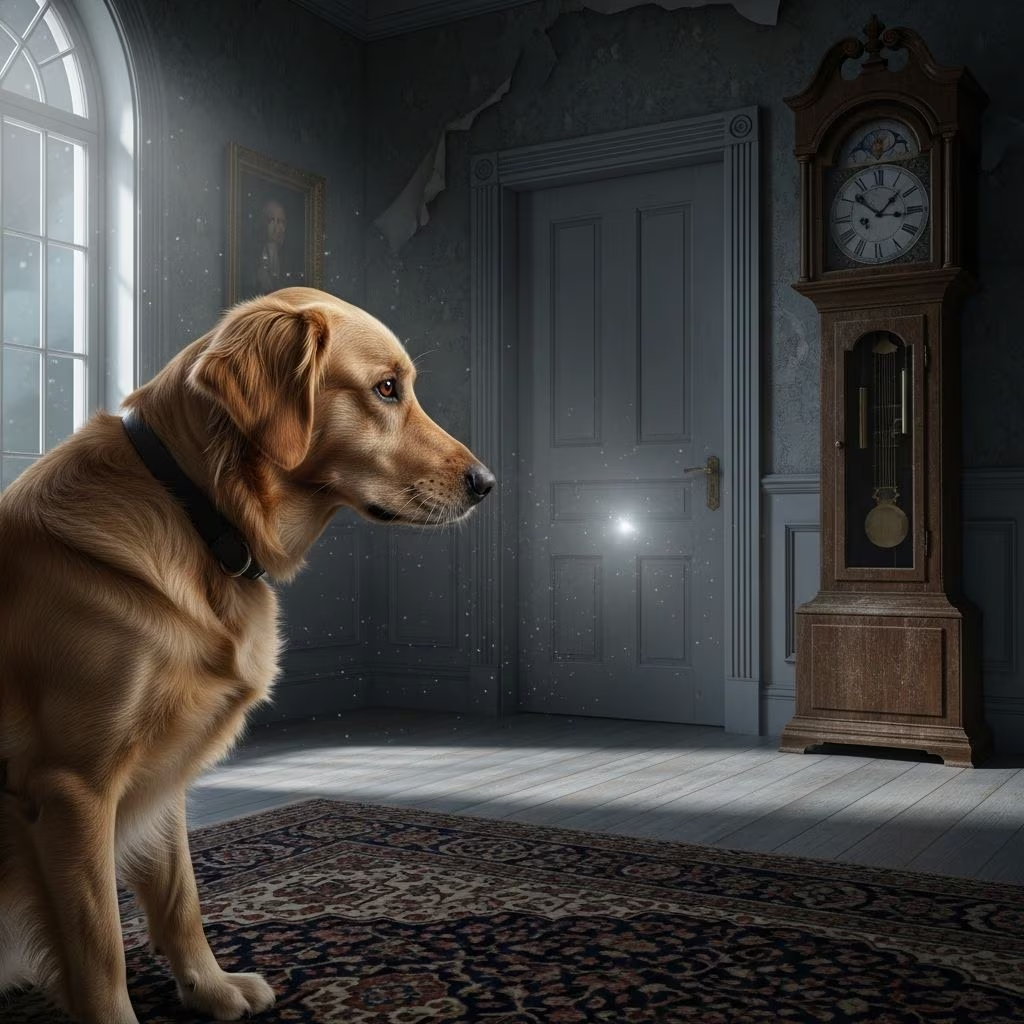
Can Dogs See Ghosts? The Scientific Truth
One of the most persistent questions pet owners ask is whether their dogs can see ghosts or spirits. The straightforward answer from science is clear: there is no scientific evidence that dogs can see ghosts or spirits. Despite popular culture’s fascination with the idea—from Hollywood films to Netflix documentaries—the scientific community has found no proof supporting this claim. However, understanding why dogs sometimes behave in ways that suggest they sense the supernatural requires exploring their remarkable sensory abilities and the psychological factors that influence how we interpret their behavior.
Why Do Dogs Act Like They See Ghosts?
Pet owners frequently report instances where their dogs bark at empty corners, stare at blank walls, or seem to follow something invisible around the house. These behaviors are particularly puzzling, especially following the death of a family member or during moments when owners feel emotionally vulnerable. A sociology professor at Ripon College documented a case where a paranormal investigator’s dog repeatedly barked at the stairs following the investigator’s father’s death, leading the grieving owner to believe his dog was sensing his father’s spirit. While these anecdotes are emotionally compelling, they often reflect a combination of misinterpretation and confirmation bias rather than supernatural perception.
When a dog barks at seemingly nothing, the owner’s preconceived beliefs about paranormal activity can heavily influence their interpretation. If an owner already believes in ghosts, they’re more likely to attribute their dog’s behavior to supernatural causes rather than exploring natural explanations. This psychological phenomenon is particularly strong during emotionally charged moments, such as grieving.
Understanding Dog Senses: Superior to Human Perception
Dogs possess sensory abilities that far exceed human capabilities in several key areas. Rather than proving they can see ghosts, these enhanced senses provide rational explanations for their mysterious behaviors. Understanding these abilities is crucial to debunking ghost-sensing myths.
The Canine Sense of Smell
Dogs’ olfactory abilities are among their most impressive talents. Dogs have approximately 220 million scent receptors in their noses, compared to roughly 5 million in humans. Beyond standard smell, dogs possess a specialized organ called the Jacobson’s organ (or vomeronasal organ) that can detect chemical cues beyond normal olfactory range. This extraordinary sensitivity allows dogs to accomplish remarkable feats. In a landmark 1950s Duke University study, scientists discovered that dogs could identify garlic oil diluted to 0.00000005 percent with 85 percent accuracy.
Modern research has expanded our understanding of canine olfactory abilities. One recent study demonstrated that dogs can identify blood samples from people with cancer with almost 97 percent accuracy. Another study confirmed that dogs can smell human stress, which may explain why they react differently when their owners are anxious or frightened.
When a dog seems to react to an invisible presence, they may actually be detecting subtle scents imperceptible to human noses. If your dog tends to get spooked when you’re walking late at night, it’s more likely they’re responding to your fear—detected through scent and behavioral cues—rather than sensing a ghostly entity.
Superior Hearing Abilities
A dog’s hearing dramatically surpasses human auditory perception in both range and sensitivity. Dogs can hear sounds up to 64,000 to 65,000 Hertz, while humans can only detect sounds around 20,000 Hertz. Additionally, dogs can hear much quieter sounds—as low as negative 15 decibels—compared to the human threshold.
This heightened hearing sensitivity means that high-pitched or intermittent sounds are more likely to spook your dog. Common household sounds that dogs find disturbing include smoke detector low-battery signals, creaking doors, indoor alarms, and the humming of ceiling fans. Owners often misinterpret their dog’s reaction to these sounds as paranormal sensitivity, when the dog is actually responding to frequencies and intensities completely beyond human perception.
Vision Differences
Unlike smell and hearing, dogs’ vision is generally inferior to human vision in several ways. Humans can see more clearly at greater distances and perceive a wider range of colors than dogs, which are red and green color blind. However, dogs excel at detecting movement and subtle changes in light. A television screen that appears smooth to humans might seem to flicker to a dog, and they can detect movement that human eyes miss.
Dogs can see objects at a greater distance and their ability to see in twilight, dusk, and dawn is far superior to humans. They can see at a distance up to eight times further than humans and navigate in darkness much more effectively. This enhanced low-light vision may account for why dogs seem to react to things during nighttime walks or in dimly lit areas—they’re actually detecting real movements or objects that remain invisible to human eyes.
Detecting Environmental Changes
Beyond the five primary senses, dogs demonstrate an uncanny ability to sense environmental changes humans cannot perceive. Barometric pressure and natural phenomena have associated odors beyond the capacity of human noses to recognize, but dogs can sense these changes immediately. This ability helps dogs detect impending disasters like earthquakes, storms, or other natural events before they occur. When dogs are more exposed to the scent of someone in a state of fear or stress, they are more likely to respond with stress themselves.
The Paranormal Perspective: ESP and Psychic Abilities
Some parapsychologists—researchers who study paranormal phenomena—propose alternative explanations for dogs’ mysterious behavior. According to this perspective, dogs might possess extrasensory perception (ESP), which includes telepathy (reading thoughts), clairvoyance (perceiving distant events), and precognition (foreseeing the future).
Parapsychologist Loyd Auerbach has stated that since ghosts aren’t physical phenomena that can be picked up by the senses, some form of non-sensory perception would be needed to perceive a ghost, and dogs and cats—like most animals—may be psychic, just like humans. However, this perspective faces significant challenges. Scientific support for ESP is scarce, and many studies fail to provide conclusive evidence that it exists.
Some ESP proponents argue that paranormal abilities operate beyond the limits of conventional science, making them impossible to prove or disprove through standard scientific methods. They suggest that perhaps we simply lack the tools to accurately measure what dogs might sense. However, without empirical evidence, this remains speculative rather than scientifically supported.
What Science Actually Knows About Dog Behavior
Certified dog behavior consultant and trainer Russell Hartstein emphasizes that the most interesting part of the science of dog behavior and understanding is that we simply don’t know so much. This acknowledgment of scientific uncertainty is important, but it doesn’t mean ghost-sensing is probable—only that animal behavior remains complex and not fully understood.
When dogs bark at apparent emptiness, a more likely explanation involves their ability to detect natural stimuli humans cannot. Dogs and cats may hear insect or small animal activity in walls or at outer walls that remain completely undetectable to humans. Psychology professor Christopher French, who studies paranormal beliefs, agrees with this sensory explanation. As a skeptic, French notes that it seems far more likely that dogs sometimes react to natural stimuli that humans cannot detect, given their superior sense of smell and hearing.
Psychology professor Ellen Furlong, who studies animal cognition, suggests another perspective: instead of seeing something spooky, dogs might be orienting their heads to smells and sounds to help them perceive these stimuli better. This behavior looks supernatural to human observers but reflects dogs’ normal sensory processing.
Frequently Asked Questions About Dogs and Ghosts
Q: Is there any scientific proof that dogs can see ghosts?
A: No. There is no scientific evidence supporting the claim that dogs can see ghosts or spirits. While dogs have exceptional senses, these abilities relate to detecting physical stimuli like sounds, scents, and movements that humans cannot perceive.
Q: Why does my dog bark at nothing?
A: Your dog is likely reacting to something you cannot detect—such as high-frequency sounds, animal activity, subtle movements, or scents. Dogs may also respond to their owner’s emotional state or stress levels.
Q: Can dogs detect human emotions?
A: Yes. Dogs can smell human stress and respond to their owner’s emotional state. Research shows that when dogs are exposed to the scent of someone in a fearful or stressed state, they become more likely to respond with stress themselves.
Q: Do dogs have extrasensory perception (ESP)?
A: While some parapsychologists believe dogs might possess ESP, there is no scientific evidence supporting this claim. Studies attempting to prove ESP have been inconclusive.
Q: What is the Jacobson’s organ in dogs?
A: The Jacobson’s organ (vomeronasal organ) is a specialized sensory organ in dogs that can detect chemical cues beyond normal smell, giving them additional olfactory capabilities.
The Bottom Line: What Dogs Can Actually “See”
While the idea of dogs sensing ghostly presences is captivating, the scientific evidence points toward a simpler explanation: dogs possess sensory abilities that far exceed human capabilities in smell, hearing, and low-light vision. What appears supernatural to us is often their natural response to stimuli we simply cannot detect. Dogs lack the ability to see ghosts in any scientifically provable way, but what they lack in ghostbusting abilities, they make up for with their incredible senses and their profound connection to us.
Understanding these abilities transforms our appreciation of dogs from seeing them as paranormal detectors to recognizing them as creatures with genuinely extraordinary sensory perception. The next time your dog barks at an empty corner, the most likely explanation isn’t a spectral visitor—it’s that your dog is detecting something real, just beyond your own sensory range.
References
- Can Dogs See Ghosts? Busting Myths & More — Tractive. 2024. https://tractive.com/blog/en/good-to-know/can-dogs-see-ghosts
- Can dogs sense ghosts? — Popular Science. 2024. https://www.popsci.com/environment/can-dogs-sense-ghosts/
- Can Dogs See Ghosts? – American Kennel Club — American Kennel Club. 2024. https://www.akc.org/expert-advice/lifestyle/can-dogs-see-ghosts-spirits/



