

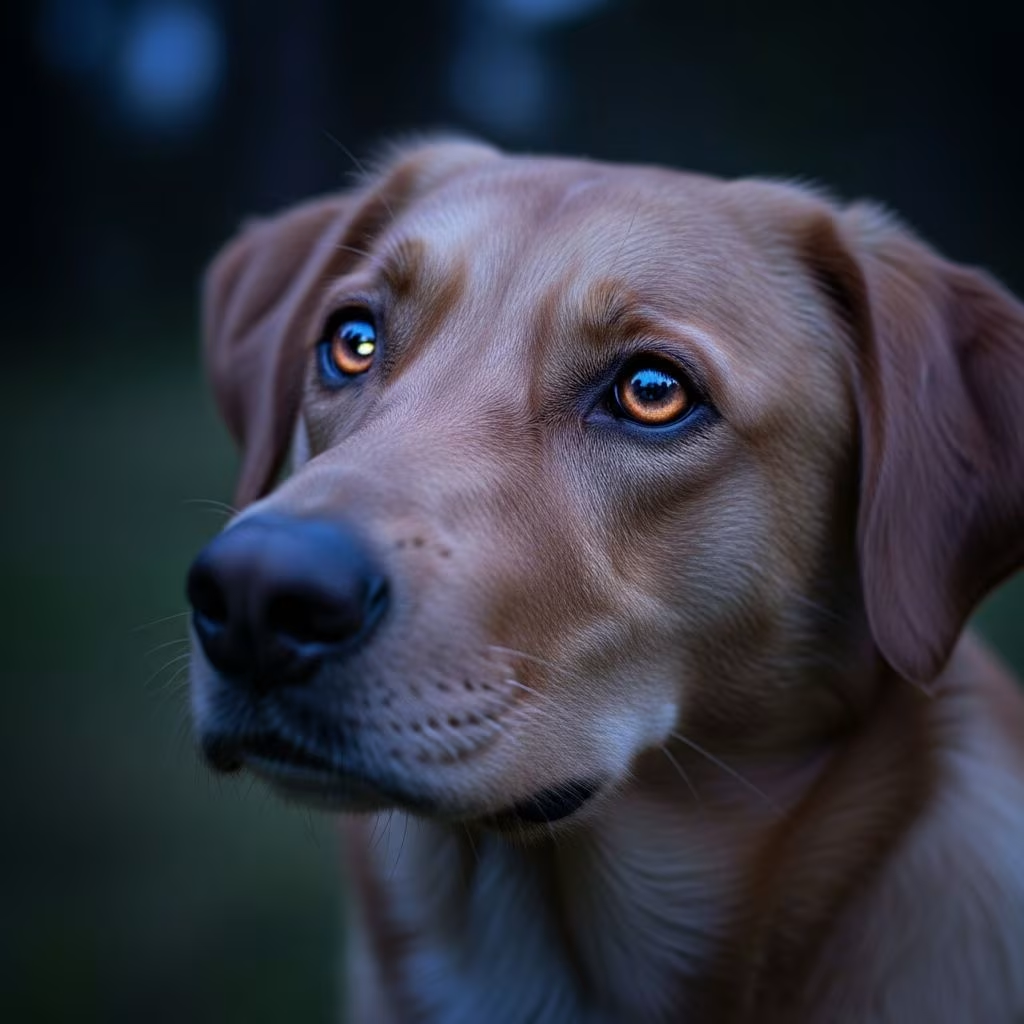
Dogs possess superior low-light vision compared to humans, enabling them to navigate dim environments effectively, though they cannot see in complete darkness. This adaptation stems from their evolutionary heritage as crepuscular hunters, with eye structures optimized for dawn and dusk activities.
How Dogs’ Eyes Differ from Humans
Canine eyes feature key anatomical differences that enhance night vision. Dogs have larger pupils that dilate more widely to capture greater amounts of available light, a higher density of rod photoreceptor cells in the retina, and a reflective layer called the tapetum lucidum.
- Larger pupils: Allow more light entry in low conditions, unlike human pupils which are smaller.
- Rod-dominated retinas: Dogs have about 120 million rods versus humans’ 90 million, prioritizing motion detection and low-light sensitivity over color.
- Tapetum lucidum: A mirror-like structure behind the retina that reflects light back through photoreceptors for a second chance at detection, causing eyeshine.
These features make dogs see in light up to five times dimmer than humans, though their acuity drops to about 20/80 compared to human 20/20 due to light scattering.
The Science Behind Dog Night Vision
Research from the University of Wisconsin-Madison confirms dogs’ low-light superiority. Their retinas have more rods concentrated in the center, excelling in dim light where human cone-heavy retinas falter. The tapetum lucidum boosts this by reflecting light, though it’s less efficient than in cats, limiting dogs to crepuscular rather than fully nocturnal vision.
Evolutionary biology links this to wolves, dogs’ ancestors, who hunted at twilight. Modern dogs retain these traits: wider field of view (240-250 degrees vs. humans’ 180), better motion detection (70 fps vs. 60 fps), aiding prey tracking in low light.
| Feature | Dogs | Humans |
|---|---|---|
| Rods per retina | ~120 million | ~90 million |
| Low-light threshold | 5x dimmer light | Standard daylight |
| Field of view | 240-250° | 180° |
| Motion detection | 70 fps | 60 fps |
| Tapetum lucidum | Present | Absent |
This table highlights dogs’ low-light advantages, supported by comparative ophthalmology studies.
What Dogs Can and Can’t See
Dogs see blues and yellows distinctly but perceive reds and greens as grays due to dichromatic vision (two cone types vs. humans’ three). In low light, rods dominate, eliminating color entirely.
- Colors: Blue/yellow sensitivity aids hunting camouflaged prey; brightness less informative than hue in some tasks.
- Motion: Superior flicker detection spots movement in dim conditions.
- Acuity: Poorer detail in bright light but excels in shapes and outlines at night.
Studies show dogs prioritize chromatic cues over brightness when both available, challenging old myths of canine color blindness.
Can Dogs See in Complete Darkness?
No, dogs cannot see in pitch blackness; they require some ambient light like moonlight or starlight. Without photons, rods and tapetum are useless—they rely on smell and hearing instead.
While superior to humans in dim light (1/6th the illumination needed), total dark impairs all vision. This crepuscular adaptation suits pack hunting at twilight.
Why Do Dog Eyes Glow in the Dark?
The eerie glow is the tapetum lucidum reflecting flashlight or headlight beams back through the retina, amplifying scant light. This eyeshine warns owners of nearby animals during night walks.
Not all dogs glow equally; breed and tapetum coverage vary, but it’s universal in canines unlike humans.
Dog Vision vs. Other Animals
Dogs surpass humans in low light but trail cats, who see in six times dimmer conditions with denser rods and fuller tapetum coverage. Wolves match dogs closely, retaining wild acuity.
- Vs. Cats: Cats superior in true dark; dogs better in motion during dusk.
- Vs. Wolves: Domestic dogs slightly diminished but still potent.
- Vs. Humans: Dogs win night; humans daytime color/detail.
Practical Tips for Night Walks with Dogs
Leverage your dog’s vision safely:
- Use a flashlight to spot reflectors in their eyes—and potential threats like coyotes.
- Choose blue/yellow toys for visibility; avoid red/green.
- Trust their alerts in dim areas; their senses detect what yours miss.
- Avoid total dark; provide minimal light for optimal use of their vision.
Breeds like hounds excel more due to selective breeding for hunting.
Frequently Asked Questions (FAQs)
Can dogs see in complete darkness?
No, dogs need some light; they see in dim conditions far better than humans but rely on other senses in total dark.
What colors can dogs see best?
Dogs distinguish blues and yellows clearly; reds/greens appear grayish.
Why do dogs’ eyes glow at night?
The tapetum lucidum reflects light, enhancing vision and creating eyeshine.
Do all dogs have the same night vision?
Vision varies by breed and individual; hunting breeds often superior.
How much better is dog night vision than human?
Dogs see in light 5x dimmer; acuity ~20/80 vs. human 20/20.
Conclusion
Dogs’ night vision, honed by evolution, offers practical edges for pet owners, from safer walks to playtime. Understanding these limits fosters better care.
References
- Can Dogs See Better In the Dark Than Humans? — Marin Humane Society. Accessed 2026. https://marinhumane.org/can-dogs-see-better-in-the-dark-than-humans/
- Can Dogs See in the Dark? A Deep Dive into Canine Night Vision — Two Tails Pet Company. Accessed 2026. https://twotailspetcompany.com/blogs/dogs/can-dogs-see-in-the-dark
- How Well Do Dogs See At Night? — University of Wisconsin-Madison via ScienceDaily. 2007-11-09. https://www.sciencedaily.com/releases/2007/11/071108140336.htm
- Colour cues proved to be more informative for dogs than brightness — PMC (National Library of Medicine). 2013. https://pmc.ncbi.nlm.nih.gov/articles/PMC3730601/
- Dog vs. Human Eyesight: A Science-Backed Comparison — Off Leash Georgia. Accessed 2026. https://offleashgeorgia.com/dog-vs-human-eyesight-a-science-backed-comparison/
- How Well Can Dogs See in the Dark? — Whole Dog Journal. Accessed 2026. https://www.whole-dog-journal.com/behavior/how-well-can-dogs-see-in-the-dark/



