

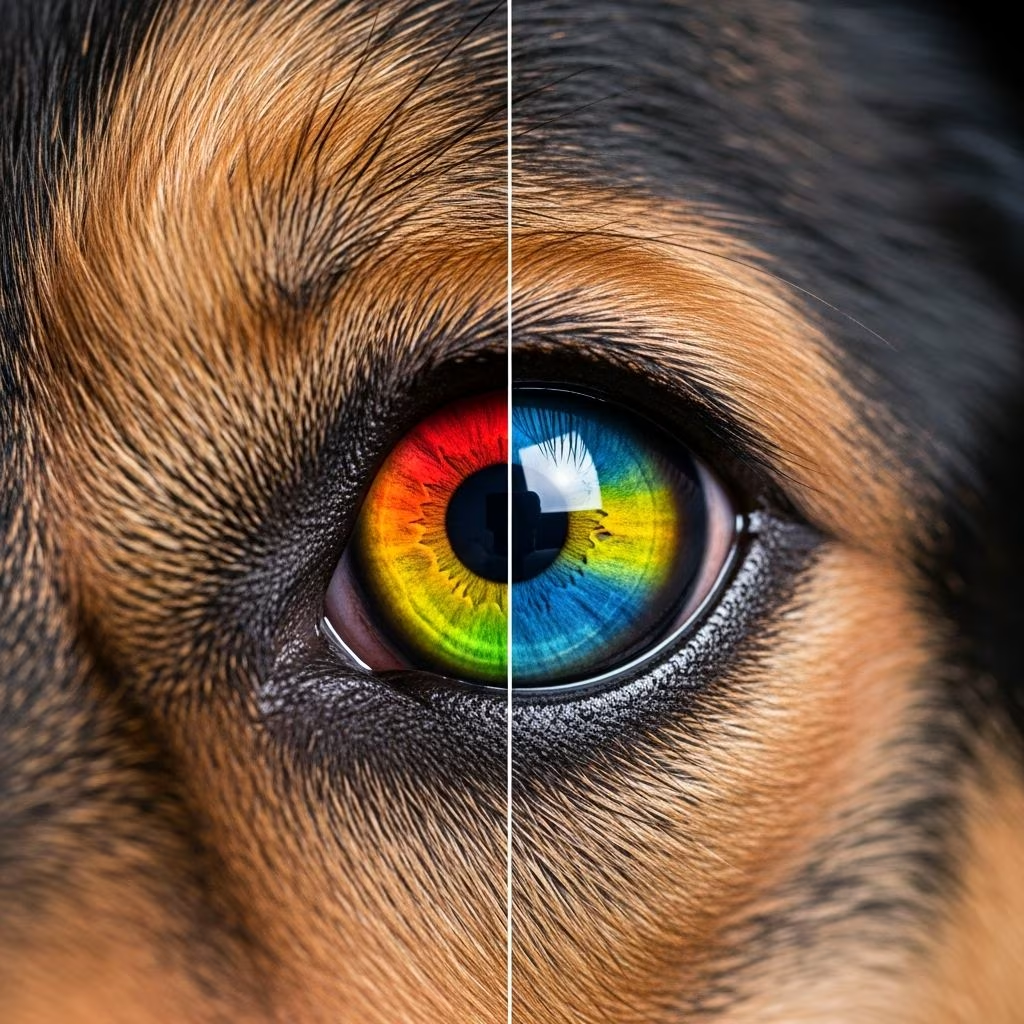
Dogs possess a form of color vision known as dichromatic vision, allowing them to distinguish blues and yellows but rendering reds and greens largely indistinguishable, akin to human red-green color blindness.
The Building Blocks of Canine Eyesight
Understanding dog vision starts with the retina, where photoreceptor cells called cones and rods process light. Humans rely on three cone types sensitive to red, green, and blue wavelengths, enabling a broad color spectrum. Dogs, however, have only two cone types: one for short wavelengths (blue-violet, peaking around 429 nm) and another for medium-to-long wavelengths (yellow, peaking around 555 nm).
This dichromatic setup means dogs perceive the world through a limited palette. Behavioral studies confirm they respond to color differences, particularly when hues outweigh brightness cues. For instance, research using modified Ishihara plates—standard tests for human color blindness—showed dogs identifying patterns visible to dichromats but not those requiring red-green discrimination.
How Dogs Perceive Specific Colors
- Blues: Dogs see vivid blues clearly, thanks to their short-wavelength cones. This makes blue toys or objects highly visible in various lighting.
- Yellows: Medium wavelengths register strongly, so yellows appear bright and distinct.
- Reds and Greens: These blend into grays or browns for dogs, as their cones cannot differentiate them.
- Oranges and Purples: Often muddled; oranges may look yellowish-gray, purples as blue-gray.
Visual simulations based on cone sensitivities illustrate this: a vibrant human rainbow becomes a muted blue-yellow-gray gradient for dogs.
Dogs vs. Humans: A Vision Comparison
| Aspect | Humans (Trichromatic) | Dogs (Dichromatic) |
|---|---|---|
| Cone Types | 3 (Red, Green, Blue) | 2 (Blue, Yellow) |
| Color Range | Full spectrum | Blue, yellow, grays |
| Low-Light Vision | Moderate | Superior (more rods, tapetum lucidum) |
| Motion Detection | Good | Excellent |
| Visual Acuity | Higher detail | Lower (4-8x worse) |
Dogs excel in dim light due to more rod cells and a reflective tapetum lucidum layer, which bounces light back through the retina for enhanced night vision. Their eyes glow in flashes because of this structure. However, acuity suffers; dogs see details at 20/75 equivalent compared to human 20/20.
Scientific Evidence Confirming Dichromatic Vision
Peer-reviewed studies provide robust proof. A 2017 PMC study tested dogs with Ishihara-inspired stimuli featuring moving cats in red-green confusion colors. Dogs detected patterns for ‘2’ (blue-yellow based) but failed on ‘6’ (red-green), mirroring human deuteranopia.
Earlier work by Neitz et al. used food-reward training; dogs matched wavelengths consistent with two-cone sensitivity, not three. PetMD references optics research equating dog vision to humans lacking green cones. VCA Hospitals notes dogs discern blue-yellow best.
These findings debunk total color blindness myths, showing color aids foraging, play, and navigation.
Why Dog Vision Evolved This Way
Ancestral wolves, dogs’ progenitors, hunted at dawn/dusk, prioritizing motion and low-light detection over color vibrancy. Fewer cones but abundant rods suited crepuscular lifestyles. Domestication retained this; breeds vary slightly, but all share dichromacy.
Modern roles like guide dogs or rescuers leverage strengths: superior scent, hearing, motion tracking compensate for color limits.
Practical Tips for Dog Owners
Knowing canine limits enhances welfare:
- Choose Toys Wisely: Opt for blue, yellow, or bright contrasts. Avoid red-green mixes, as they appear uniform.
- Training Aids: Use color-paired scents or textures; dogs rely more on nose than eyes.
- Daily Life: Green grass and red balls blend; add white stripes or use balls with scent.
- Health Checks: Vision changes signal issues; watch for bumping or hesitation in low light.
For Halloween or holidays, dogs see orange pumpkins as dull yellows, reds as dark grays—stick to blues for visibility.
Debunking Vision Myths
- Myth: Dogs See Black and White Only. False; they detect hues, just fewer.
- Myth: Dogs Can’t See TV. They perceive motion but flicker rates differ; modern screens may register colors dimly.
- Myth: All Breeds See Identically. Minor cone variations exist, but dichromacy is universal.
Breed Variations in Vision
While core vision is consistent, eye shape affects fields: brachycephalic breeds (Pugs) have wider panoramas but shallower focus; sighthounds (Greyhounds) prioritize speed detection. No breed achieves trichromacy.
Implications for Canine Research
Dogs model human retinal disorders due to genetic similarities. Vision studies advance therapies for both species, from gene edits to prosthetics.
Frequently Asked Questions
Are dogs completely colorblind?
No, dogs have dichromatic vision, seeing blues and yellows but not reds/greens distinctly.
What do reds look like to dogs?
Reds appear as dark grays or browns, blending with greens.
Can dogs see better at night?
Yes, rods and tapetum give superior low-light and motion vision.
Do color-correcting glasses work for dogs?
Unlikely; designed for human trichromatic deficits, not canine physiology.
How was dog color vision scientifically proven?
Via behavioral tests like modified Ishihara plates and cone pigment analysis.
Enhancing Your Dog’s Visual World
Incorporate blues/yellows in environments. Puzzle toys with color cues paired with smells boost engagement. Regular vet eye exams catch cataracts or PRA early—common in aging dogs.
Apps simulating dog vision highlight contrasts; test toys by converting photos to dichromatic filters.
References
- Are dogs red–green colour blind? — PMC – PubMed Central. 2017-11-08. https://pmc.ncbi.nlm.nih.gov/articles/PMC5717654/
- Inside a Dog’s Eyes: The Science of Canine Color Vision — Vet Today. Accessed 2026. https://vettoday.com/blog/pet-health/the-science-of-canine-color-vision/
- Are Dogs Really Colorblind? — PetMD. Accessed 2026. https://www.petmd.com/dog/general-health/are-dogs-really-colorblind
- How do dogs see the world? — BBC Science Focus Magazine. Accessed 2026. https://www.sciencefocus.com/nature/how-do-dogs-see-the-world
- Do Dogs See Color? — VCA Animal Hospitals. Accessed 2026. https://vcahospitals.com/know-your-pet/do-dogs-see-color
- Are Dogs Color Blind? — EnChroma. Accessed 2026. https://enchroma.com/blogs/beyond-color/are-dogs-color-blind
- Dog vision, explained — YouTube (Scishow). Accessed 2026. https://www.youtube.com/watch?v=EJXG-5mZfJM



