

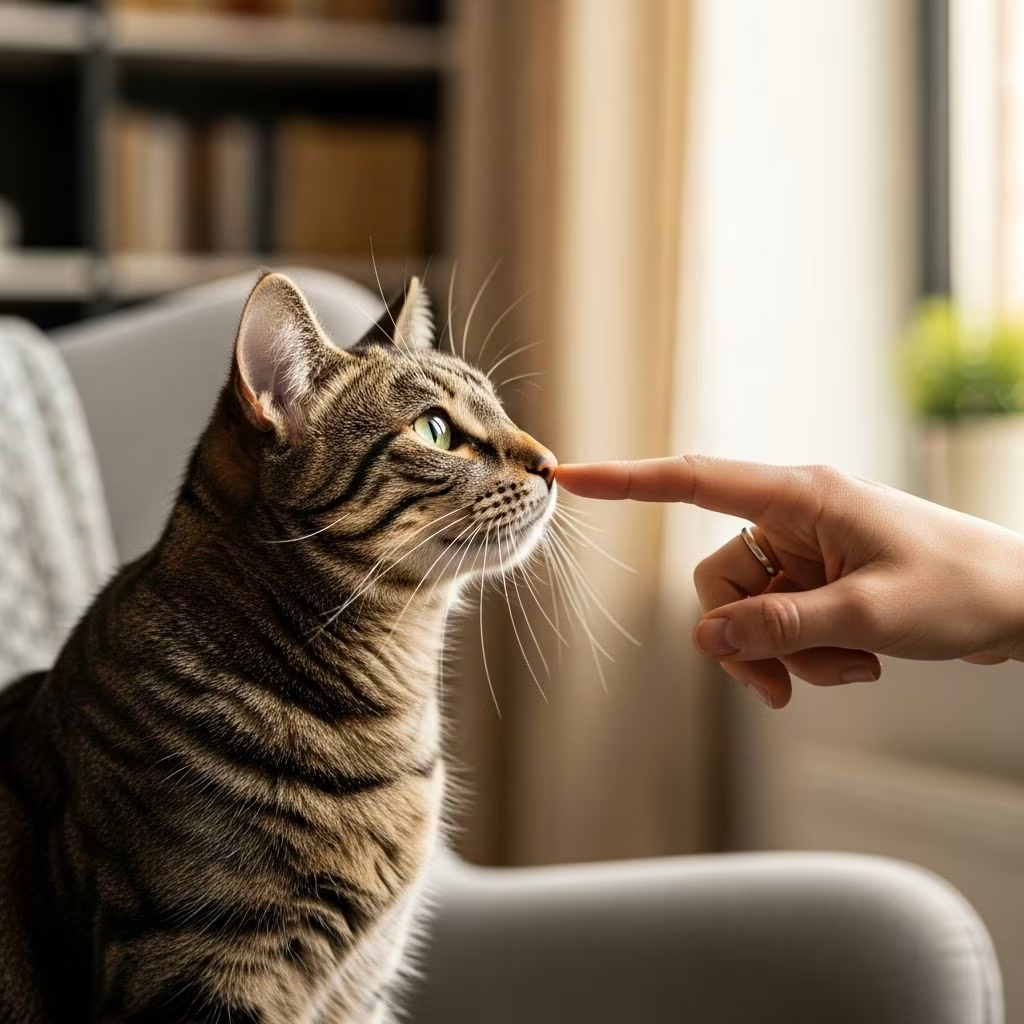
Cats have long been perceived as independent and aloof, but recent research reveals they pay close attention to humans, forming associations with words, recognizing emotions, and responding to gestures in ways that suggest a deeper understanding than previously thought. This article delves into scientific studies showing cats’ cognitive abilities, debunking myths, and offering practical tips for better communication.
How Much Do Cats Understand Us?
Cats demonstrate a remarkable ability to link human words with images or objects, often faster than human infants. In a study published in Scientific Reports, researchers from Azabu University tested 31 domestic cats using a picture-word association task originally designed for babies. Cats viewed images of a sun and a unicorn while hearing their caregivers say “keraru” for unicorn and “parumo” for sun. Most cats formed these associations after just two 9-second sessions, outperforming 14-month-old infants who needed four 15-second sessions. Lead author Shao Takagi noted that this indicates “cats pay attention to what we say in everyday life and try to understand us more than we realize.”
However, this association does not equate to full linguistic comprehension. Psychobiologist Ignacio Morgado explains that cats, like other mammals, excel at conditioned behaviors, linking sounds to images for survival rewards such as food, but lack true language understanding. Genetic changes over 10,000 years of domestication, including modifications in at least 13 genes, have enhanced cats’ attention to humans. Despite their solitary origins, domestic cats have adapted socially, recognizing that human interaction often leads to benefits.
Do Cats Recognize Words?
Evidence suggests cats can distinguish certain words, particularly their names. Studies show cats respond selectively to their own names amid similar-sounding words, indicating phonetic discrimination. In one experiment, cats reacted more to their names spoken by owners compared to strangers or other words, displaying ear twitches, head movements, or vocalizations.
While cats may not grasp sentence meaning, they associate specific words with routines. For instance, saying “dinner” or “treat” prompts anticipation. This mirrors dog capabilities but suits cats’ independent nature. A 2024 study highlighted cats’ rapid word-picture learning, suggesting everyday exposure tunes them to human speech patterns. Owners often report cats responding to commands like “come” or “no,” though consistency and tone play key roles.
Can Cats Understand Emotions?
Cats are adept at reading human emotions through facial expressions, tone, and body language. Research from the University of Milan found cats distinguish happy from angry human faces, preferring positive ones and seeking comfort during distress. Cat psychologist Kristyn Vitale emphasizes that cats form secure attachments similar to dogs, looking to owners for emotional cues in novel situations—a phenomenon called social referencing.
Cats respond to owner distress by altering behavior, such as purring, rubbing, or staying close, akin to infant comforting. Vocal media analyses note cats detect emotions with high accuracy, approaching calmly during sadness and avoiding anger. Tone matters immensely; a soft, high-pitched voice elicits affiliation, while harsh tones trigger avoidance. These responses stem from evolutionary adaptations, as attuned cats secure better care and resources.
Do Cats Understand Gestures and Pointing?
Cats comprehend human pointing gestures, following directions to locate hidden objects or food, though less consistently than dogs. A study in Animal Cognition showed cats succeed in momentary pointing tasks but falter in distant ones, suggesting reliance on proximal cues. Unlike dogs, cats rarely learn problem-solving by observing humans; NIH research found no behavior changes after human demonstrations in food-reward tasks, attributing this to cats’ solitary hunting instincts and inhibitory control needs.
Still, cats interpret gaze direction and body orientation, approaching pointed locations. Local enhancement—being drawn to attended areas—explains some successes. In opaque tube experiments, cats ignored human models, prioritizing direct access over imitation. This highlights cats’ independence: they solve problems solo unless socially motivated.
The Human-Cat Bond: Attachment and Communication
The cat-human bond rivals dog-owner attachments. Vitale’s research using attachment tests mirrors Ainsworth’s strange situation: cats show secure base behaviors, greeting owners post-separation and using them as safe havens. Cats vocalize more with humans than conspecifics, developing ‘cat-like meows’ tailored to elicit responses.
Eye contact, slow blinks, and head bunting signal trust. Purring frequencies (25-150 Hz) promote healing and bonding, released during contentment or stress recovery. Recent genomics confirm domestication enhanced social cognition. Despite independence, cats prefer human company, choosing interaction over toys or food in free-choice tests.
Signs Your Cat Understands You
- Responds to name: Perks ears or approaches when called amid noise.
- Follows routines: Anticipates feeding or play based on verbal cues.
- Mirrors emotions: Comforts distress or matches excitement.
- Learns commands: Sits, comes, or stops on cue with training.
- Uses eye contact: Slow blinks convey affection; stares seek attention.
- Adjusts vocalizations: Meows specifically for humans, varying by need.
How to Communicate Better with Your Cat
Enhance mutual understanding with these evidence-based tips:
- Use consistent words: Pair actions with specific terms repeatedly.
- Employ tone variation: High-pitched for positives, calm for directives.
- Incorporate gestures: Point clearly while naming objects.
- Practice slow blinking: Builds trust; mimic to invite interaction.
- Respect space: Let cats initiate contact to avoid stress.
- Enrich environment: Provide puzzles mirroring natural behaviors.
Training leverages positive reinforcement; clickers aid timing. Patience yields results, as cats learn deliberately.
Common Myths About Cats and Understanding
| Myth | Reality | Evidence |
|---|---|---|
| Cats are aloof and don’t care | Cats form attachments, seek human interaction | Secure attachment studies |
| Cats only understand dogs better | Cats adapt communication for humans | Vocal studies, social referencing |
| Cats ignore gestures | Respond to pointing, less than dogs | Pointing experiments |
| Cats don’t learn words | Form rapid associations | Word-picture tasks |
Frequently Asked Questions (FAQs)
Can cats learn their names?
Yes, cats distinguish their names from similar words, responding with attention or approach.
Do cats know when you’re sad?
Cats detect sadness via cues and offer comfort like purring or closeness.
Why don’t cats follow pointing like dogs?
Cats do in simple tasks but prioritize independence; no imitation from human demos.
How can I teach my cat tricks?
Use treats, consistent cues, and positive reinforcement; start simple like ‘sit’.
Do cats understand ‘no’?
They associate tone and word with stopping, especially with repetition.
Are some cats smarter at understanding humans?
Individuals vary; breeds like Siamese may vocalize more, but all can learn.
References
- Cats pay more attention to us than we realize – they outperform babies in word association game — El Pais. 2024-12-18. https://english.elpais.com/science-tech/2024-12-18/cats-pay-more-attention-to-us-than-we-realize-they-outperform-babies-in-word-association-game.html
- Cats Did Not Change Their Problem-Solving Behaviours after Observing Human Demonstration — PMC / NIH. 2023-03-08. https://pmc.ncbi.nlm.nih.gov/articles/PMC10044084/
- What’s going on inside your cat’s head? — American Psychological Association. 2022-05-16. https://www.apa.org/news/podcasts/speaking-of-psychology/cat-human-bond



