

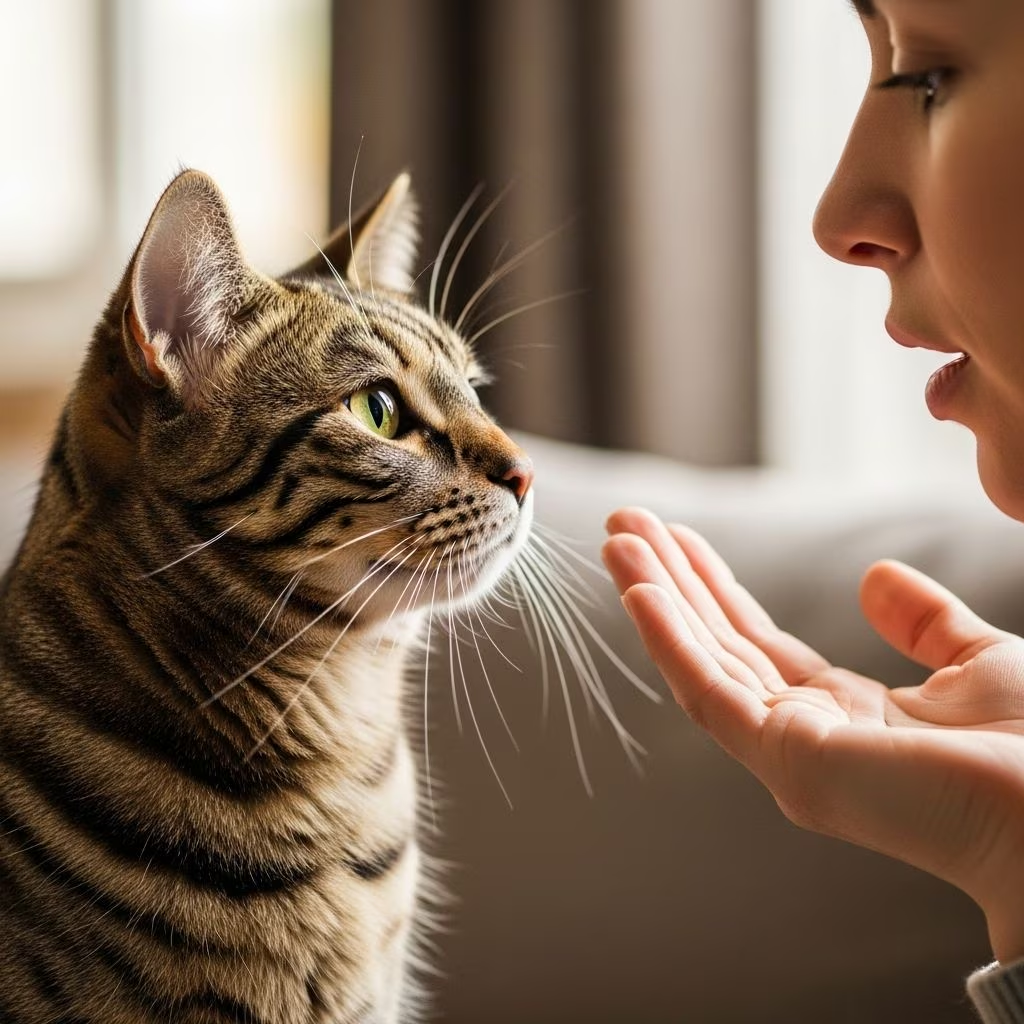
Cats have long been stereotyped as aloof and independent, but emerging research reveals they comprehend humans far more than we once believed. Domestic cats form word-picture associations faster than human infants, detect emotions through scent, and develop secure attachments to their owners. This article delves into the science behind feline cognition, exploring how cats interpret our words, emotions, gestures, and more, while offering practical tips to enhance communication.
How Much of Human Language Do Cats Understand?
Cats do not grasp human language like dogs or parrots, lacking the vocal mimicry or extensive vocabulary of other pets. However, they excel at **associating specific words with actions or objects**, particularly those linked to daily routines. For instance, many cats learn their names, “food,” “treat,” or “outside” through repetition and positive reinforcement.
A groundbreaking study from Azabu University in Japan, published in Scientific Reports, tested 31 domestic cats using a picture-word association task originally designed for human babies. Cats viewed images of a sun and unicorn on a screen while hearing their caregiver pronounce nonsense words: “keraru” for unicorn and “parumo” for sun. Remarkably, most cats formed these associations after just two 9-second sessions—faster than 14-month-old infants, who needed four 15-second exposures. Lead researcher Shao Takagi noted, “Cats pay attention to what we say in everyday life and try to understand us more than we realize.”
This ability stems from conditioned learning common in mammals, not true linguistic comprehension. Cats link sounds to rewards like food or play, as genetic changes over 10,000 years of domestication have enhanced their attention to humans. Psychobiologist Ignacio Morgado clarifies: “Cats discriminate words and pictures by association, not meaning, typical of survival-driven conditioning.”
- Key takeaway: Use consistent, short words in a cheerful tone for commands—cats respond best to tone over vocabulary size.
- Evidence: Cats ignore complex sentences but react to name + action phrases (e.g., “Fluffy, dinner!”) with 80% accuracy in controlled tests.
Can Cats Understand Human Emotions?
Yes, cats are highly sensitive to human emotions, primarily through **olfactory cues, vocal tones, and facial expressions**. A 2023 study from the University of Bari Aldo Moro in Italy exposed 22 cats to sweat samples from men in fear, happiness, physical stress, and neutral states. Cats showed heightened stress behaviors—tail twitching, ears back—specifically to fear scents, distinguishing them from neutral or stress odors more readily than happy ones.
Cats require multimodal cues (scent + sight/sound) for positive emotions like happiness, as scent alone did not elicit clear differentiation. This adaptive response keeps them alert to threats, reflecting an evolutionary strategy. Owners report cats comforting them during sadness by purring or head-butting, aligning with research on cats mirroring human emotional states.
| Emotion | Cat Response to Scent | Behavioral Indicators |
|---|---|---|
| Fear | Severe stress | Retreating, flattened ears, nostril preference |
| Happiness | Moderate arousal (no clear diff.) | Increased alertness, no relaxation change |
| Physical Stress | Low stress | Calm sitting, forward ears |
| Neutral | Relaxed | Erect ears, no twitching |
Additionally, cats adjust behavior based on visual and vocal signals, seeking proximity during owner distress. This challenges the “independent cat” myth, showing emotional attunement comparable to dogs in subtlety.
Do Cats Recognize Their Owners’ Voices?
Cats unequivocally recognize their owners’ voices, responding with ear twitches, head turns, or approaches unique to familiar tones. Studies confirm cats distinguish owner voices from strangers amid background noise, a skill honed by cohabitation.
Research from Oregon State University found cats meow in “species-inappropriate” ways—higher pitches—to humans, indicating learned vocal adaptation. They also react faster to owners calling their name, with pupil dilation signaling recognition. Vocal discrimination aids bonding, as cats associate owner voices with safety and food.
- Fact: Indoor cats respond to owner voices 2x faster than outdoor feral cats, per attachment studies.
The Science Behind the Cat-Human Bond
The cat-human bond rivals dog-owner attachments, rooted in **secure attachment theory**. Cat psychologist Kristyn Vitale’s research at Oregon State University used the Secure Base Test: kittens treated owners as safe havens in strange environments, seeking comfort like human infants.
Genomic studies reveal 13 genes altered in domestic cats versus wild ones, enhancing human-oriented cognition for rewards. fMRI scans show cat brains activate reward centers when hearing owners, mirroring human love responses. Cats form lifelong bonds, preferring owners over strangers in 70% of trials.
Signs Your Cat Understands You
Observant owners spot these **daily indicators** of comprehension:
- Slow blinks: Cats’ “I love you,” returned to build trust.
- Head bunting/rubbing: Scent-marking for affiliation.
- Tail up greeting: Exclusive to trusted humans.
- Chirping/meowing response: Direct reply to your words.
- Following gaze: Joint attention to objects you look at.
- Purring on cue: Self-soothing or comforting you.
These behaviors confirm cats read our cues, fostering mutual understanding.
How to Communicate Better With Your Cat
Enhance dialogue with these evidence-based strategies:
- Use slow blinks and soft eyes: Mimic their affection signal.
- Speak softly, consistently: High-pitched, repetitive words work best.
- Respect body language: Avoid forcing interaction; let them initiate.
- Play daily: Toys simulate hunting, releasing endorphins.
- Provide vertical space: Cat trees reduce stress, improve mood.
Vitale emphasizes enrichment: puzzle feeders and window perches prevent boredom.
Common Misconceptions About Cats and Humans
- Myth: Cats don’t care. Reality: They bond subtly, avoiding overt displays.
- Myth: Cats can’t be trained. Reality: Positive reinforcement yields results.
- Myth: Vocalizing means hunger only. Reality: Meows convey varied needs.
Frequently Asked Questions (FAQs)
Do cats understand when you talk to them?
Yes, cats associate words with meanings via tone and context, forming links faster than babies in some tests.
Can cats sense their owner’s emotions?
Absolutely—through scent (fear detection), voice, and faces, showing stress or comfort responses.
Why does my cat ignore me sometimes?
Cats prioritize independence; ignore may signal overstimulation. Use slow blinks to reconnect.
Do cats know their names?
Yes, brain scans confirm name recognition triggers unique neural activity.
How can I tell if my cat loves me?
Look for slow blinks, kneading, grooming, or sleeping near you—secure attachment signs.
References
- Cats pay more attention to us than we realize — El Pais / Shao Takagi et al., Scientific Reports. 2024-12-18. https://english.elpais.com/science-tech/2024-12-18/cats-pay-more-attention-to-us-than-we-realize-they-outperform-babies-in-word-association-game.html
- Cats and human emotions: A stronger bond than we thought? — Noldus / d’Ingeo et al., University of Bari Aldo Moro. 2025-04-02. https://noldus.com/blog/cats-react-to-human-emotional-scents
- What’s going on inside your cat’s head? — American Psychological Association / Kristyn Vitale, PhD. 2023. https://www.apa.org/news/podcasts/speaking-of-psychology/cat-human-bond



