

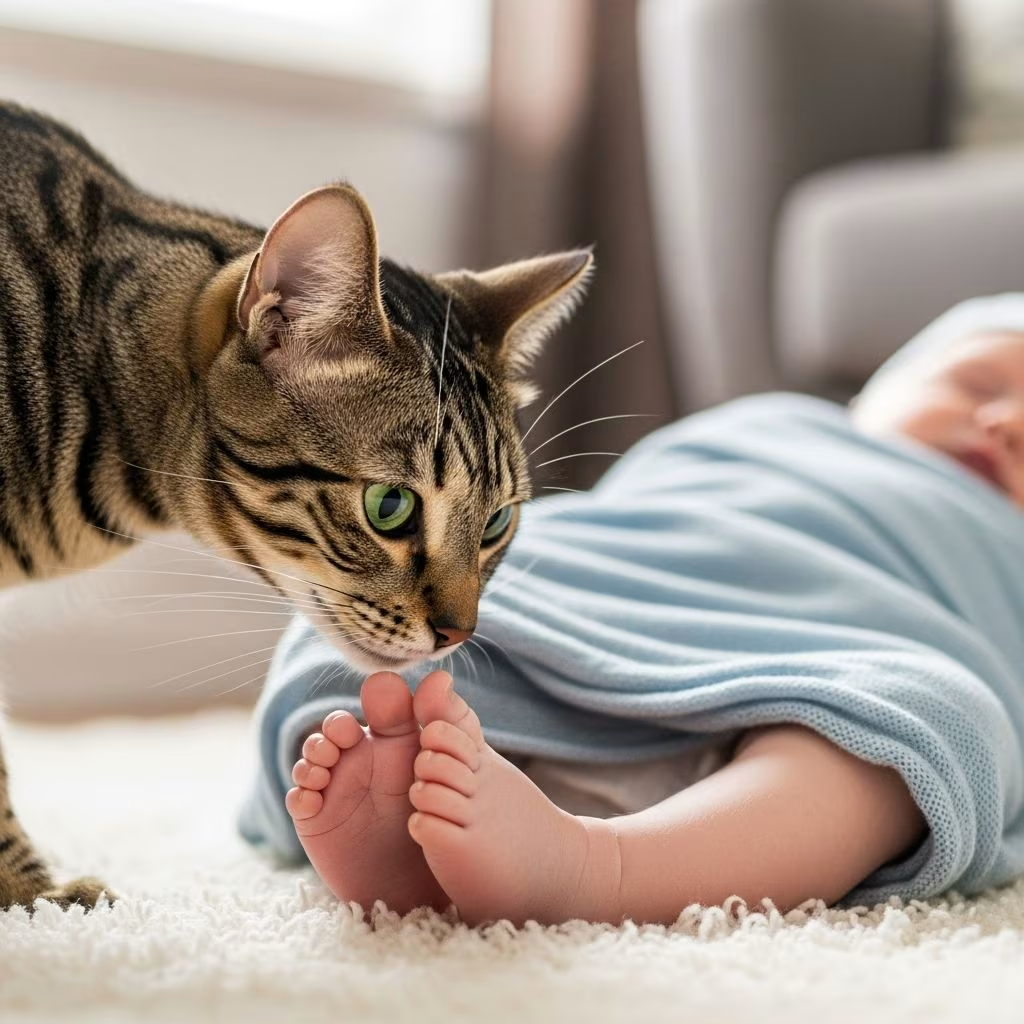
Cats possess remarkable sensory abilities and emotional intelligence that allow them to detect subtle changes in their environment, including the arrival of a human baby. While cats may not comprehend the concept of a ‘baby’ in human terms, research and observations indicate they recognize newborns as distinct from adults through scent, sound, and movement, often responding with curiosity, protectiveness, or caution.
How Do Cats Perceive Human Babies?
Cats rely heavily on their acute senses to interpret the world. Human babies emit unique scents from amniotic fluid remnants, milk, and lotions, which differ markedly from adult odors. High-pitched cries mimic kitten distress calls, triggering instinctive responses in felines. A study published in Animal Cognition demonstrates that cats react strongly to ‘cat-directed speech’ or baby talk from their owners, suggesting they perceive humans in a caregiver-infant dynamic similar to parent-child bonds. This perception extends to actual infants, where cats may view babies as vulnerable littermates or extensions of their human family.
Cats’ whiskers and vision detect the erratic, uncoordinated movements of babies, contrasting with the predictable actions of adults. Their hearing picks up on irregular breathing and coos, further distinguishing infants. These sensory cues collectively inform cats that a baby is not a typical human but something novel and potentially needy.
Can Cats Sense Pregnancy?
Many cat owners report behavioral shifts in their pets during pregnancy, indicating felines can sense physiological changes. Cats detect hormonal fluctuations like increased progesterone and human chorionic gonadotropin (hCG) through enhanced smell, perceiving pregnancy as early as a few weeks in.
- Increased Affection: Cats often become more cuddly, purring excessively and seeking physical contact to offer comfort.
- Protective Vigilance: Territorial instincts activate, leading cats to guard their pregnant owner from perceived threats.
- Attachment Behaviors: Following the owner closely, lying on the belly, or staying nearby during rest signal a desire to bond with the changing family dynamic.
These responses stem from empathy, routine sensitivity, and a strong human-cat bond. Cats thrive on consistency, so pregnancy-related fatigue or nausea can prompt clinginess as they adapt to reduced attention.
Cats’ Reactions to Babies: Curiosity, Caution, or Care?
Upon meeting a baby, cats display a spectrum of reactions influenced by personality, prior socialization, and environment. Videos and owner anecdotes capture initial skepticism—wide-eyed stares, tentative sniffs, or dramatic retreats—as cats assess the tiny intruder.
| Reaction Type | Description | Common Triggers |
|---|---|---|
| Curiosity | Slow approaches, sniffing, gentle paw touches | New scents, soft sounds |
| Protectiveness | Positioning near baby, alert posture | Cries resembling kitten calls |
| Avoidance | Hiding or ignoring the baby | Overstimulation, loud cries |
| Gentleness | Licking or lying nearby without aggression | Calm introductions, positive associations |
Most cats are gentle initially, with close contact potentially boosting infant immunity through beneficial microbes, though supervision is crucial. Aggressive responses are rare but can occur in unsocialized or stressed cats.
Do Cats View Babies as Kittens?
Cats may anthropomorphize babies as oversized, helpless kittens due to shared traits: high-pitched vocalizations, dependency, and milky scents. Adult cats rarely meow except to humans, and their purrs contain frequencies echoing baby cries, evolved to elicit caregiving. This parallel suggests cats treat babies with littermate-like tolerance, grooming or curling protectively nearby.
However, babies’ larger size and intense cries can confuse cats, prompting wariness. Well-socialized cats exposed to children during the 2-7 week critical period adapt best. Caretaking behaviors reinforce parent-child-like attachments between humans and cats.
Preparing Your Cat for a New Baby
Proactive preparation minimizes stress and jealousy. Use pregnancy months to acclimate your cat gradually.
- Adjust Routines Early: Shift feeding and play schedules to mimic post-baby life, preventing resentment.
- Create Safe Spaces: Install cat trees, shelves, and beds away from baby areas for retreat.
- Desensitize to Baby Sounds: Play recordings of cries, vacuums, and monitors at low volumes, rewarding calm behavior.
- Introduce Scents: Rub baby blankets on your cat and vice versa to familiarize odors.
- Maintain Attention: Schedule daily one-on-one time to reaffirm your bond.
Avoid reinforcing negative habits like hand-playing, which could lead to scratches on delicate baby skin.
Safe Introductions: First Meetings and Beyond
Post-birth, orchestrate controlled introductions. Carry the baby in a carrier; let the cat sniff from a distance. Reward calm reactions with treats and praise. Never force proximity—let curiosity guide.
- Supervise all interactions; cats and babies should never be alone.
- Keep cribs and changing areas cat-free using gates or netting.
- Trim claws regularly and teach gentle petting.
- Monitor for stress signs: hiding, spraying, aggression.
Positive experiences foster lifelong harmony, with many cats becoming gentle guardians.
Potential Risks and How to Mitigate Them
While rare, risks include suffocation if cats sleep on infants’ faces due to heat-seeking. Allergies affect 10-20% of children, though early exposure may reduce incidence. Aggression often stems from fear, not malice—address via environmental enrichment and pheromone diffusers.
Relinquishing cats due to baby conflicts is avoidable with planning. Rescue statistics show urine spraying and child-directed aggression as common surrender reasons. Prioritize your cat’s needs alongside the baby’s for a balanced home.
Benefits of Cats and Babies Together
Beyond companionship, cats teach empathy, responsibility, and gentleness to children. Supervised interactions build immunity and reduce asthma risks per some studies. The mutual bond strengthens family ties, with cats providing emotional support to parents.
Frequently Asked Questions (FAQs)
Can cats sense pregnancy in humans?
Yes, cats detect hormonal changes and altered routines, often becoming more affectionate or protective.
Are cats gentle with babies?
Most are, showing curiosity or care, but supervision is essential to prevent accidents.
How do I introduce my cat to a new baby?
Prepare during pregnancy with scent swapping and sound desensitization, then allow gradual, supervised meetings.
What if my cat is aggressive toward the baby?
Consult a behaviorist; enrich environment and maintain routines to reduce stress.
Do cats think babies are kittens?
They may perceive similarities in vulnerability and sounds, treating them protectively.
Conclusion
Cats’ ability to ‘tell’ what a human baby is stems from sensory acuity and emotional bonds, enabling nuanced reactions from protectiveness to playfulness. With preparation, most households enjoy peaceful cat-baby dynamics, enriching lives for all.
References
- Cats react to ‘baby talk’—but only from their owners — Science | AAAS. 2022-10-24. https://www.science.org/content/article/cats-react-baby-talk-only-their-owners
- Pregnant and have a cat? | Expert Insights — The Cat Behavior Clinic. Accessed 2026. https://www.thecatbehaviorclinic.com/how-do-cats-behave-when-humans-are-pregnant/
- Cats Have The Best Reactions to Meeting a Baby for the First Time — YouTube. Accessed 2026. https://www.youtube.com/watch?v=hU8kMxd_07s
- Hilarious Cats Reacting to a New Baby for the First Time — YouTube. Accessed 2026. https://www.youtube.com/watch?v=6sg4HxpuHEI
- Cats and Babies — ASPCA. Accessed 2026. https://www.aspca.org/pet-care/cat-care/cats-and-babies
- Introducing a New Baby to the Home — Hill’s Pet. Accessed 2026. https://www.hillspet.com/cat-care/training/introducing-cat-to-baby
- 8 Reasons Your Cat Will Always Be Your “Baby” — Psychology Today. 2021-12-19. https://www.psychologytoday.com/us/blog/the-modern-heart/202112/8-reasons-your-cat-will-always-be-your-baby



