

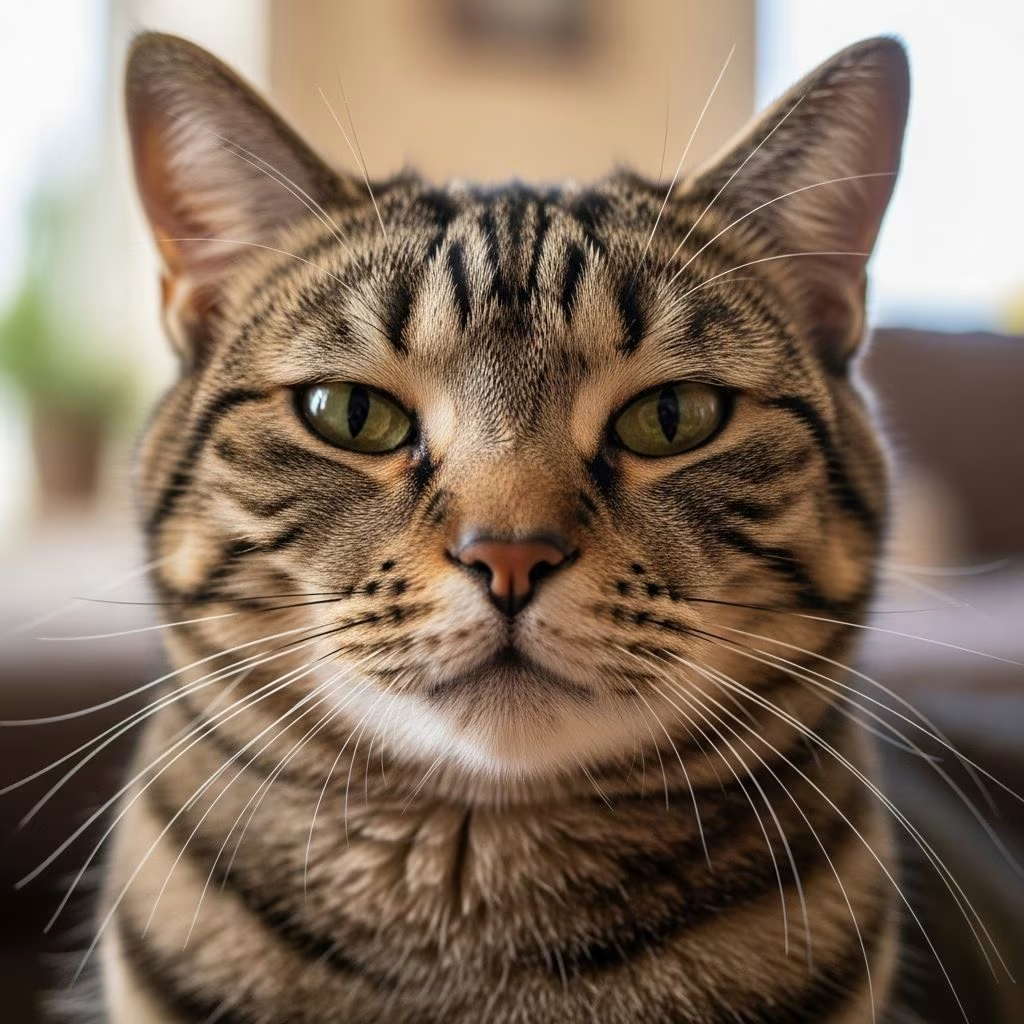
Cats communicate happiness and trust through subtle facial cues rather than mouth smiles like humans. Their primary “smile” is the slow blink, a narrowing of the eyes that signals relaxation and affection.
What Does a Cat Smile Look Like?
Unlike humans, cats lack the facial muscles to curve their lips upward in a grin. What appears as a smile is often the natural shape of their mouth due to teeth placement and jaw structure, especially in breeds like Russian Blues. True feline smiling involves eye narrowing and slow blinking, mimicking a human Duchenne smile but focused on the eyes.
Researchers from the Universities of Portsmouth and Sussex conducted experiments showing cats respond positively to human slow blinks, approaching and reciprocating more than to neutral expressions. This eye-based communication enhances cat-human bonds.
The Science Behind the Cat Smile
A landmark study published in Scientific Reports tested 45 cats aged from kittens to seniors. In homes, owners’ slow blinks prompted 71% more cat responses than neutral faces. Strangers using slow blinks saw cats approach and accept hands 2.5 times more often.
Cats produce 276 distinct facial expressions toward other cats, combining 26 movements like ear positions, whisker twitches, and blinks—more than dogs’ 27 but fewer than chimpanzees’ 357. Of these, 45% are friendly, indicating rich emotional signaling.
Slow Blinking: The Feline Smile
- Narrow your eyes slowly: Mimic a relaxed human smile without opening your mouth.
- Hold for 1-2 seconds: Close eyes briefly, then reopen gradually.
- Combine with calm posture: Avoid direct stares; let the cat initiate contact.
This technique works across ages and with shelter cats, aiding welfare assessments in vets and rehoming centers. Professor Karen McComb notes it’s a conversational tool any cat lover can use.
Other Cat Facial Expressions
Cats’ faces convey complex messages beyond smiles:
- Flehmen response: Upper lip curl and head tilt to analyze scents via Jacobson’s organ—not a smile, but investigative.
- Relaxed ears forward: Indicates curiosity or contentment.
- Dilated pupils: Excitement, fear, or playfulness.
- Tooth baring: Aggression or play, not joy.
Overall, 37% of cat expressions are aggressive, 18% ambiguous.
Why Cats Don’t Smile Like Humans
Cats prioritize scent, posture, and vocalizations over facial grins due to evolutionary differences. Human smiles signal submission; cats use blinks for safety. Misinterpreting a “grin” as happiness can overlook stress signals like pinned ears.
| Human Smile | Cat Equivalent | Meaning |
|---|---|---|
| Lips upturned, teeth visible | Slow blink, half-closed eyes | Trust, relaxation |
| Eye crinkles (Duchenne) | Eye narrowing | Genuine happiness |
| Open mouth laugh | No direct equivalent | Chirps, trills for joy |
Do Cats Laugh?
Cats don’t laugh like humans with audible chuckles. Joy shows in purring, kneading, or playful chirps. What seems like laughter is often the “chatty” trill or excitement during zoomies. No evidence supports feline humor sense akin to primates.
Signs Your Cat Is Happy (Beyond Smiles)
- Slow blinking at you: Ultimate trust signal.
- Tail up with hook: Greeting and affection.
- Head butting (bunting): Scent-marking love.
- Exposed belly: Rare trust display (don’t always rub).
- Purring with relaxed body: Contentment.
Monitor for clusters; single signs can mislead.
How to Respond to Your Cat’s Smile
- Reciprocate slowly: Blink back to continue the “conversation.”
- Offer a finger sniff: Let cat approach first.
- Use soft voice: Pair with gentle tones.
- Avoid picking up abruptly: Respect their space.
For shy cats, consistency builds confidence over weeks.
Frequently Asked Questions
Can all cats smile?
Yes, slow blinking is universal across breeds, ages, and sexes, as shown in studies with 45 diverse cats.
Why does my cat show teeth?
Tooth display signals aggression or flehmen, not smiling. Check ears and tail for context.
Is the flehmen response a smile?
No, it’s a scent-analysis grimace using the vomeronasal organ.
How do I teach my cat to slow blink?
You don’t teach; model it consistently. Most respond naturally within trials.
Do kittens smile like adults?
Yes, the study included kittens from a few months old with similar responses.
What if my cat never blinks slowly?
Observe stress: dilated pupils, swishing tail. Consult a vet for welfare.
This FAQ covers common queries on cat smiles and expressions.
Building a Stronger Bond with Slow Blinks
Incorporate slow blinks daily: during feeding, play, or cuddles. Studies prove it increases approachability, vital for multi-cat homes or adoptions. Track progress; enhanced welfare follows better understanding.
Expand to body language: upright tail, rubbing. These affirm the human-cat socio-cognitive link, understudied yet profound.
References
- Can cats smile? Yes — but they use their eyes to do it, study discovers — StudyFinds.org / University of Portsmouth. 2020-01-01. https://studyfinds.org/slow-blink-cats-smile/
- Can Cats Smile? Your Vet Explains Feline Expressions in 2025 — AskAVet.com. 2025-01-01. https://askavet.com/blogs/news/can-cats-smile-your-vet-explains-feline-expressions-in-2025-%F0%9F%98%8A
- Study Reveals a Simple Technique to Communicate With Your Cat — ScienceAlert / University of Sussex. 2020-01-01. https://www.sciencealert.com/study-reveals-a-simple-technique-to-communicate-with-your-cat
- The Truth About Cat Smiles: Can Felines Really Laugh? — Petcube. 2023-01-01. https://petcube.com/blog/can-cats-smile-or-laugh/
- Cats have nearly 300 facial expressions — Science.org / AAAS. 2024-01-01. https://www.science.org/content/article/cats-have-nearly-300-facial-expressions



