

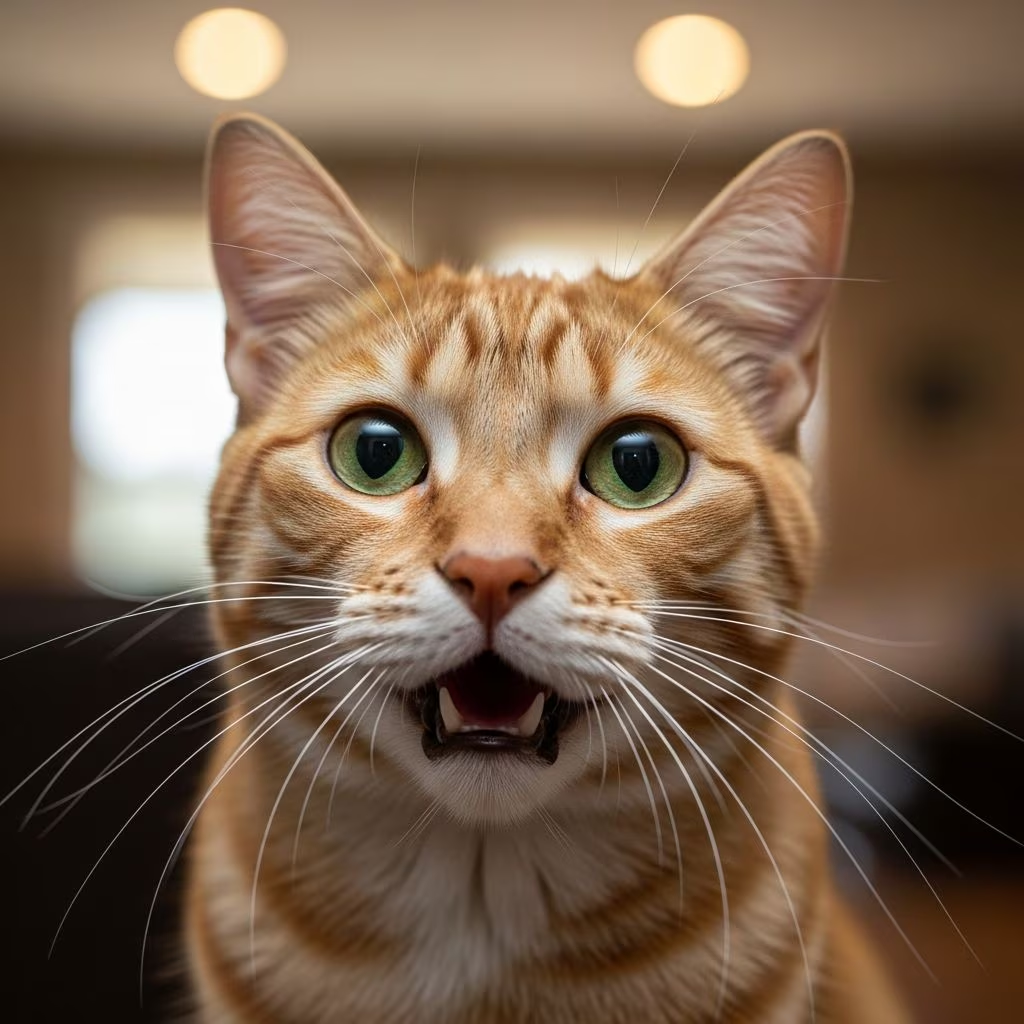
Cats captivate us with their mysterious expressions, often leading owners to wonder if their pet is flashing a genuine smile. While cats cannot smile in the human sense—lacking the facial muscles to curve their lips upward—they communicate happiness and trust through subtle cues like the slow blink, which researchers equate to a feline smile. This article delves into cat facial expressions, debunking myths and revealing science-backed ways cats show contentment.
What Does a Cat Smile Look Like?
Humans associate smiles with upturned lips and exposed teeth, signaling joy or friendliness. In cats, what appears as a “smile” is often the natural shape of their muzzle, influenced by breed genetics. For instance, breeds like the Russian Blue or certain tabbies have a perpetual upturned mouth due to jaw structure and teeth placement, not emotion.
Cats possess nearly 300 distinct facial expressions, combining 26 unique movements such as parted lips, whisker adjustments, ear positions, and pupil changes. About 45% of these are friendly, 37% aggressive, and 18% ambiguous. True contentment shows in relaxed eyes, half-closed lids, or the slow blink rather than mouth shape.
Do Cats Actually Smile?
No, cats do not smile like humans. They lack the zygomaticus major muscle responsible for lip elevation in our grins. Instead, their communication relies on body language, scent marking, posture, and vocalizations. What we interpret as smiling is typically the flehmen response: a curled upper lip and squinted eyes as the cat analyzes pheromones via the vomeronasal (Jacobson’s) organ. This investigative behavior mimics a smile but serves a sensory purpose, not emotional expression.
Research confirms cats’ facial repertoire is rich—276 expressions observed in interactions, far exceeding prior estimates and rivaling chimpanzees’ 357. However, these are directed at other cats, emphasizing social signals over human-style emoting.
How Do Cats Show They’re Happy?
Cats express happiness through a combination of facial, body, and auditory cues. Key indicators include:
- Slow blink: Narrowed eyes followed by a prolonged close, signaling trust and relaxation—equivalent to a cat smile.
- Relaxed posture: Ears forward or slightly to the side, whiskers relaxed, tail gently swaying or curled at the tip.
- Purring: Often during petting or kneading, indicating pleasure (though also used in distress).
- Head butting (bunting): Rubbing to deposit scent glands, showing affection and ownership.
- Exposed belly: A sign of trust, though approach cautiously as it may lead to play-swatting.
Studies show slow blinking elicits reciprocal responses from cats, enhancing bonds with owners and strangers alike.
The Science Behind the Cat Smile: Slow Blinking
A landmark 2020 study from the Universities of Portsmouth and Sussex demonstrated that the slow blink is cats’ way of smiling. In experiments with 45 cats (aged months to 17 years), owners and strangers slow-blinked at felines. Cats responded more frequently with slow blinks to blinkers than neutral faces and were likelier to approach and touch offered hands.
Dr. Leanne Proops noted, “It’s definitely not easy to study natural cat behavior so these results provide a rare insight into the world of cat-human communication.” Professor Karen McComb added that owners can try it: narrow eyes in a relaxed smile, close for seconds, prompting mutual “conversation.”
This works across ages, genders, and household setups, aiding welfare in shelters and vets by assessing trust.
| Experiment | Method | Results |
|---|---|---|
| Owner Slow Blink | Owners blinked slowly at home cats | Cats blinked back more than to neutral expression |
| Stranger Approach | Researchers blinked or neutral, offered hand | Cats blinked back, approached, and touched more |
Other Cat Facial Expressions Explained
Beyond smiles, cats’ faces convey a spectrum:
- Flehmen response: Lip curl for scent analysis—not happiness.
- Grimace/teeth baring: Pain, aggression, or nausea (e.g., drooling, squinting).
- Dilated pupils: Excitement, fear, or low light.
- Half-blink: Friendly greeting with relaxed ears/whiskers.
- Ear flattening: Fear or anger.
A 2024 study cataloged 276 cat-to-cat expressions, with friendly ones dominant in play. Humans have 44 movements; dogs 27—cats are expressive but subtle.
How to Smile Back at Your Cat
Reciprocate the slow blink to build rapport:
- Sit calmly, avoid direct stare (threatening to cats).
- Narrow eyes slowly as in a smile.
- Close eyes for 1-2 seconds.
- Watch for response; repeat to converse.
This technique boosts attractiveness to cats, per researchers. Try with shelter cats to encourage adoptions. Veterinarian Dr. Dwight Alleyne confirms slow blinks signal love and happiness.
Can Cats Laugh?
Cats do not laugh like humans—no vocal chuckling or grinning in amusement. They lack a sense of humor in our terms, but show joy through chirps, trills, and play bows. What seems like laughter is often the “warble” greeting or excitement purr. Play fighting mimics joy, but it’s instinctual, not humorous.
Why Does My Cat Look Like It’s Smiling?
That grin? Likely anatomy. Breeds with short muzzles or specific tooth alignment create a happy facade. Stress or pain can cause open-mouth breathing mistaken for smiling—watch for panting, which signals distress (cats are obligate nose breathers). Always check context: relaxed body means content; tense means trouble.
Frequently Asked Questions (FAQs)
Why does my cat slow blink at me?
It means your cat trusts and likes you— their version of a smile. Return it to strengthen your bond.
Is the flehmen response a smile?
No, it’s for scent detection via Jacobson’s organ, often after sniffing urine or pheromones.
Do all cats slow blink?
Most do when relaxed, across ages and breeds. Feral cats may be warier.
What if my cat shows teeth?
Usually not smiling—indicates aggression, fear, or health issues like dental pain. Consult a vet.
Can slow blinking help shy cats?
Yes, it builds trust with strangers or shelter cats, increasing approachability.
Conclusion
While cats can’t smile human-style, their slow blink is a profound expression of happiness and trust. Understanding these cues—from 300 facial movements to body signals—deepens the cat-human bond. Next time your cat slow blinks, smile back with your eyes for a heartfelt feline conversation.
References
- Can cats smile? Yes — but they use their eyes to do it, study discovers — StudyFinds.org / University of Portsmouth. 2020-01-22. https://studyfinds.org/slow-blink-cats-smile/
- Can Cats Smile? Your Vet Explains Feline Expressions in 2025 — AskAVet.com. 2025-01-01. https://askavet.com/blogs/news/can-cats-smile-your-vet-explains-feline-expressions-in-2025-%F0%9F%98%8A
- Study Reveals a Simple Technique to Communicate With Your Cat — ScienceAlert. 2020-06-01. https://www.sciencealert.com/study-reveals-a-simple-technique-to-communicate-with-your-cat
- The Truth About Cat Smiles: Can Felines Really Laugh? — Petcube. 2024-05-15. https://petcube.com/blog/can-cats-smile-or-laugh/
- Cats have nearly 300 facial expressions — Science.org / AAAS. 2024-04-04. https://www.science.org/content/article/cats-have-nearly-300-facial-expressions
- Want to make friends with a cat? Blink slowly, say scientists — BBC Science Focus. 2020-06-05. https://www.sciencefocus.com/news/want-to-make-friends-with-a-cat-blink-slowly-say-scientists



