

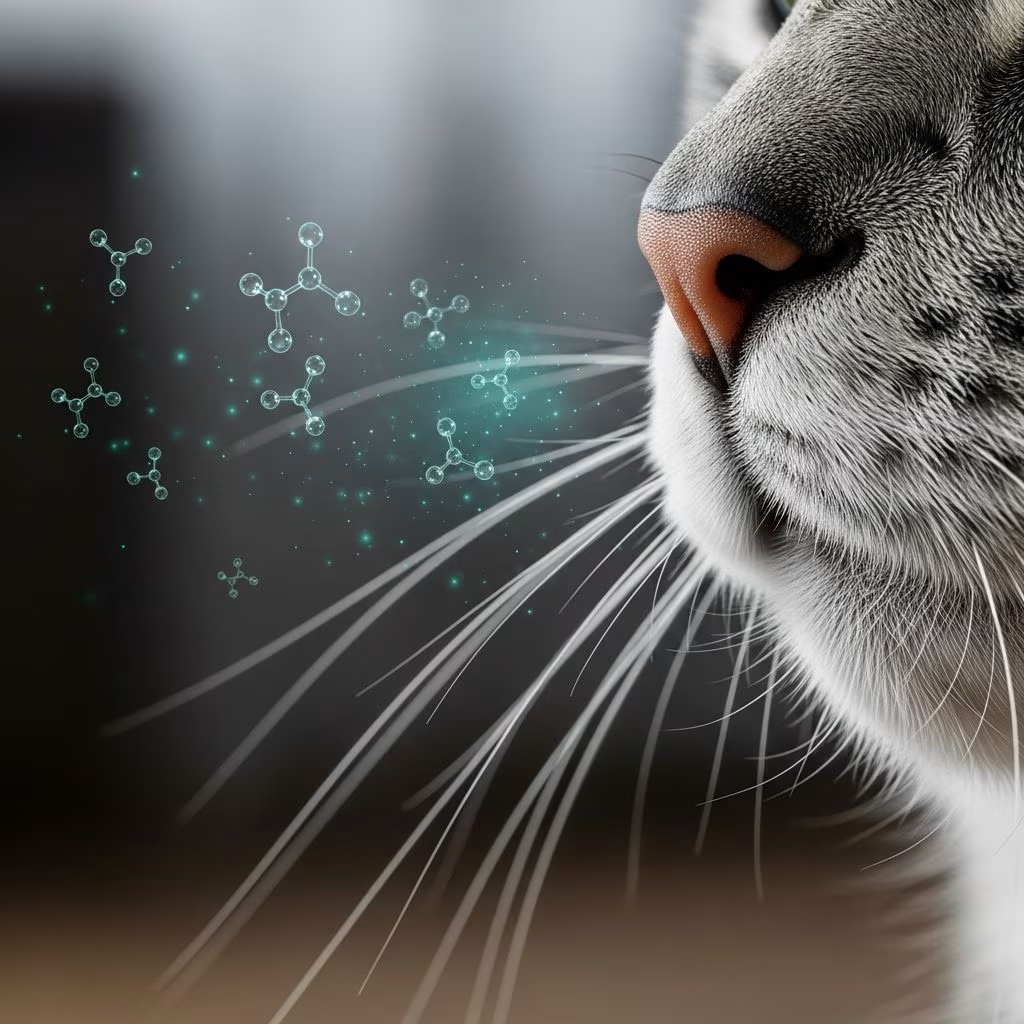
Can Cats Smell Stress?
If you’ve ever wondered whether your cat knows when you’re stressed, anxious, or afraid, the answer might be simpler and more sophisticated than you thought. Recent scientific research suggests that cats can indeed detect stress in humans through their extraordinarily sensitive sense of smell. This discovery adds another layer to our understanding of the complex relationship between cats and their human companions, revealing that feline perception goes far beyond what we see in their behavior and body language.
The Science of Emotional Body Odor
To understand how cats might smell stress, we first need to recognize that humans emit different odors based on their emotional state. Research has demonstrated that there is a measurable difference between how you smell when experiencing fear or happiness compared to when you’re calm and content. This phenomenon is rooted in the physiological responses our bodies undergo during emotional experiences.
Scientists have long known that when humans experience stress or fear, our bodies release specific chemical compounds through sweat and other physiological processes. These changes in body odor are subtle but detectable by those with a keen sense of smell. While humans can sometimes identify these emotional odors when directly sniffing sweat samples, our olfactory capabilities pale in comparison to many animals.
Multiple studies have explored how various animal species respond to human emotional odors. Dogs, for example, have demonstrated the ability to discriminate between the scent of fearful and stressed humans and that of relaxed individuals. But dogs aren’t alone in this capability. Research has revealed that horses, cows, and even mice can distinguish between different emotional states based on human body odor. This widespread ability across multiple species suggests that emotional odors are a fundamental form of communication that transcends species boundaries.
The Landmark Study on Cat Olfaction and Emotions
A pivotal study titled “Relationship between asymmetric nostril use and human emotional odours in cats” set out to answer a specific question: Can cats discriminate between human “happy sweat” and “fearful sweat,” and if so, do they prefer to use one nostril over the other when doing so?
The research team assembled 22 healthy pet cats living in home environments for their experiments. Sweat samples were collected from three healthy male donors who followed specific dietary guidelines and avoided scented products during the collection period. To obtain these samples, researchers placed multiple cotton swabs under the donors’ arms during different emotional states.
The collection process involved creating distinct emotional conditions:
- Donors watched 15-minute videos specifically designed to elicit fear or happiness responses
- A “physical stress” sample was collected after donors ran on a treadmill for 15 minutes
- A neutral body odor sample was taken immediately after donors showered
Each of the 22 cats was then presented with these four different scent samples for 45 seconds each, with 40-second intervals between samples. Researchers carefully observed and recorded each cat’s behavior and nostril preference during the sniffing process. To eliminate bias, the person analyzing the video recordings was kept unaware of which emotional sample each cat was investigating.
What the Research Revealed About Cat Stress Responses
The findings were remarkably clear and significant. Cats displayed noticeably more stress-related behaviors when sniffing the fear odor compared to neutral or physical stress odors. These stress-related behaviors included:
- Backing away from the swab
- Flattening their ears
- Swishing their tail in an agitated manner
This behavioral response demonstrates that cats aren’t simply sniffing odors passively; they’re actively processing and reacting emotionally to what they detect. The more stressed behaviors a cat displayed, the more likely they were to sniff that odor with a specific nostril—the right one.
Importantly, cats showed no significant behavioral differences when exposed to happiness, physical stress, or neutral body odor samples, suggesting that cats specifically detect and respond to the scent of human fear. This specificity indicates that cats may have evolved or developed a particular sensitivity to fearful humans, which could have survival implications in their relationship with their human caregivers.
The Remarkable Role of Nostril Preference
One of the most intriguing aspects of the research concerns which nostril cats preferentially use when detecting different types of odors. The studies revealed a consistent pattern: cats tended to use their right nostril when sniffing fear-related odors.
This preference isn’t random or coincidental. The predominant use of the right nostril for sniffing relates to how the right hemisphere of the brain processes arousal and emotions, particularly fear. Scientists have observed similar nostril-preference patterns in other animals. Dogs, for instance, preferred to use their right nostril when sniffing stress smells of other dogs (which relates to right brain processing), but switched to their left nostril when investigating fearful and stressed human sweat (left brain processing).
Horses demonstrated another interesting pattern: they preferred using their right nostril when smelling adrenaline or detecting another horse in estrus. These findings across different species suggest a deeper biological principle at work—that animals may route different types of emotional or arousal-related information through different brain hemispheres depending on the nature of the threat or stimulus.
Interestingly, older cats in the study were more likely to use their left nostril in general, regardless of the odor type, suggesting that age may influence olfactory processing and strategy in cats.
Understanding Cats’ Emotional Perception Beyond Smell
While this research specifically focuses on olfactory detection of human emotional states, it’s important to recognize that cats perceive human emotions through multiple sensory channels. Research has demonstrated that cats are sensitive to human body language, tone of voice, and facial expressions. Cats can read our cues when we encounter potentially scary objects, using our reactions to determine whether something is safe or threatening.
Additionally, recent studies have shown that cats can recognize their owner’s scent compared to a stranger’s scent. In these studies, researchers found that cats tended to sniff familiar odors with their left nostril, while mostly using their right nostril for unfamiliar scents. This pattern suggests that scent recognition may be related to how different brain hemispheres process familiar versus novel information.
What This Means for Your Relationship With Your Cat
The implications of this research are profound for cat owners. If your cat can detect the chemical signature of your stress or fear through scent, it explains some puzzling cat behaviors. Yes, next time you’re thinking of getting your cat into a cat carrier and your heart is pounding, your cat may very well be picking up on your fear. This sensory awareness might explain why cats sometimes hide or act anxious when their owners are stressed, or why they might be more difficult to handle during situations where the owner is nervous or afraid.
Understanding this capability invites us to reconsider the complexities of cat-human interactions. Cats haven’t just adapted to live alongside humans; they’ve developed sophisticated mechanisms to perceive and respond to our emotional states. This awareness operates in a sensory dimension that we as humans can barely access, highlighting just how different the cat’s perceptual world truly is from our own.
The Broader Context of Feline Olfaction
Cats’ ability to detect human stress should be understood within the broader context of their remarkable olfactory system. Domestic cats possess an extraordinarily sensitive sense of smell, with abilities that have drawn scientific attention to them as potential candidates for detecting cancer and other diseases in humans. This sensitivity to subtle chemical changes in the environment is a fundamental part of how cats navigate and understand their world.
The olfactory system in cats is intimately connected to brain regions that control stress response and emotional processing. This connection means that scents don’t just provide information to cats—they can directly influence a cat’s emotional state and stress levels. Understanding this relationship has opened new avenues for stress management in cats, with some research exploring how specific scents might be used to help reduce anxiety and improve welfare in domestic cats.
Limitations and Future Research Directions
While this research provides compelling evidence that cats can detect human emotional odors, scientists emphasize the importance of viewing these findings within appropriate context. Some researchers caution against overstating the implications without further investigation using techniques like brain imaging to confirm exactly how cats process these odors.
The study adds to our understanding of cat-human relationships, but many questions remain. How consistent is this ability across different cats? Do individual cats vary in their sensitivity to human emotional odors? How does this ability develop as kittens grow into adult cats? These questions represent fertile ground for future investigation and could further illuminate the remarkable sensory world of our feline companions.
Frequently Asked Questions About Cats and Stress Detection
Q: If my cat can smell my stress, does that mean my cat will become stressed too?
A: Not necessarily. While cats can detect your stress through scent and may respond to it, whether they become stressed depends on many factors, including their individual personality, temperament, and past experiences. Some cats are more sensitive to environmental changes than others.
Q: Can cats smell other emotions besides fear?
A: The research specifically demonstrated that cats could detect fear-related odors. While humans emit different odors for different emotions like happiness, the study found that cats didn’t show different responses to these other emotional odors, at least not through behavioral stress indicators.
Q: Does a cat’s nostril preference have practical implications for cat owners?
A: While the nostril preference is scientifically interesting, it’s not something a typical cat owner needs to worry about or act on. It’s more useful for researchers understanding how cats process information and emotions internally.
Q: How sensitive is a cat’s sense of smell compared to a dog’s?
A: While both cats and dogs have remarkable olfactory abilities far superior to humans, they detect scents differently and have evolved different olfactory strengths based on their species-specific needs. Cats have a highly sensitive olfactory system adapted to their hunting and territorial behaviors.
Q: Should I try to hide my stress from my cat?
A: While it’s impossible and impractical to completely hide your stress, maintaining a calm demeanor when possible can help create a peaceful environment for your cat. Focus on consistent routines, gentle handling, and creating safe spaces rather than trying to completely mask your emotional state.
References
- Relationship between asymmetric nostril use and human emotional odours in cats — American Veterinary Society of Animal Behavior (AVSAB). 2023. https://avsab.org/can-cats-smell-when-youre-stressed/
- Dealing With Stress in Cats: What Is New About the Olfactory Strategy? — National Center for Biotechnology Information (NCBI). https://pmc.ncbi.nlm.nih.gov/articles/PMC9334771/
- Cats Can Recognize Their Owner’s Scent Compared to a Stranger’s: New Research Suggests — Smithsonian Magazine. https://www.smithsonianmag.com/smart-news/cats-can-recognize-their-owners-scent-compared-to-a-strangers-new-research-suggests-180986710/
- Feline olfaction and the extraordinary superpower of cat smell — Felidae Fund. https://felidaefund.org/news/general/feline-olfaction-and-the-extraordinary-superpower-of-cat-smell
- Can Dogs & Cats Sense Human Emotions — VCA Animal Hospitals. https://vcahospitals.com/shop/articles/can-dogs-and-cats-sense-emotions



