

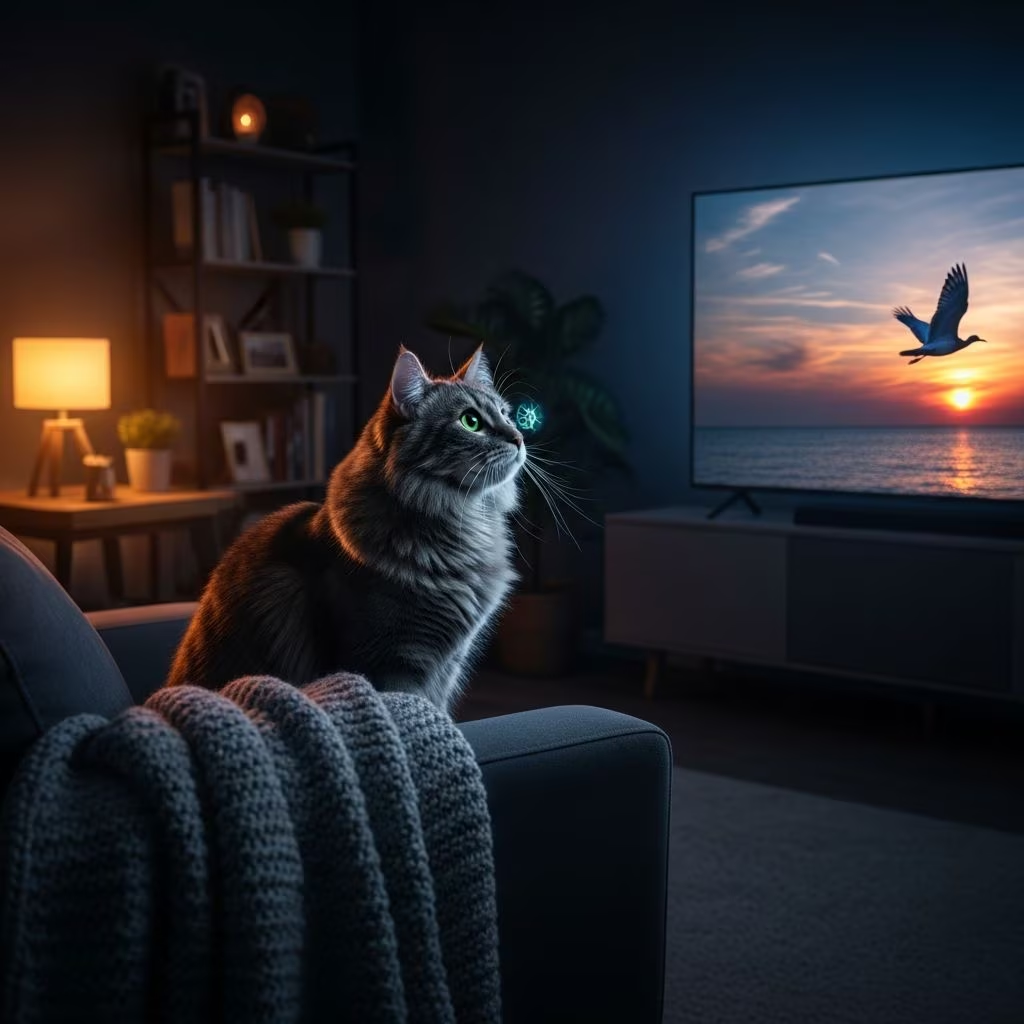
Cats often stare intently at television screens, following movements with their heads and perking up their ears at certain sounds, indicating they can perceive and engage with TV content, though not in the same cognitive way humans do.
This behavior stems from their evolutionary adaptations for hunting, where motion detection and acute hearing play key roles. Modern flat-screen TVs with higher refresh rates make content more visible to cats compared to older CRT screens. While cats do not comprehend narratives or enjoy shows for entertainment like people, screens provide visual and auditory stimulation that mimics prey or environmental cues.
How Do Cats See? Understanding Feline Vision
Cat vision differs significantly from human vision, optimized for low-light hunting rather than color detail or distance acuity. Cats possess a high density of rod cells in their retinas, enabling superior night vision—up to six times better than humans in dim conditions—and exceptional motion detection.
The tapetum lucidum, a reflective layer behind the retina, amplifies light, giving cats their glowing eye effect in the dark and aiding crepuscular (dawn/dusk) hunting. However, fewer cone cells limit their color perception; cats see blues and greens well but perceive reds and oranges as dull grays, missing violet hues entirely.
Cats are also more nearsighted, with clear vision optimized for 6-20 feet, ideal for spotting nearby prey. Binocular vision provides good depth perception for pouncing accuracy. These traits explain why fast-moving, primary-colored objects on TV captivate them more than static or complex scenes.
- Rod cells: Enhance low-light vision and motion sensitivity.
- Cone cells: Allow limited color vision (red, green, blue).
- Tapetum lucidum: Reflects light for better night sight.
- Nearsightedness: Focuses on close-range movement.
Why Do Cats Watch TV?
Cats watch TV primarily due to instinctual responses to motion and sound resembling prey or territory signals, not for leisure. Their wide field of view and rapid head-tracking follow on-screen action, especially birds, mice, fish, or other small animals.
Hearing is crucial: Cats detect frequencies up to 65 kHz (humans max at 20 kHz) and locate sounds precisely within milliseconds from distances four to five times farther than humans. Chirps, rustles, or wing flaps trigger hunting instincts, making nature documentaries or cat-specific videos highly engaging.
Screens act as a “false window,” offering a glimpse of inaccessible stimuli like an aquarium, providing enrichment for indoor cats without full comprehension of the 2D illusion. Studies confirm cats spend more time viewing animate or inanimate motion than static images or humans, though interest wanes after hours due to habituation.
Can Cats Tell the Difference Between Real Life and TV?
Cats distinguish screens from reality through missing sensory cues: no scent from over 200 million olfactory receptors, no texture, and no 3D depth beyond basic motion parallax. They may paw at screens or look behind them, indicating awareness it’s not tangible prey.
Other cats on screen rarely provoke aggression since scent absence signals non-threat; territorial responses require pheromones. Research on shelter cats showed preferences for movement over species recognition, with only 6% of time spent watching overall, dropping further with repetition.
Modern high-frame-rate TVs (cats need ~100 fps for smooth motion vs. humans’ 20 fps) reduce flicker, making content more realistic, yet the flat image and absent smells prevent full deception.
Do All Cats Like Watching TV?
- High-energy hunters: Leap, paw, or vocalize at fast prey simulations.
- Curious observers: Stare calmly, tracking without physical reaction.
- Indifferent types: Ignore screens entirely, preferring real toys or windows.
Temperament, age, and environment influence engagement. Kittens and young cats show most interest; seniors may lose acuity. A 125-cat shelter study found varied preferences, with movement boosting watch time but not universally.
Best Types of TV Shows for Cats
Optimal content features rapid motion in reds/greens/blues, nature sounds, and prey animals. Avoid slow or human-centric programs.
| Content Type | Why Cats Love It | Examples |
|---|---|---|
| Birds/Fish | Fluttering, swimming motion + chirps | Nature docs, aquariums |
| Mice/Rodents | Quick scurrying + rustles | Cat YouTube videos |
| Cat Videos | Fellow felines playing, though less predatory | Dedicated cat channels |
| Kids’ Shows | Bright colors, fast cartoons | Animated programs |
YouTube abounds with cat TV compilations keeping solo pets occupied for 10-30 minutes.
Is Watching TV Good for Cats?
Moderate screen time offers enrichment, reducing boredom and stress for indoor cats, akin to window gazing. However, over-reliance discourages real play, exercise, or social interaction; limit to 1-2 hours daily.
Supervise active reactors to prevent knocks or scratches. No evidence of eye strain from appropriate viewing, but ensure good lighting and distance.
Tips for Setting Up Cat TV
- Position screen at cat-eye level, 3-6 feet away.
- Use high-refresh-rate (120Hz+) TVs for smoother motion.
- Combine with toys or perches for multi-sensory fun.
- Rotate videos to prevent boredom.
- Safety: Secure TV to avoid tipping.
Frequently Asked Questions (FAQs)
Can all cats see TV the same way?
No, vision varies by age, breed, and health; older cats may have reduced acuity.
Why does my cat look behind the TV?
They’re seeking the real source of perceived prey, as screens lack depth and scent.
Is cat TV enriching or just a gimmick?
Studies show it provides temporary stimulation, especially for apartment dwellers, but pair with physical activity.
Do cats recognize themselves on video?
Unclear; they may react to motion but not self-identity without scent cues.
How much TV is too much for cats?
Interest fades after 1-3 hours; excessive use may lead to inactivity—balance with play.
References
- Can Cats Understand TV? — WagWalking. Accessed 2026. https://wagwalking.com/sense/can-cats-understand-tv
- Can Cats See TV? — Hill’s Pet Nutrition. Accessed 2026. https://www.hillspet.com/cat-care/behavior-appearance/can-cats-see-or-watch-tv
- How Cats See TV (The Science Will Shock You) — The Cat and Dog House (YouTube). 2025-10-31. https://www.youtube.com/watch?v=OL1fEuutcZs
- Is Your Pet Actually Watching TV With You? — Northeastern University News. 2025-03-20. https://news.northeastern.edu/2025/03/20/is-your-pet-watching-tv/
- Ask a Vet: Do Pets Watch TV? — Rocklin Ranch Veterinary Hospital. Accessed 2026. https://www.rocklinranchvet.com/blog/ask-a-vet-do-pets-watch-tv/



