

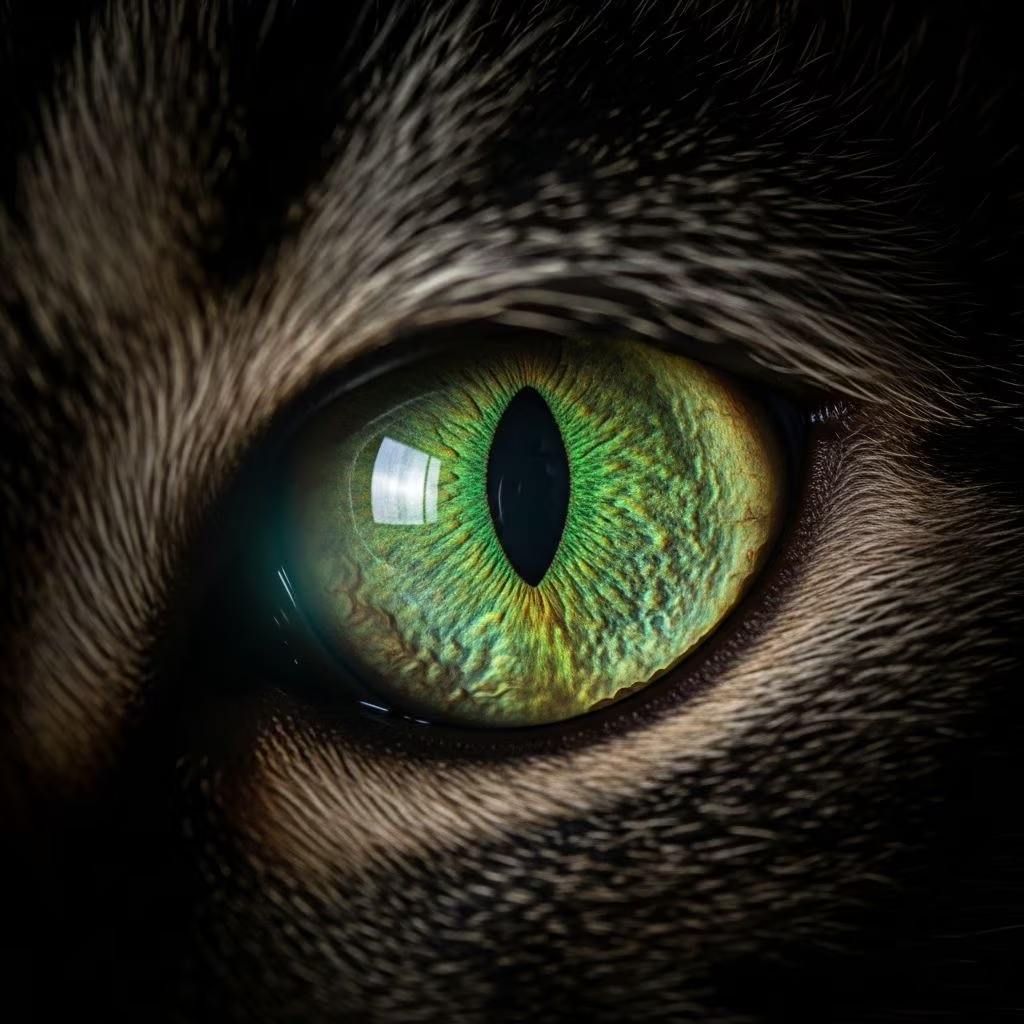
Can Cats See in the Dark?
If you’ve ever wondered why your cat seems to navigate effortlessly through your dark home while you stumble around looking for a light switch, you’re not alone. The truth is, cats possess remarkable night vision capabilities that far exceed human abilities. But can cats actually see in complete darkness? The answer is both yes and no. Cats can’t see in absolute darkness, but they can see exceptionally well in low-light environments—up to six to eight times better than humans. This extraordinary ability is the result of millions of years of evolution as nocturnal hunters and is built into the very structure of their eyes.
The Evolution of Cat Night Vision
To understand why cats have such superior night vision, we need to look back at their evolutionary history. Cats are descended from wild felines like lions, tigers, and other big cats that hunt primarily during dawn, dusk, and nighttime hours. These crepuscular and nocturnal hunters needed to see well in low-light conditions to locate and pursue prey effectively. As obligate carnivores that rely entirely on meat for nutrition, cats evolved specialized visual systems that gave them a competitive hunting advantage in dimly lit environments.
This evolutionary adaptation shaped not just their eyes, but their entire bodies. Cats developed exceptional hearing to detect the slightest movements, flexible spines and cushioning discs that allow them to move silently when stalking prey, and sensitive whiskers that help them judge distance and sense vibrations. All of these traits work together to make cats incredibly effective hunters in low-light conditions.
The Anatomy of a Cat’s Eye: Built for Low-Light Vision
Cats’ remarkable night vision isn’t magic—it’s the result of highly specialized anatomical structures within their eyes. Understanding these components reveals just how perfectly adapted cats are for nocturnal hunting.
Rod and Cone Cells
The retina of a cat’s eye contains a much higher concentration of rod cells compared to cone cells. Rod cells are photoreceptors responsible for detecting light and movement in dim conditions, while cone cells handle color vision and fine detail in bright light. Cats have approximately six to eight times more rod cells than humans, which gives them dramatically superior light sensitivity. In contrast, cats have fewer cone cells than humans, which explains why their color vision is not as refined as ours.
The Tapetum Lucidum: The Reflective Layer
One of the most fascinating features of a cat’s eye is a specialized tissue layer called the tapetum lucidum, located behind the retina. This reflective layer works like a mirror, bouncing light back through the photoreceptor cells a second time. This means that light gets two chances to be detected and absorbed by the rod and cone cells, significantly amplifying visual sensitivity. The tapetum lucidum is also responsible for the characteristic “glow” you see in a cat’s eyes when light reflects off them in the dark—that eerie green or yellow shine that seems almost supernatural.
Pupils and Corneas
Cats have vertical slit pupils that can expand to become nearly perfectly round in darkness, allowing maximum light to enter the eye. Their pupils are also significantly larger than human pupils—approximately 50% larger—which permits even more light to pass through and reach the retina. Additionally, cats have large corneas that function like wide-angle lenses, capturing more light and expanding their peripheral vision to detect the slightest movements in dim lighting.
How Cat Vision Compares to Human Vision
While cats have undeniable advantages in low-light situations, the comparison between cat and human vision is more complex than “cats see better.” Each species has different strengths and weaknesses.
| Visual Aspect | Cats | Humans |
|---|---|---|
| Low-Light Vision | 6-8 times better than humans | Poor in low light |
| Field of Vision | 200 degrees | 180 degrees |
| Daytime Visual Acuity | 20/100 to 20/200 | 20/20 (standard) |
| Color Perception | Limited (blues and grays) | Full spectrum (red, green, blue) |
| Light Sensitivity | Extremely high | Moderate |
| Detail Recognition | Limited in bright light | Excellent detail recognition |
Wider Field of Vision
Cats have a visual field of approximately 200 degrees, compared to humans’ 180-degree field of vision. This extra 20 degrees of peripheral vision functions like built-in motion detectors, allowing cats to spot movement at the edges of their visual field without turning their heads. This adaptation is crucial for hunting, as it helps them detect prey movement from various angles.
Nearsightedness in Cats
Despite their superior night vision, cats are naturally nearsighted. They need to be within about 20 feet to see an object with clarity; anything beyond that distance appears blurry to them. This is actually advantageous for hunting close-range prey but means cats don’t see distant objects as well as humans do.
Daytime Vision Limitations
Interestingly, cats’ daytime visual acuity is only about one-seventh of human acuity. This means that in bright daylight, cats don’t see as clearly or with as much detail as humans. What a human can see clearly at 100 feet, a cat can only see clearly at approximately 20 feet. This trade-off makes sense evolutionarily: cats evolved to be crepuscular hunters active during twilight hours, not daytime foragers.
Ultraviolet Vision: A Secret Weapon
Beyond their exceptional low-light vision, cats possess another visual superpower that humans completely lack: they can see ultraviolet (UV) light. Cats can perceive light wavelengths below 400 nanometers, while human vision only extends to approximately 380-700 nanometers. This ultraviolet vision gives cats a significant hunting advantage because many prey animals leave urine trails and other markers that reflect UV light. Additionally, some rodent fur reflects UV light, making prey animals appear like neon signs to hunting cats. This hidden visual dimension is completely invisible to human eyes.
Color Vision in Cats
Contrary to popular belief, cats are not completely colorblind. However, their color perception is significantly more limited than human color vision. Humans have three types of cone cells that allow us to perceive the full spectrum of colors—red, green, and blue. Cats, however, have only two types of cone cells, meaning they perceive the world in shades of blue and gray. What appears as green or red to humans looks gray or desaturated to cats. Think of cat color vision as similar to red-green colorblindness in humans; cats can still see colors, just not the full range that humans experience.
Do Cats Need Artificial Light at Night?
Given cats’ superior night vision, many pet owners wonder if they need to provide lighting for their cats at night. The answer is straightforward: no, cats do not need artificial light on at night. Their exceptional low-light vision allows them to navigate and see clearly in conditions that would leave humans completely disoriented.
In fact, providing bright artificial light to cats at night can be counterproductive. Bright lights can disrupt a cat’s natural sleep-wake cycle because harsh lighting suppresses melatonin production, the hormone that regulates sleep. This disruption can cause cats to become more active at night, leading to behavioral problems and sleep disturbances.
If your cat experiences anxiety in complete darkness, a dim nightlight is a better alternative than bright overhead lighting. This provides just enough illumination to comfort your cat without interfering with their circadian rhythm or sleep quality.
Why Do Cats Stare at You in the Dark?
Many cat owners have experienced the slightly unnerving sensation of waking up in the middle of the night to find their cat staring at them with glowing eyes. While this can feel eerie, the explanation is quite mundane. The glow in your cat’s eyes is simply the result of light reflecting off the tapetum lucidum, the reflective tissue layer behind the retina that enhances night vision. The tapetum lucidum acts like a mirror, bouncing light back out of the eye in the same direction it came from, which is why you see that characteristic glow.
As for why your cat is staring at you, there are several innocent explanations. Cats may stare due to natural curiosity, to monitor their environment for any changes or potential threats, or simply because they’re awake and observing their surroundings. Some cats may also stare at their owners as a form of affection or to see if you’re awake. Rather than something to fear, your cat’s nighttime staring is usually just feline behavior and attention-seeking.
Key Takeaways About Cat Night Vision
Understanding your cat’s extraordinary night vision reveals just how specialized and sophisticated their sensory systems are. Here are the essential facts:
- Cats can see six to eight times better than humans in low-light conditions
- Cats cannot see in complete darkness but see exceptionally well in dim light
- The tapetum lucidum reflective layer doubles the light detection capability
- Cats have a 200-degree field of vision compared to humans’ 180 degrees
- Cats are naturally nearsighted with visual acuity of 20/100 to 20/200
- Cats have superior night vision but poor daytime visual acuity
- Cats can see ultraviolet light invisible to humans
- Cats don’t need artificial light at night and may be disturbed by bright lighting
Frequently Asked Questions
Q: Can cats see in complete darkness?
A: No, cats cannot see in absolute darkness. However, they can see in very low-light conditions that would appear completely dark to humans. They need at least some ambient light to see, as the tapetum lucidum requires light to reflect.
Q: Why do cats’ eyes glow in the dark?
A: Cats’ eyes glow due to the tapetum lucidum, a reflective tissue layer behind the retina that bounces light back through the eye. This reflection is what creates the characteristic green or yellow glow you see in photographs or when light hits your cat’s eyes at night.
Q: How much better can cats see in the dark compared to humans?
A: Cats can see six to eight times better than humans in low-light conditions. While a cat can spot a mouse moving across a dimly lit room from a distance, a human in the same situation would see only shadows.
Q: Are cats colorblind?
A: Cats are not completely colorblind, but they have limited color vision. They see primarily in shades of blue and gray, similar to red-green colorblindness in humans. They cannot perceive red and green the way humans do.
Q: Can cats see ultraviolet light?
A: Yes, cats can see ultraviolet light that is completely invisible to humans. This gives them an advantage when hunting, as they can see UV markings and trails that prey animals leave behind.
Q: Should I leave a light on for my cat at night?
A: No, you should not leave bright lights on for your cat at night. Cats don’t need artificial light, and bright lights can disrupt their sleep cycle and melatonin production. If your cat is anxious in darkness, use a dim nightlight instead.
References
- Can Cats Really See in the Dark? — Pumpkin Pet Insurance. 2024. https://www.pumpkin.care/post/can-cats-see-in-the-dark
- Can cats really see in the dark? — Live Science. 2024. https://www.livescience.com/can-cats-see-in-dark
- Can Cats See in the Dark? Exploring Cat Vision — Noble Vet Clinic. 2024. https://noblevetclinic.com/blog/can-cats-see-in-the-dark-exploring-cat-vision
- How Well Can Cats See in Low Light Compared to Humans? — PetsCare.com. 2024. https://www.petscare.com/news/faq/can-cats-see-in-total-darkness
- Can Cats See in the Dark? Feline Night Vision Facts — Hill’s Pet Nutrition. 2024. https://www.hillspet.com/cat-care/behavior-appearance/can-cats-see-in-the-dark



