

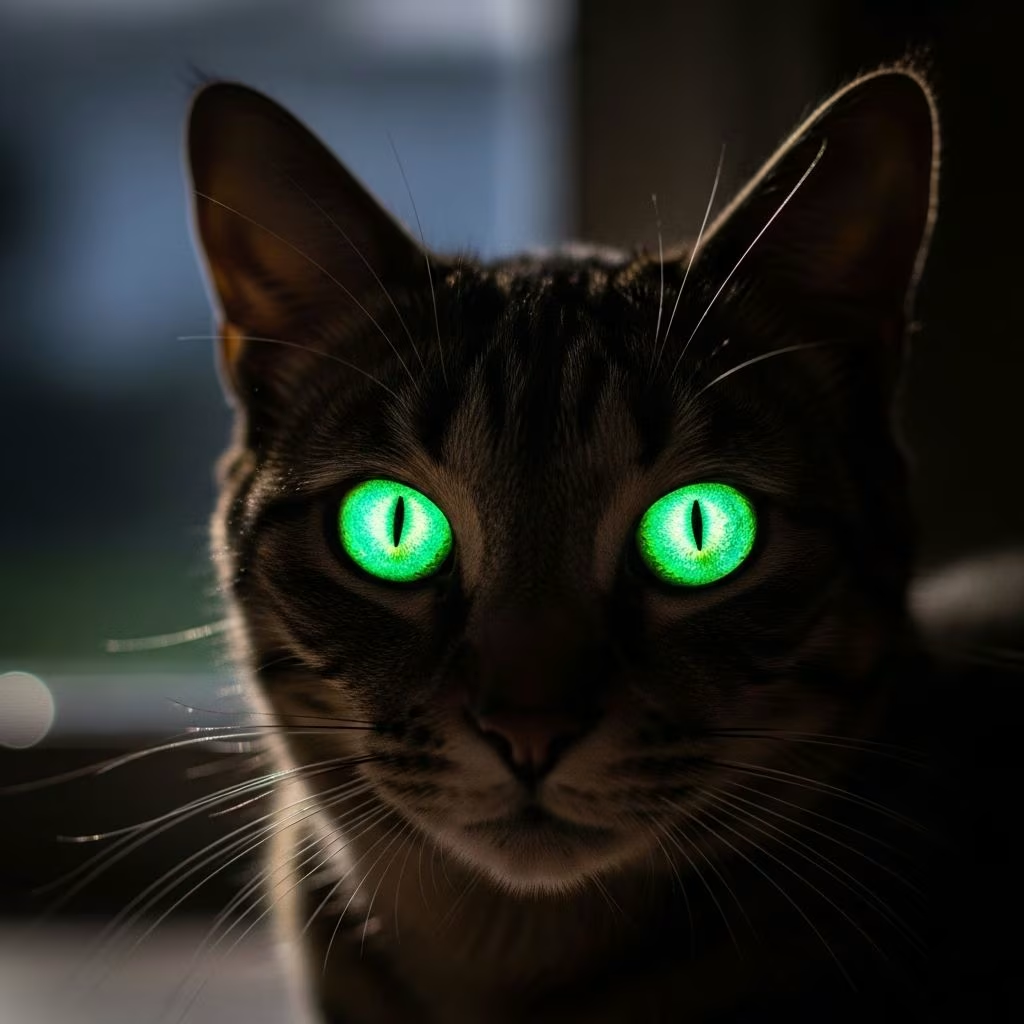
Cats possess remarkable **night vision** capabilities that allow them to navigate and hunt effectively in low-light conditions, far surpassing human abilities, though they cannot see in complete darkness.
This adaptation stems from their evolutionary role as crepuscular hunters, active primarily at dawn and dusk when light is dim. Their eyes are equipped with specialized structures that amplify available light, making them appear to “see in the dark.” Understanding these features reveals why your cat effortlessly prowls at night while you fumble for the light switch.
How Cats See in the Dark
Cats excel in low light due to several unique anatomical features in their eyes. Unlike humans, who rely more on cone cells for color and detail in bright light, cats prioritize rod cells for sensitivity in dim conditions.
- High Concentration of Rod Cells: Rods detect light and motion in low illumination. Cats have six to eight times more rods than humans, enabling them to see in light levels as low as 1/6th of what humans require.
- Tapetum Lucidum: This reflective layer behind the retina acts like a mirror, bouncing light back through the photoreceptors for a second chance at detection. It’s responsible for the glowing eye effect in cats at night.
- Large Pupils and Corneas: Feline pupils dilate to nearly circular shapes, and their corneas are larger, capturing more light. This design enhances peripheral vision and motion detection.
These adaptations mean cats can spot subtle movements—like a twitching toy or scurrying prey—from afar in near-darkness, though their vision remains somewhat blurry compared to daylight.
The Science Behind Cat Night Vision
The retina in a cat’s eye contains a higher density of rod photoreceptors, which are hypersensitive to low light. According to veterinary experts, this structure permits cats “better” vision than humans in dim environments.
The **tapetum lucidum** is particularly crucial: it reflects wavelengths back through the retina, increasing light absorption efficiency. Studies confirm cats need only minimal ambient light—about 1/6th of human requirements—to perceive shapes and motion.
Additionally, cats’ vertical slit pupils expand dramatically in darkness, admitting up to 50% more light than human round pupils. This combination evolved for nocturnal hunting, giving cats an edge over prey in twilight hours.
Cat Eye Anatomy Explained
A cat’s eye is a marvel of evolutionary engineering, optimized for survival as ambush predators. Key components include:
- Cornea and Lens: Larger than in humans, these focus more light onto the retina, improving low-light acuity.
- Retina: Dominated by rods (over cones), with the tapetum lucidum enhancing photon capture.
- Pupils: Vertical slits allow precise control, dilating widely for night and contracting to slits in bright light to prevent overload.
- Whiskers and Other Senses: While not part of the eye, these complement vision by sensing air currents and distances in total dark.
Humans, conversely, have more cones for color and detail but fewer rods, making our night vision inferior.
Daytime vs. Nighttime Vision: Cats vs. Humans
Cats’ night prowess comes at a cost during the day. Their visual acuity is roughly 1/7th of humans’, appearing “fuzzy” in bright light due to fewer cones and the tapetum’s interference.
| Feature | Cats | Humans |
|---|---|---|
| **Low-Light Sensitivity** | 6–8x better | Poor |
| **Color Perception** | Limited (blues, grays, yellows) | Full spectrum (trichromatic) |
| **Daytime Acuity** | Moderate (1/7th human) | High |
| **Motion Detection** | Superior, even in dim light | Moderate |
| **UV Vision** | Yes, for tracking scents | No |
This table highlights how cats dominate in low light but lag in colorful, detailed daytime vision.
What Colors Can Cats See?
Cats are dichromats with two cone types, perceiving blues, grays, and possibly yellow-greens, but reds and greens appear as shades of gray. They lack the third cone for full color like humans.
Research indicates cats see a muted world: vibrant greens look washed out, aiding focus on motion over hue during hunts. Recent studies also reveal cats detect ultraviolet light, invisible to us, helping track urine-marked trails or UV-reflective fur.
Can Cats See in Total Darkness?
No, cats cannot see in pitch blackness—neither can humans. They require some light, but thrive in levels too dim for us.
In complete dark, cats rely on acute hearing, whiskers, and memory. Their eyes glow from the tapetum only when light is present, confirming light dependency.
Why Do Cats’ Eyes Glow in the Dark?
The eerie glow is the **tapetum lucidum** reflecting flashlight or moonlight back out, like a retroreflector. This amplifies internal light for better vision and startles prey.
Not all cats glow equally; coat color and tapetum pigmentation influence the effect’s intensity.
How Well Can Cats See Compared to Humans?
In low light, cats see 6–8 times better, detecting objects at distances humans can’t. Daytime, humans lead in sharpness and color.
Cats’ field of view is wider (200° vs. 180°), with superior near-focus for pouncing. Overall, feline vision suits twilight predation perfectly.
Frequently Asked Questions (FAQs)
Can cats see in complete darkness?
No, cats need minimal light but perform exceptionally in low-light conditions, about 6 times better than humans.
Why do cats’ eyes glow at night?
The tapetum lucidum reflects light back through the retina and outward, causing the glow and enhancing vision.
What colors do cats see?
Cats see blues, grays, and some yellows/greens but not reds; they are dichromats.
Do cats have better vision than humans overall?
No, cats excel at night and motion; humans have superior daytime color and detail vision.
Can cats see ultraviolet light?
Yes, allowing them to detect UV-reflective patterns invisible to humans.
Enhancing Your Cat’s Nighttime Environment
To support your cat’s vision, provide night lights, avoid total darkness, and enrich with toys that mimic movement. Regular vet check-ups ensure eye health.
Understanding these traits deepens the bond with your feline friend, appreciating their superpower in the shadows.
References
- Can cats really see in the dark? — Live Science. 2023-10-12. https://www.livescience.com/can-cats-see-in-dark
- How Do Cats See In The Dark? The Science Behind Your Cat’s Night Vision — Sam’s Cats and Dogs. 2024-05-15. https://samscatsanddogs.com/everett/blog/how-do-cats-see-in-the-dark-the-science-behind-your-cats-night-vision
- Can Cats See in the Dark in Cincinnati, OH? — Carey Animal Hospital. 2024-08-20. https://careyanimalhospital.com/blog/can-cats-see-in-the-dark-cincinnati-oh/
- Can Cats Really See in the Dark? — Pumpkin Pet Insurance. 2023-11-05. https://www.pumpkin.care/post/can-cats-see-in-the-dark
- What Colors Can Cats See? See The World Through A Cats Eyes — Litter-Robot. 2024-02-28. https://www.litter-robot.com/blog/what-colors-can-cats-see/
- Can Cats See in the Dark? Feline Night Vision Facts — Hill’s Pet. 2024-07-10. https://www.hillspet.com/cat-care/behavior-appearance/can-cats-see-in-the-dark



