

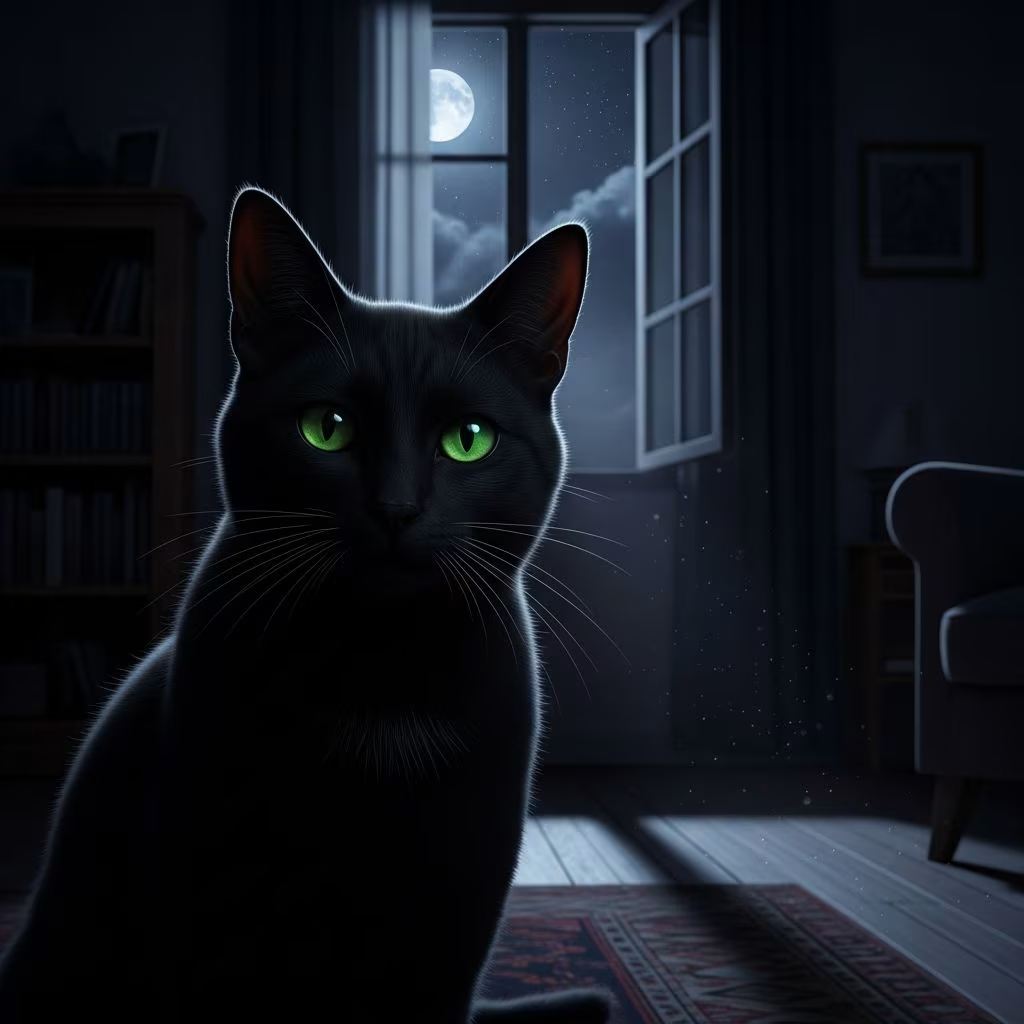
Cats possess remarkable low-light vision due to specialized eye structures like a high concentration of rod cells and the tapetum lucidum, allowing them to see 6-8 times better than humans in dim conditions, though not in complete darkness.
How Cats’ Eyes Work
The feline eye is engineered for twilight hunting, with key adaptations that amplify available light. Cats’ retinas contain a higher density of rod photoreceptors, which detect low light levels, compared to human eyes. Rods enable superior sensitivity, letting cats function effectively during dawn and dusk—their crepuscular active periods.
Cats’ pupils dilate into near-perfect circles in darkness, maximizing light intake. Their large corneas and lenses further enhance this by capturing more photons. Unlike humans, cats prioritize motion detection and peripheral vision over fine detail or color in low light.
The Tapetum Lucidum: Cats’ Glow-in-the-Dark Secret
Behind the retina lies the tapetum lucidum, a reflective layer unique to many nocturnal animals. This membrane bounces unabsorbed light back through the photoreceptors, giving rods and cones a second chance to process it. This boosts light sensitivity by over 50%, explaining why cats’ eyes glow green or gold in dim light—light reflecting off the tapetum.
Without the tapetum, cats’ night vision would be far less impressive. This adaptation, combined with rods, makes them excel in semi-darkness but renders their daytime acuity only about 1/6th of humans’.
Rod Cells vs. Cone Cells: Why Cats Trade Color for Night Vision
Rod cells thrive in dim light for detecting shapes and movement, while cone cells handle color and detail in bright conditions. Cats have 6-8 times more rods relative to cones than humans, prioritizing night vision over vibrant daytime sight.
Humans boast three cone types for full color (red, green, blue), but cats have two, perceiving blues and yellows while seeing reds/greens as shades of gray. This dichromatic vision suits their prey-focused lifestyle, where motion trumps hue.
| Feature | Cats | Humans |
|---|---|---|
| Low-Light Sensitivity | 6–8x better | Poor |
| Color Perception | Limited (blue/gray tones) | Full spectrum |
| Daytime Acuity | 1/6th of humans | High detail |
| Motion Detection | Superior | Moderate |
| Pupil Dilation | Near-circular | Round |
Can Cats See in Complete Darkness?
No—cats require some light, like moonlight or streetlamps, to utilize their adaptations. In pitch black, they rely on whiskers, hearing, and smell. Myths of total night vision stem from their prowess in very low light, needing just 1/6th the illumination humans do.
Optimal cat vision range is 6-20 feet, with blurred edges and nearsightedness beyond. They detect brightness differences 7 times better than us, spotting tiny movements.
Cats’ Color Vision and UV Sight
Cats aren’t fully colorblind; they see blues and yellows but confuse reds/greens. Their world appears in muted tones, aiding camouflage detection over aesthetics.
Additionally, cats perceive ultraviolet (UV) light below 400 nm—invisible to humans (380-700 nm). UV reveals urine trails, fur patterns, and markings, enhancing hunting. This ‘secret weapon’ highlights contrasts rodents can’t hide.
Daytime vs. Nighttime: Cats vs. Humans
While cats rule the night, humans lead in daylight. Cats’ vision is blurrier in bright light due to fewer cones and no fovea centralis (sharp central focus spot). Their 200-degree field of view (vs. humans’ 180) excels peripherally but sacrifices distance clarity—cats are nearsighted.
- Night: Cats see clear shapes, motion; humans struggle.
- Day: Humans get sharp, colorful detail; cats see moderately.
Evolution of Cat Night Vision
Cats evolved as crepuscular hunters, targeting rodents active at twilight. High rods, tapetum, and dilating pupils gave predatory edges. Domestic cats retain these traits, thriving indoors at night despite artificial lights.
This trade-off—stellar night sight for average day vision—mirrors wild felines. Ancestral survival favored low-light prowess over human-like daytime sharpness.
Common Myths About Cat Vision
- Myth: Cats see perfectly in total dark. Reality: Need minimal light.
- Myth: Cats are fully colorblind. Reality: See limited colors.
- Myth: Glowing eyes produce light. Reality: Reflect ambient light.
- Myth: Cats have better vision always. Reality: Only in low light.
How to Support Your Cat’s Vision
Provide dim night lights for navigation. Offer UV-reflective toys mimicking prey. Regular vet checks detect issues like cataracts. Antioxidant-rich foods (e.g., blueberries) support eye health. Avoid bright flashes harming sensitive retinas.
- Feed taurine-rich diets for retinal health.
- Enrich environment with motion toys for natural instincts.
- Monitor for clouding eyes or bumping objects—signs of vision loss.
Frequently Asked Questions (FAQs)
Can cats really see in the dark?
Cats see exceptionally well in low light (6-8x better than humans) but not complete darkness, thanks to rods and tapetum lucidum.
Why do cats’ eyes glow at night?
The tapetum lucidum reflects light, amplifying vision and causing the glow.
What colors can cats see?
Blues, yellows, and grays; reds/greens appear similar.
Do cats have better vision than humans overall?
No—superior at night, inferior in daylight detail and color.
Can cats see ultraviolet light?
Yes, aiding hunting by revealing hidden patterns.
How far can cats see clearly?
Best at 6-20 feet; nearsighted beyond.
References
- Can cats really see in the dark? — Live Science. 2023-10-12. https://www.livescience.com/can-cats-see-in-dark
- How Do Cats See In The Dark? Understanding Feline Night Vision — Sam’s Cats and Dogs. 2024-05-15. https://samscatsanddogs.com/everett/blog/how-do-cats-see-in-the-dark-the-science-behind-your-cats-night-vision
- Ever Wondered Why? Curious Facts About Cats – Conclusion — PetAssure. 2022-11-01. https://www.petassure.com/new-newsletters/ever-wondered-why-curious-facts-about-cats-conclusion/
- Can Cats See in the Dark? — Purina Canada. 2024-08-20. https://www.purina.ca/articles/cat/behaviour/can-cats-see-in-the-dark
- Can Cats Really See in the Dark? — Pumpkin Pet Insurance. 2023-09-10. https://www.pumpkin.care/post/can-cats-see-in-the-dark
- Can Cats See in the Dark? Feline Night Vision Facts — Hill’s Pet. 2024-02-28. https://www.hillspet.com/cat-care/behavior-appearance/can-cats-see-in-the-dark



