

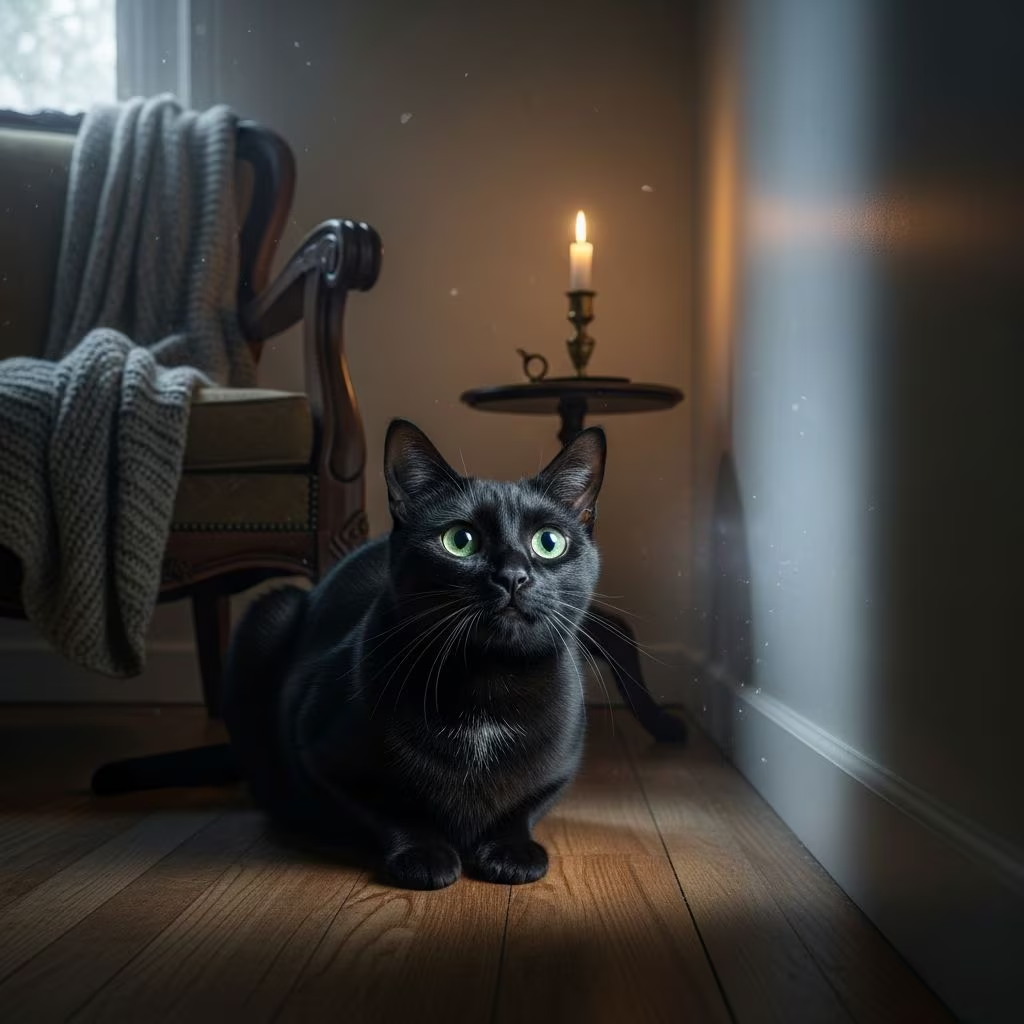
Cats have long been shrouded in mystery, their piercing gazes and sudden reactions to seemingly empty spaces sparking age-old questions: can cats see ghosts? From ancient Egyptian reverence to modern Halloween tales, felines are often portrayed as supernatural sentinels. But science offers compelling explanations rooted in their extraordinary sensory abilities, not otherworldly visions.
This comprehensive guide explores the behaviours that fuel ghost-seeing myths, the biology behind cats’ heightened perceptions, historical folklore, and practical advice for cat owners. By the end, you’ll understand why your cat’s ‘ghostly’ stares are a testament to evolutionary brilliance rather than spectral encounters.
Why Do Cats Seem to See Ghosts?
Cat owners frequently report their pets fixating on blank walls, chasing invisible prey, or arching their backs at ‘nothing.’ These eerie behaviours create the illusion of paranormal perception. However, studies in Applied Animal Behaviour Science reveal that cats detect subtle environmental stimuli imperceptible to humans, such as micro-movements, sounds, and vibrations.
Common scenarios include:
- Staring at empty corners: Cats track dust motes, shadows, or insects too tiny for human eyes.
- Sudden pouncing: Reflections from sunlight or faint air currents trigger hunting instincts.
- Nighttime alertness: Low-light movements like a spider or distant rodent become visible spectacles.
- Hissing or freezing: High-frequency sounds from electronics, pipes, or wildlife outside human hearing range.
These reactions stem from cats’ survival adaptations as nocturnal hunters, not ghosts. A 2014 study in Proceedings of the Royal Society B confirms many mammals, including cats, perceive ultraviolet patterns invisible to us, adding another layer to their ‘hidden world’ view.
The Science of Feline Senses: What Cats Really ‘See’
Cats’ sensory toolkit far surpasses humans’, explaining why they react to ‘ghosts.’ Here’s a breakdown:
| Sense | Cat Ability | Human Comparison | Impact on ‘Ghost’ Behaviours |
|---|---|---|---|
| Vision | 200° field of view; sees in 1/6th the light; possible UV detection | 180° view; needs 6x more light | Detects subtle shadows, insects, particles in dark |
| Hearing | 48 Hz–85 kHz (up to 64 kHz per Cornell); ultrasonic sensitivity | 20 Hz–20 kHz | Hears rodents, electronics hum, wall scratches |
| Whiskers | Detect air currents, vibrations, spatial changes | Limited touch sensitivity | Senses drafts, approaching objects, tiny shifts |
| Smell | 14x more scent receptors; detects pheromones, chemicals | Basic odour detection | Picks up lingering scents, emotional cues |
| Vibration Sense | Paw pads sense floor tremors, electromagnetic fields (research suggests) | Minimal | Feels distant footsteps, subtle quakes |
Night vision dominates: a reflective tapetum lucidum layer behind the retina amplifies low light, making eyes glow and revealing movements in near-darkness. Hearing spans ultrasonic frequencies, ideal for hunting rodents that chirp beyond our range—perfect for detecting household ‘hauntings’ like HVAC whirs. Whiskers act as radar, twitching at air displacements from opening doors or passing pets.
Research from the Cornell Feline Health Center underscores cats hear up to 64,000 Hz, over three times human limits, capturing faint home noises. Combined, these senses create a richer environmental map, turning mundane stimuli into vivid alerts.
Debunking the Myth: No Evidence for Supernatural Sight
Despite captivating anecdotes, no scientific evidence supports cats seeing ghosts. Purina UK’s analysis states plainly: there’s no data showing cats perceive spirits. Behavioural experts attribute ‘spooky’ actions to natural instincts:
- Tiny insects, reflections, or dust particles.
- Drafts, temperature shifts, or vibrations.
- Playful curiosity or stress responses.
- Nocturnal rhythms amplifying alertness at night.
Times of India echoes this: behaviours like staring arise from advanced senses, not the supernatural. What owners interpret as ghosts is cats ‘seeing ghosts’ literally—fleeting, invisible-to-us phenomena. Myths persist due to confirmation bias: we notice eerie stares but ignore normal ones.
Cultural and Historical Beliefs in Cats as Ghost Guardians
Folklore amplifies the mystery. Ancient Egyptians worshipped cats as protectors against evil spirits, mummifying them as divine intermediaries. Medieval Europe viewed them as witches’ familiars, both revered and feared for sensing the unseen.
In Japanese Maneki-neko tales, cats beckon good fortune while warding off malevolent ghosts. Islamic tradition credits Prophet Muhammad with loving cats, believing they purify spaces from jinn (spirits). These stories portray cats as liminal beings bridging worlds, their glowing eyes and silent stalks fuelling supernatural lore.
Modern pop culture—from movies like The Conjuring to viral TikToks—reinforces this. Yet, as one YouTube analysis notes, science and faith coexist: believers see spiritual sensitivity, skeptics sensory prowess.
Understanding Cat Behaviour: When to Worry
Not all ‘ghost-seeing’ is benign. Persistent unusual behaviours may signal health issues:
- Hyperthyroidism: Causes restlessness, staring.
- Vision loss: Dilated pupils, misjudged pounces.
- Neurological problems: Twitching, disorientation.
- Stress/Anxiety: Hissing at shadows from new environments.
Monitor for changes: sudden aggression, appetite loss, or lethargy warrant vet visits. Enrich environments with toys, perches, and routines to channel instincts, reducing ‘haunted’ reactions.
How to Test If Your Cat Sees Ghosts (Safely)
Curious? Experiment scientifically:
- Record videos of ‘ghost stares’ in slow-motion to spot insects/shadows.
- Use a high-frequency sound app (above 20 kHz) and observe reactions.
- Dim lights and introduce subtle stimuli like feather tickles.
- Track patterns: time of day, locations match sensory hotspots?
These reveal natural causes 99% of the time.
Frequently Asked Questions (FAQs)
Can cats see ghosts scientifically?
No. Science attributes behaviours to superior vision (6x better low-light), hearing (48-85 kHz), and whiskers detecting air currents.
Why does my cat stare at nothing?
It’s tracking imperceptible stimuli: dust, sounds, shadows, or UV patterns.
Do all cats ‘see ghosts’?
Most exhibit these behaviours due to shared biology, but individuals vary by breed, age, health.
Are cats sensitive to spirits in folklore?
Yes, from Egyptian protectors to witch familiars, but unsupported by evidence.
Should I worry if my cat acts scared?
Usually not, but rule out medical issues like hypertension or anxiety with a vet.
Conclusion: Admire the Natural Wonder
Your cat isn’t chasing phantoms—it’s showcasing evolutionary genius. Next time it fixates on ‘nothing,’ celebrate its super-senses illuminating a hidden world. This understanding deepens bonds, turning mystery into marvel.
References
- Can your cat see ghosts? Here’s what science says — Times of India. 2025-05-18. https://timesofindia.indiatimes.com/life-style/relationships/pets/can-your-cat-see-ghosts-heres-what-science-says/articleshow/123678180.cms
- Can Cats See Ghosts? What Science, Faith, and Folklore Say — YouTube (Transcript). 2023-10-31. https://www.youtube.com/watch?v=zK1kcF4i3OM
- Can Cats See Ghosts? The Spooky Myth Busted! — Purina UK. 2022-09-27. https://www.purina.co.uk/articles/cats/behaviour/common-questions/can-cats-see-ghosts
- Do Cats See Ghosts? The Highly Sensitive Person & Their Cat — Love and Above Cat Club. 2024-01-15. https://loveandabovecatclub.com/blogs/post/do-cats-see-ghosts-the-highly-sensitive-person-their-cat



